
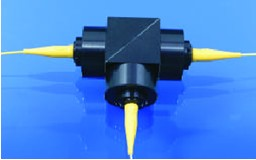
PM Optical WDM - Micro-Optics Type PM-WDM
Wavelength division multiplexers (WDM) are used to couple light operating at two different wavelengths into a single fiber for transmission, and can also be used in reverse as demultiplexers. Polarization-maintaining WDMs (PM-WDM) use PM fiber for input and output and are suitable for different applications. PM-WDMs are usually made by two technologies: fused biconical taper (FBT) and micro-optics. The two technologies have their own advantages and disadvantages: FBT products have lower loss, but because they are limited by the PM fiber, they cannot offer more wavelength choices; in addition, because the coupling region produced by FBT is wavelength-sensitive, they are subject to more constraints. Currently, the company can provide 1310/1550 nm fused-taper PM-WDMs. Micro-optic PM-WDMs use collimating lenses to couple light of different wavelengths into a dichroic mirror and then refocus it into a single output fiber. This technology places no additional requirements on the input and output PM fibers, so users have more wavelength choices. The operating wavelength of the micro-optic PM-WDMs provided by our company can be selected within the range of 400 nm~1625 nm.
 Save to Favorites
Overview
Specifications
| Parameter | Value |
|---|---|
| Operating Wavelength Range (Optional Range) | 400~1625 |
| Extinction Ratio | 20dB or higher |
| Wavelength Spacing | 40nm |
Applications
Datasheet
Supplier Information
Related Products
-
 Nufern with optics
Wavelength-Division Multiplexing (WDM)
Ovlink
Nufern with optics
Wavelength-Division Multiplexing (WDM)
Ovlink
Provides a full range of platinum fibre-optic products; meets the most demanding optical amplifier design requirements; magnification covers the C and L bands. Applying 1480 nm or 980 nm pump technology; mixing fibers to achieve 35 nm magnification bandwidth; and remaining flat within bandwidth; ideal power conversion is available. Combination fibres are specially designed for fibre-optic amplifiers required by high performance, low noise indicators; e.g., light front amplifiers, light circuit amplifiers and photopower amplifiers in WDM communication systems. Good fibre-optic homogeneity, good hydrogen resistance, high power conversion efficiency, low noise design, low melting loss, industry-led fibre-optic geometry, other wavelength absorption peaks, as required, up to a wavelength of less than 980 nm fibre-optics, DLPC 9 double layer to ensure intentional fibre-optic mechanical performance, EDF 10007 large field fibres are available
-
 1um-ray device
Wavelength-Division Multiplexing (WDM)
Ovlink
1um-ray device
Wavelength-Division Multiplexing (WDM)
Ovlink
Product description; the following is a list of 1um passive devices; high power oscillator; high power oscillator; high power oscillator; escillator; escillator; oscillator; oscillator; oscillator; oscillator; oscillator; oscillator; oscillator; oscillator; oscillator; oscillator; oscillator; oscillator; oscillator; oscillator; oscillator; oscillator; oscillator; oscillator; oscillator; oscisclerator; oscillator; oscillator; oscillator; WDM; WDM coscillator 1 x 2 x 2 lumes; WDM; WDM online fixed reduction (FOA)
-
 2um-ray device
Wavelength-Division Multiplexing (WDM)
Ovlink
2um-ray device
Wavelength-Division Multiplexing (WDM)
Ovlink
Product description; the following is a list of 2um passive separators; 1 x 2 x 2 x 2 x 2 x 2 x 2 x 2 n m) 2000 nm 1 x 2 x 2 x 2 nm 2 x 1 x 2 x 1 x 1 x 1 n 2 x 1 n 2 x 1 x 1 n 9 x 1 x 1 x 1 x 1 x 9 x 1 x 9 x 1 x 1 x 1 x 1 x 1 x 1 x 1 x 1 x 1 x 1 x 1 x 1 x 1 x 1 x 1 x 1 x 1 x 1 x 1 x 1 x 1 x 9 x 1 x 1 x 1 x 1 x 1 x 1 x 1 x 1 x 1 x 1 x 1 x 1 x 1 x 1 x 1 x 1 x 1 x 1 x 2 x 1 x 1 x 1 x 1 x 1 x 2 x 1 x 1 x 1 x 1 x 1 x 1 x 1 x 1 x 1 x 1 x 9 x 1 x 1 x M x 1 x 9 x 1 x 1 x 1 x 1 x 1 x M x 1 x 1 x 1 x 1 x 1 x M x 1 x 1 x 1 x 1 x 1 x 9 x M x 1 x 1 x 1 x 1 x
-
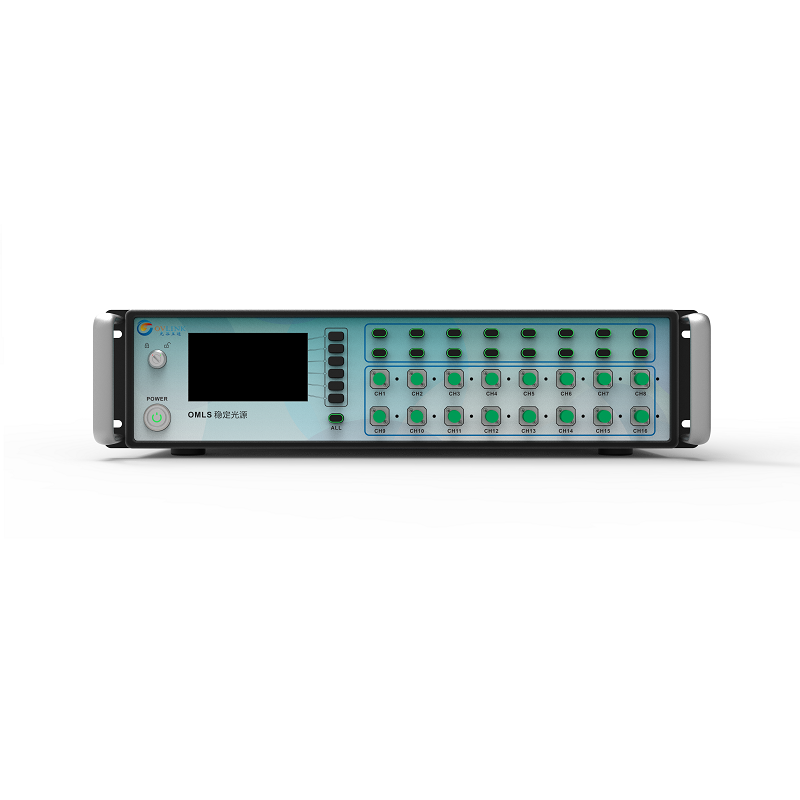 Multichannel stabilization light source OMLS
Wavelength-Division Multiplexing (WDM)
Ovlink
Multichannel stabilization light source OMLS
Wavelength-Division Multiplexing (WDM)
Ovlink
Wavelength range@CWDM: ‡2(CWDM)nm Wavelength accuracy: ‡0.05(DWDM)nm Wavelength accuracy@LAN-WDM: ‡0.3(LAN-WDM)nm
A multi-channel light source that functions highly integrated; an option for each channel wavelength bearing within 650~2000nm; 18-wave CWDM wavepole that supports wavering, including light communication; 144-wave DWDM wavepole; 12-wave LANWDM wavepole and other types of regular radium; light source devices employing an ITU-T-marked butterfly semiconductor laser; high precision ATC and ACC (APC) control circuits; very high wavepole stability and power stability; with high-resolution touch screens and remote control software; while ensuring that light sources are fast and intuitive in the conduct of manoeuvres; very suitable for experimental scientific research and production testing. Multi-channel combination output, bodega precision, high power stability
-
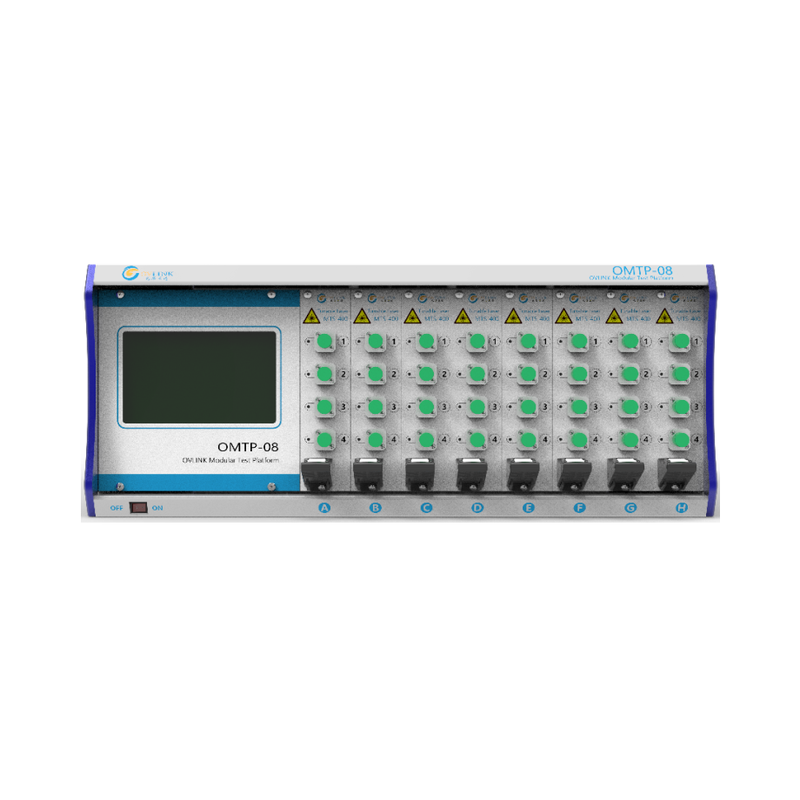 Modularized Test Platform OMTP Series
Wavelength-Division Multiplexing (WDM)
Ovlink
Modularized Test Platform OMTP Series
Wavelength-Division Multiplexing (WDM)
Ovlink
Maximum number of modules: 8; 12 Control Mode: Touch screen/top machine;top machine Communications interface: RJ45/USB2.0/RS232
The Modularized Test Platform OMTP series is an extended programmable multi-sole generic optical test platform; it is an ideal solution for building an automated optical manufacturing test system. This series of products is divided into OMTP-08 and OMTP-12 models; of which OMTP-08 can be controlled by a 5-inch high-altitude touch screen or an upper machine; up to 8 slots can be provided to access submodules; OMTP-12 without a screen; up to 12 slots can be controlled by an upper machine; and up to 12 slots can be provided to access submodules. Supported submodules are the truncable light source module, the stable light source module, the broadband light source module, the modifiable light decayer module, the light switch module, the power meter module, the spectrometer module, etc. Platform + Modularized Design; Compatible with various optical performance test modules; Flexible configuration; Resilient cell slot recognition, up-to-power control, etc.; Support for heat-plugging, compact test platform; Up to 12 slots to support touch screen or up-to-spot control; Provision of multiple communication control interfaces such as USB/RS232/net; Designed with standard aircraft; Fit-to-place installation or desktop testing to support the selection range of channels 1 - 4; C/C++ and L band full bands to adjust side-band suppression to high output power and stability; Supported 1 - 4 channels with good wavelength stability and light stability; Output power to stand alone high fine ATC and AWCC (APC) circuit CWDM
Related Articles
Precise spectral screening is essential for high-precision medical detection, spectroscopic analysis and intelligent imaging systems. Tailored for visible and near-infrared spectral separation, the SP900 shortpass optical filter delivers high-efficiency light transmission and deep infrared blocking performance. It effectively eliminates stray light interference, improves signal-to-noise ratio (SNR), and serves as a core optical component for biomedical instruments, scientific analysis equipment and machine vision systems.
Driven by the rapid upgrading of intelligent vehicles, optoelectronic sensing technologies represented by laser sensing and infrared thermal imaging have become core pillars for high-level autonomous driving and smart cockpit iteration. Leveraging automotive-grade optoelectronic R&D advantages, Pilot Technology Group launches the VITAL intelligent vehicle solution. By integrating high-power VCSEL laser chips and vehicle infrared night-vision thermal imagers, the system comprehensively enhances vehicle environmental perception and realizes safer, smarter and more comfortable driving experiences.
In UV laser testing, UV spectroscopy and lithography optical experiments, excessive light intensity will lead to detector saturation, optical component damage and overexposed imaging.
Founded in 2003, BWT Beijing Optoelectronics adheres to the mission "Let Dreams Fly With Light" and vision of becoming a Global Leader in Laser Solutions, guided by the core value "Innovate to Achieve Extraordinary".
Loading...
Name
Phone
Organization
Use Case

Database Platform