What Is a Neutral Density UV Filter? Working Principle & Key Applications of Thorlabs NDUV530B
Published: 2026-08-05 15:22:39 Views: 56
1. Why Choose Neutral Density UV Filters
In UV laser testing, UV spectroscopy and lithography optical experiments, excessive light intensity will lead to detector saturation, optical component damage and overexposed imaging. Ordinary colored glass filters suffer unstable transmittance and severe chromatic dispersion in UV range, which cannot evenly attenuate ultraviolet light.
Neutral Density UV (NDUV) filters are uniform light attenuation components optimized for ultraviolet bands. Nickel absorbing coating provides equal attenuation across the spectrum without distorting spectral ratio, only reducing overall optical power evenly for precise UV optical testing.
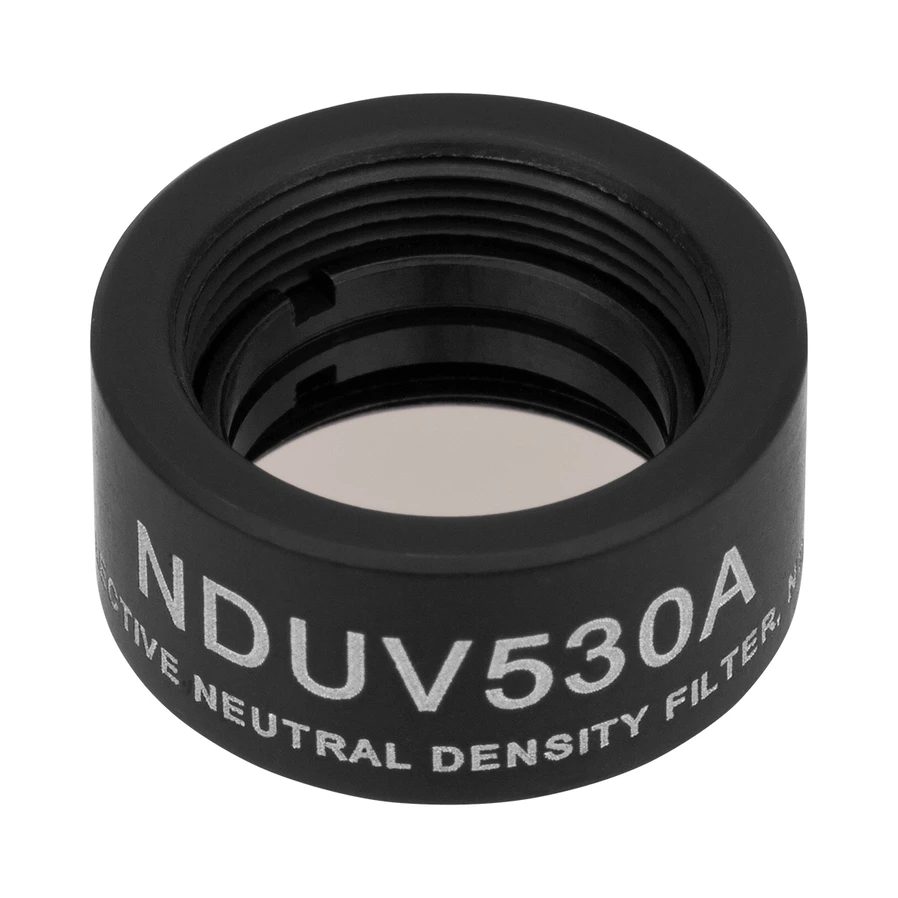
Thorlabs NDUV530B is a fused silica ND UV filter pre-mounted with standard SM05 aluminum housing. It delivers OD3.0 optical density with nominal transmittance of only 0.1% at 200–400 nm. Featuring superior surface flatness and parallelism, it acts as a standard light attenuator for lab UV optical paths and UV laser calibration.
2. Working Principle of Neutral Density UV Filters
NDUV530B uses UV fused silica substrate with nickel absorbing coating on the front surface to realize absorption-based neutral attenuation:
- UV Transparent Substrate: UV fused silica shows negligible intrinsic absorption from 200–400 nm, allowing full UV radiation to reach the coating layer;
- Nickel Absorption Coating (Surface S1): Nickel thin film absorbs most incident UV photons and converts optical energy into heat, realizing strong light attenuation;
- Uniform Neutral Attenuation: Nickel coating absorbs light at identical ratios across 200–1200 nm, no selective wavelength filtering, so the spectral composition of the beam remains unchanged;
- Dual Precision Polished Surfaces (S1/S2): Both sides are high-precision polished with parallelism <20 arcmin and surface flatness <2λ @633 nm, avoiding beam shift or wavefront distortion for collimated optical systems.
3. Core Product Highlights of Thorlabs NDUV530B
- UV-Optimized Bandwidth: Optimized for 200–400 nm UV range, usable spectrum extended to 200–1200 nm covering UV, visible and near-infrared;
- OD3.0 Fixed Attenuation: Optical Density OD=3.0 at 300 nm with nominal transmittance 0.1%, effectively cutting high-power UV light to prevent detector saturation;
- Premium Optical Surface Quality: 40-20 scratch-dig grade, surface flatness <2λ @633 nm, parallelism <20 arcmin, free of wavefront distortion for imaging and collimation systems;
- UV Fused Silica Base Material: Superior to common optical glass, no deep UV absorption and anti-degradation under long-term UV irradiation;
- Integrated Standard SM05 Mount: Anodized aluminum housing with internal & external SM05 φ0.535-40 threads, directly compatible with general optomechanical mounts and cage systems;
- Durable Nickel Absorption Coating: Strong film adhesion, no peeling or attenuation drift under long-term UV exposure;
- Large Clear Aperture: Clear aperture >11.0 mm, fits standard 12.7 mm beam without edge vignetting;
- Lightweight Compact Design: Total weight only 5 g, no extra load for precision laboratory optical setups.
4. Key Product Applications
- UV Laser Measurement Systems: Attenuate nanosecond/femtosecond UV pulsed laser to avoid saturation of pyroelectric detectors and photodiodes;
- Spectroscopy Instruments: Attenuate high-intensity light for UV spectrophotometers and Raman spectrometers to balance measurement dynamic range;
- Lithography & UV Exposure Experiments: Adjust UV source power to stabilize exposure dosage and improve lithography pattern uniformity;
- UV Imaging Inspection: Reduce light intensity for UV industrial cameras and fluorescence microscopes to eliminate overexposure;
- Academic Optical Labs: Standard neutral attenuation accessory for polarization, interference and collimation optical platforms;
- Metrology & Calibration Equipment: Reference attenuation standard for UV radiometers and optical power meter calibration.