What Is a Laser Pump Module? Working Principle & Key Applications of II-VI CM97-1000-76PM
Published: 2026-08-05 15:14:41 Views: 51
1. Why Choose Laser Pump Modules
Fiber lasers and fiber amplification systems require excitation sources with stable wavelength, narrow spectral linewidth and consistent output power. Discrete laser diodes suffer severe wavelength drift, power fluctuation, unstable polarization and poor heat dissipation, which cannot support long-term stable operation of fiber amplifiers and precision optical sensing equipment.
A laser pump module is an integrated packaged excitation component integrating TEC cooling, FBG wavelength locking, monitor photodiode and polarization maintaining pigtail. It solves core pain points including wavelength thermal drift, power jitter, polarization control and thermal management. It acts as the core excitation unit for fiber lasers and optical amplification systems.
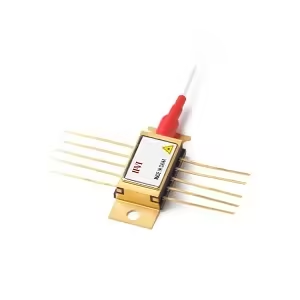
The II-VI CM97-1000-76PM is a 976nm mini-butterfly high-power pump module with kink-free 1W output. Equipped with internal FBG wavelength stabilizer and polarization maintaining single-mode fiber, it complies with Telcordia GR-468 telecom reliability standards, serving as the preferred pump source for industrial pulsed fiber pre-amplifiers and EDFA systems.
2. Working Principle of Laser Pump Modules
Taking the II-VI CM97-1000-76PM 976nm butterfly pump module as an example, the device consists of five core subsystems: laser emitter, wavelength locking, thermoelectric cooling, power monitoring and polarization-preserving transmission.
- Laser Emission Unit: Laser chip emits 976nm laser when forward current is applied, delivering maximum kink-free output power of 1000mW with typical threshold current 60~80mA.
- FBG Wavelength Stabilization: Fiber Bragg Grating embedded in pigtail reflects only 975–977nm light back to the laser chip, restraining wavelength shift caused by temperature and current variation, with typical spectral width only 0.2nm.
- TEC Thermoelectric Temperature Control: Built-in miniature thermoelectric cooler paired with thermistor for active temperature regulation, supporting maximum temperature difference of 35℃, ensuring stable laser performance under case temperature -20℃ ~ +75℃.
- Real-Time Power Monitoring: Integrated monitor photodiode tracks output optical power for closed-loop control, featuring ultra-low dark current and signal-to-noise ratio ≥20dB.
- PM Fiber Coupled Output: Coupled with Nufern PM980-XP or Corning PM98-U25 polarization maintaining single-mode fiber, offering typical polarization extinction ratio of 13dB to maintain stable polarization for polarization-sensitive fiber optic systems.
3. Core Product Highlights of II-VI CM97-1000-76PM
- 1W kink-free high power output: Wide linear operating range without power curve kink for consistent light output;
- Built-in FBG wavelength locking: Fixed peak wavelength at 976nm with narrow spectral width, minimizing thermal wavelength drift and improving beam quality of fiber lasers;
- Polarization maintaining single-mode fiber pigtail: 13dB polarization extinction ratio, compatible with polarization-sensitive optical amplification and sensing circuits;
- All-in-one thermal & monitoring assembly: Integrated TEC cooler, thermistor and monitor PD, eliminating extra external monitoring and heat dissipation components;
- Compact hermetic mini-butterfly package: 10-pin sealed metal housing with small footprint for space-limited equipment integration;
- Telecom-grade reliability: Fully compliant with Telcordia GR-468-CORE standard and RoHS environmental directive;
- Wide operating temperature range: Case temperature from -20℃ to +75℃, reliable for industrial and telecommunication equipment under extreme ambient temperatures;
- Robust fiber mechanical specifications: 2.1m standard pigtail length, minimum fiber bend radius 20mm, qualified tensile strength to avoid fiber breakage during long-term operation.
4. Key Product Applications
- Fiber Laser Systems: Pump source for industrial pulsed fiber pre-amplifiers and continuous-wave fiber lasers;
- EDFA Erbium-Doped Fiber Amplifiers: Core pump component for optical signal amplification in telecommunication transmission networks;
- Fiber Optic Sensing: Excitation light source for distributed fiber sensing and polarization-based optical detection equipment;
- Precision Optical Test Instruments: Narrow-linewidth stable light source and fiber amplification test platforms for laboratories;
- Supporting Industrial Laser Processing: Built-in pump module for low-to-medium power fiber marking and micro-machining lasers.