
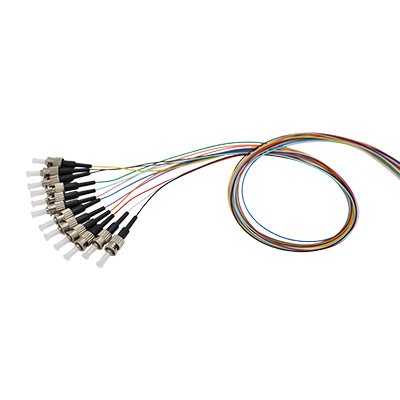
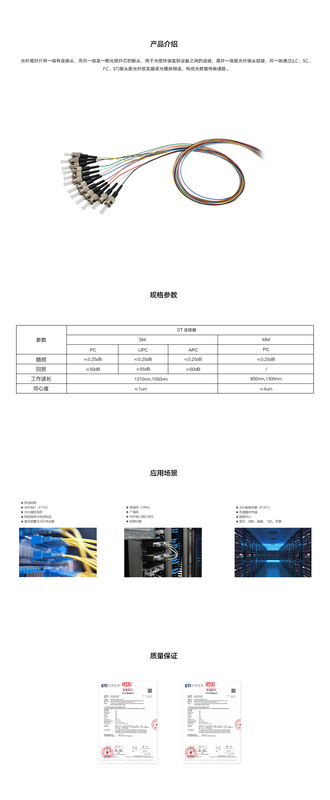
ST UPC 12-Color Fiber Pigtail
 Save to Favorites
Specifications
| Parameter | Value |
|---|---|
| Connector A | ST |
| Connector B | None |
| Fiber Type | 9/125 μm |
| Number of fiber cores | Simplex |
| Cable Model | G.652D/G.657A2 |
| Minimum bending radius | 30 mm |
| End face type | UPC |
| Cable Outer Diameter | 0.9 mm |
| Cable Sheath Material | PVC/LSZH |
| Cable Color | 12 Colors |
| Wavelength | 1310 nm/1550 nm |
| Lifetime | >1000 times |
| Insertion Loss | ≤0.25 dB |
| Interchangeability | ≤0.2 dB |
| Return Loss | ≥55 dB |
| Vibration Test | ≤0.2 dB |
| Operating Temperature | -40~85 °C |
| Storage Temperature | -40~85 °C |
Datasheet
Please provide your email to download the datasheet.
Invalid email format. Please try again.
Supplier Information
Related Products
-
Linear Illumination Fiber Bundle SMA-FDP-DUVXZ-02 Fiber Cables & Bundles Fiberock
Optical fiber material: High-temperature-resistant UV-resistant silica fiber Connector Type: SMA905/FC/custom Fiber core count: Multicore
Linear illumination bundles, or line sources, deliver light from one or more sources through fibers as elongated directional illumination. Industrial vision uses include automated inspection, surface-defect scanning, and edge detection. They emphasize contours or provide uniform camera backgrounds to reveal details, shapes, and irregularities. Clear line-generated shadows help determine positions/dimensions. Design considerations: 1. Uniform intensity along the full length for accurate recognition/measurement. 2. Directionality enhances contrast/shadows and features. 3. Size/configuration matches tasks; wider fields need longer sources. 4. Low-loss, high-transmission materials improve efficiency/stability. 5. Chemical, thermal, and physical durability for harsh conditions. 6. Heat management, especially high power. 7. Compatible sources, potentially requiring special coupling. 8. Adjustable brightness/focus. 9. Easy maintenance/replacement after source/bundle damage. 10. Cost optimization without sacrificing performance. 11. Simple reliable integration/mounting. 12. Appropriate IP protection for changing environments. Address these during design for effective stable illumination.
-
Linear Illumination Fiber Bundle SMA-PI-UVXZ-02 Fiber Cables & Bundles Fiberock
Optical fiber material: High-temperature-resistant UV silica fiber Connector Type: SMA905/FC/custom Fiber core count: Multicore
Linear illumination bundles, or line sources, deliver light from one or more sources through fibers as elongated directional illumination. Industrial vision uses include automated inspection, surface-defect scanning, and edge detection. They emphasize contours or provide uniform camera backgrounds to reveal details, shapes, and irregularities. Clear line-generated shadows help determine positions/dimensions. Design considerations: 1. Uniform intensity along the full length for accurate recognition/measurement. 2. Directionality enhances contrast/shadows and features. 3. Size/configuration matches tasks; wider fields need longer sources. 4. Low-loss, high-transmission materials improve efficiency/stability. 5. Chemical, thermal, and physical durability for harsh conditions. 6. Heat management, especially high power. 7. Compatible sources, potentially requiring special coupling. 8. Adjustable brightness/focus. 9. Easy maintenance/replacement after source/bundle damage. 10. Cost optimization without sacrificing performance. 11. Simple reliable integration/mounting. 12. Appropriate IP protection for changing environments. Address these during design for effective stable illumination.
-
Linear Illumination Fiber Bundle SMA-PI-IRXZ-02 Fiber Cables & Bundles Fiberock
Optical fiber material: High-temperature-resistant infrared silica fiber Connector Type: SMA905/FC/custom Fiber core count: Multicore
Linear illumination bundles, or line sources, deliver light from one or more sources through fibers as elongated directional illumination. Industrial vision uses include automated inspection, surface-defect scanning, and edge detection. They emphasize contours or provide uniform camera backgrounds to reveal details, shapes, and irregularities. Clear line-generated shadows help determine positions/dimensions. Design considerations: 1. Uniform intensity along the full length for accurate recognition/measurement. 2. Directionality enhances contrast/shadows and features. 3. Size/configuration matches tasks; wider fields need longer sources. 4. Low-loss, high-transmission materials improve efficiency/stability. 5. Chemical, thermal, and physical durability for harsh conditions. 6. Heat management, especially high power. 7. Compatible sources, potentially requiring special coupling. 8. Adjustable brightness/focus. 9. Easy maintenance/replacement after source/bundle damage. 10. Cost optimization without sacrificing performance. 11. Simple reliable integration/mounting. 12. Appropriate IP protection for changing environments. Address these during design for effective stable illumination.
-
Linear Illumination Fiber Bundle SMA-POXZ-01 Fiber Cables & Bundles Fiberock
Optical fiber material: Plastic Fiber Connector Type: SMA905/FC/custom Fiber core count: Single-core
Linear illumination bundles, or line sources, deliver light from one or more sources through fibers as elongated directional illumination. Industrial vision uses include automated inspection, surface-defect scanning, and edge detection. They emphasize contours or provide uniform camera backgrounds to reveal details, shapes, and irregularities. Clear line-generated shadows help determine positions/dimensions. Design considerations: 1. Uniform intensity along the full length for accurate recognition/measurement. 2. Directionality enhances contrast/shadows and features. 3. Size/configuration matches tasks; wider fields need longer sources. 4. Low-loss, high-transmission materials improve efficiency/stability. 5. Chemical, thermal, and physical durability for harsh conditions. 6. Heat management, especially high power. 7. Compatible sources, potentially requiring special coupling. 8. Adjustable brightness/focus. 9. Easy maintenance/replacement after source/bundle damage. 10. Cost optimization without sacrificing performance. 11. Simple reliable integration/mounting. 12. Appropriate IP protection for changing environments. Address these during design for effective stable illumination.
-
Linear Illumination Fiber Bundle SMA-GFXZ-01 Fiber Cables & Bundles Fiberock
Optical fiber material: Multicomponent Glass Fiber Connector Type: SMA905/FC/custom Fiber core count: Multicore
Linear illumination bundles, or line sources, deliver light from one or more sources through fibers as elongated directional illumination. Industrial vision uses include automated inspection, surface-defect scanning, and edge detection. They emphasize contours or provide uniform camera backgrounds to reveal details, shapes, and irregularities. Clear line-generated shadows help determine positions/dimensions. Design considerations: 1. Uniform intensity along the full length for accurate recognition/measurement. 2. Directionality enhances contrast/shadows and features. 3. Size/configuration matches tasks; wider fields need longer sources. 4. Low-loss, high-transmission materials improve efficiency/stability. 5. Chemical, thermal, and physical durability for harsh conditions. 6. Heat management, especially high power. 7. Compatible sources, potentially requiring special coupling. 8. Adjustable brightness/focus. 9. Easy maintenance/replacement after source/bundle damage. 10. Cost optimization without sacrificing performance. 11. Simple reliable integration/mounting. 12. Appropriate IP protection for changing environments. Address these during design for effective stable illumination.
Related Articles
For semiconductor, coating and laboratory vacuum chambers, thermal conductivity gauges suffer large measurement errors caused by gas type and ambient temperature.
Founded in Beijing in 2011, Beijing FJR Opto-electronic Technology Co., Ltd. specializes in R&D, manufacturing and sales of infrared thermal imaging equipment and complete optoelectronic systems.
A microlens array (MLA) is a high-precision optical component composed of hundreds or thousands of tiny, uniformly arranged micro lenses on a single flat substrate. Unlike traditional single lenses that focus one light beam, a microlens array can split, homogenize, and reshape light on a micro scale. It is widely paired with VCSELs, lasers, and image sensors, becoming a core part of modern miniature optical systems.
A laser bar is an array semiconductor laser chip integrated with dozens of emitters, which realizes hundred-watt quasi-continuous output on a single chip. With regular emitter arrangement and controllable fill factor, integrated thermal design and superior wall-plug efficiency compared to single chips, it acts as the core light source for high-power pumping, medical lasers and precision processing.
Loading...
Name
Phone
Organization
Use Case

Database Platform