What Is a Microlens Array? Working Principle & Key Applications
Published: 2026-07-23 15:05:38 Views: 92
What Is a Microlens Array?
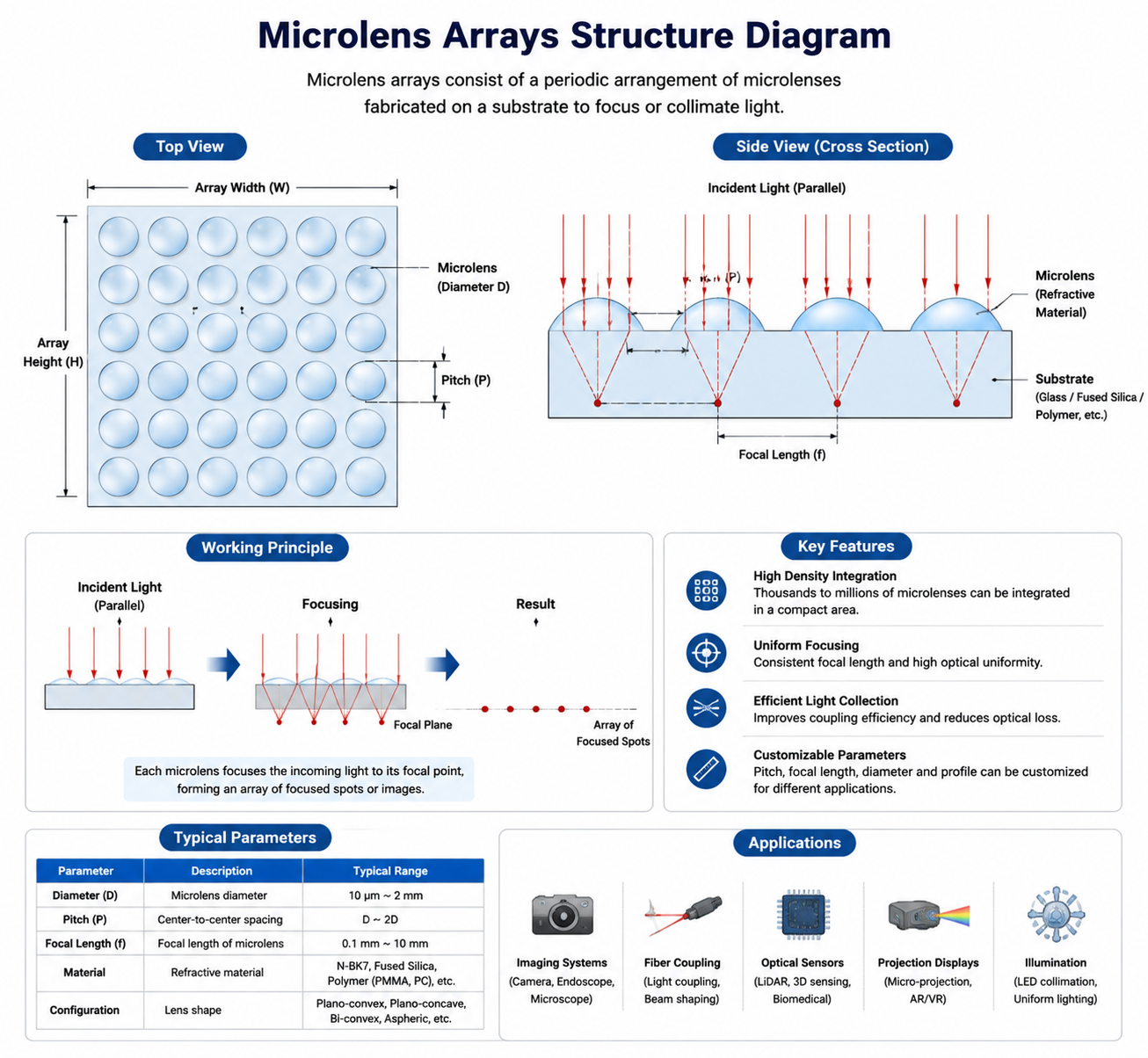
A microlens array is a compact optical device made of multiple micron-sized lenses arranged in regular rectangular or hexagonal patterns. Each tiny lens works independently while cooperating as a whole optical unit.
The biggest advantage of an MLA is its ability to convert uneven, concentrated light beams into uniform, soft, and high-density light spots. It solves common optical problems such as laser speckle, uneven illumination, and low light utilization, making micro optical systems smaller, more stable, and more efficient.
How Does a Microlens Array Work?
The working principle of a microlens array is simple. When incident light (usually laser or infrared light) passes through the array, each micro lens splits a small part of the light beam. These split sub-beams overlap and integrate with each other after refraction, finally forming a highly uniform light field. This process realizes efficient light homogenization, beam shaping, and light focusing without complex optical structures.
Key Applications of Microlens Arrays
Microlens arrays are essential for miniaturized, high-precision optical systems. They are widely used in consumer electronics, industrial optics, and intelligent sensing fields:
1. 3D Sensing & Face Recognition
Paired with VCSEL laser emitters, microlens arrays shape infrared laser into uniform structured light. This enables high-precision 3D depth scanning, facial recognition, and device unlocking for smartphones and tablets.
2. Laser Beam Shaping & Homogenization
MLAs eliminate laser speckles and uneven light intensity, optimizing laser beam quality. They are commonly used in laser marking, laser cutting, ultraviolet curing, and industrial laser processing equipment to improve processing accuracy.
3. Optical Imaging & Display Technology
Microlens arrays improve light transmittance and imaging uniformity for micro cameras, miniature imaging modules, and AR/VR display devices. They help reduce screen glare, enhance display clarity, and realize lightweight display design.
4. Optical Communication & Sensing Devices
In optical transceivers and photoelectric sensing modules, MLAs assist in precise light coupling and improve light receiving efficiency. They effectively reduce optical signal loss and stabilize high-speed optical transmission.
5. Automotive & Smart Lighting
Used in automotive ambient lighting, headlight uniform illumination, and vehicle infrared sensing systems. The component ensures even light distribution and improves the stability of vehicle optical systems.
Conclusion
A microlens array (MLA) is a critical micro optical component for light shaping and homogenization. With its compact size, high precision, and excellent optical performance, it perfectly matches the development trend of miniaturized and high-efficiency optical devices. It plays an irreplaceable role in 3D sensing, laser processing, intelligent display, and optical communication industries.