
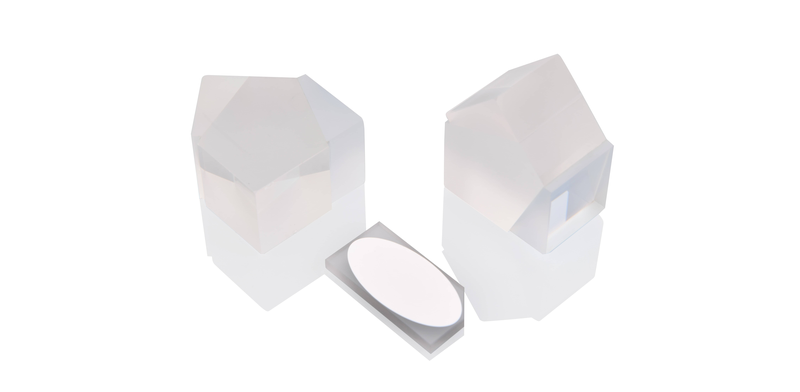
Prism
The core uses of a prism include deviating light at a specific angle, while also enabling light deviation and image orientation adjustment. The way it interacts with light is entirely determined by its own design. When light enters a prism, there are mainly two paths of action: one is that light first reflects off one or more surfaces of the prism and then exits; the other is that light is directly refracted while passing through the prism substrate. As an example, the right-angle prism belongs to the former. When light enters, it first reflects off one of its surfaces, ultimately achieving a 90° light deviation. The wedge prism, however, belongs to the latter; since the thickness of its substrate varies, light deviates due to refraction when passing through. Prisms have the following types: dispersive prisms, reflective prisms, roof prisms, etc.
 Save to Favorites
Overview
Specifications
| Parameter | Value |
|---|---|
| Diameter / Clear Aperture [Processing Capability] | 1.5 - 200 mm |
| Diameter / Clear Aperture [Inspection Equipment] | Image Measuring Instrument |
| Diameter Tolerance [Processing Capability] | ±0.02 mm |
| Diameter Tolerance [Inspection Equipment] | Image Measuring Instrument |
| Prism Angle Error [Processing Capability] | 30 arcsec |
| Prism Angle Error [Inspection Equipment] | Goniometer |
| Surface Figure [Processing Capability] | 0.1(0.1) |
| Surface Figure [Inspection Equipment] | Interferometer |
| Surface Defects [Processing Capability] | 2*0.1 |
| Surface Defects [Inspection Equipment] | Visual Inspection or Microscope |
Datasheet
Please provide your email to download the datasheet.
Invalid email format. Please try again.
Supplier Information
Related Products
-
 Pentaprism
Prisms
Sunday-optics
Material: BK7, UV fused silica, sapphire, ZnSe, Caf2, Si, Ge, etc. Dimensions: 3mm-380mm Dimensional tolerance [Customer requirements]: +/-0.02mm or Customer requirements
Pentaprisms are widely used in laser levels, imaging, precision systems and optics. Their 90° deviation is independent of prism orientation, making them especially important where orientation cannot be precisely controlled. We manufacture high-precision pentaprisms with customer-specified coatings.
-
 Littrow Prism
Prisms
Sunday-optics
Material: BK7, UV fused silica, sapphire, ZnSe, Caf2, Si, Ge, etc. Dimensions: 0.5mm-300mm Dimensional tolerance [Customer requirements]: +/-0.02mm or Customer requirements
A Littrow prism is usually a 30°/60°/90° prism with a reflective coating on its hypotenuse. A coated Littrow dispersion prism deflects the line of sight by 60°. An uncoated Littrow dispersion prism disperses light into its component spectrum.
-
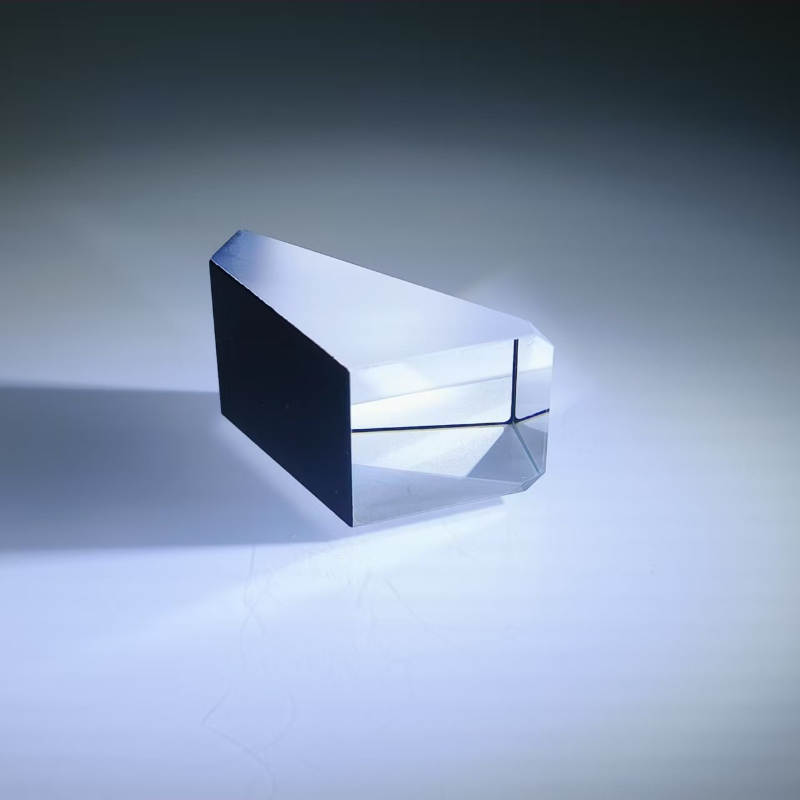 Half-Pentaprism
Prisms
Sunday-optics
Material: BK7, UV fused silica, sapphire, ZnSe, Caf2, Si, Ge, etc. Dimensions: 3mm-380mm Dimensional tolerance [Customer requirements]: +/-0.02mm or Customer requirements
Sunday-optics manufactures half-pentaprisms to customer dimensions/drawings.
-
 Anamorphic Prism
Prisms
Sunday-optics
Material: N-SF11 Dimensional tolerance: +/-0.05mm CA: >80%
Anamorphic prism pairs convert elliptical laser-diode beams into nearly circular beams. Operation near Brewster's angle and angle-specific antireflection coatings tailored to SF11 glass achieve 95% average throughput.
-
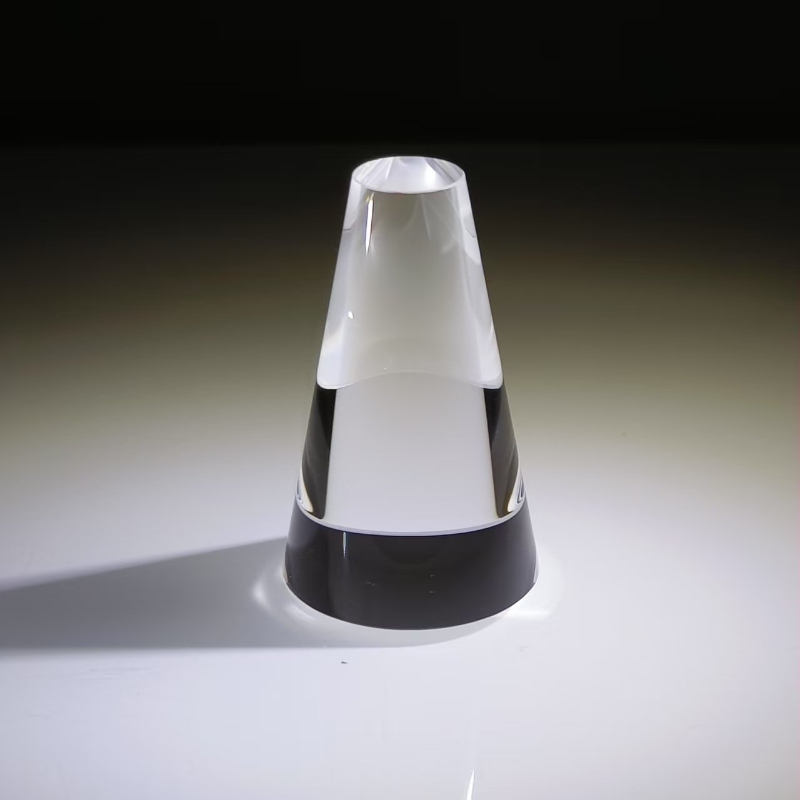 Solar Energy Prism
Prisms
Sunday-optics
Material [or Customer requirements 。]: BK7, UV Fused Silica or Customer-Specified Material Dimensions: 0.5mm-300mm Dimensional tolerance [Customer requirements]: +/-0.1mm or Customer requirements
The CPV solar prism collects sunlight for solar concentrators, concentrated photovoltaic (CPV) systems and solar power generation. It is a principal optical component for converting solar energy into electricity.
Related Articles
As a core precision optical component for wavelength screening, frequency locking and spectral demodulation, optical etalons are widely used in high-end scientific research and precision laser equipment.
As a vital emerging sector of modern three-dimensional spatial economy, the low-altitude economy has become a new global growth driver. It covers a wide range of commercial scenarios, including UAV navigation and obstacle avoidance, precise airspace management, aerial mapping, low-altitude logistics distribution, security monitoring and emergency disaster rescue. Nevertheless, frequent extreme weather, complex terrain obstacles and increasingly dense low-altitude flight activities pose severe challenges to the safety and stability of low-altitude aircraft operations.
Laser pump sources are the core energy input component of solid-state lasers and laser amplifiers, and their performance directly determines the output power, beam quality and service life of the entire laser system. In scenarios such as industrial processing, scientific research experiments and high-end equipment, improper pump source selection will not only result in substandard system performance, but also bring a series of problems such as rapid device degradation and high operation and maintenance costs. This article sorts out the core selection logic and key pitfalls of pump source procurement, and provides selection references based on mature, mass-produced high-reliability products to help purchasers efficiently screen suitable products.
Shandong Haucore Optoelectronics Co., Ltd. introduces the HGLD‑792‑COS‑D‑10WB semiconductor laser within its COS series. Delivering an output power of 10 W at a central wavelength of 792 nm, this device adopts gold‑tin bonding COS packaging. Featuring high reliability and long service life, it serves as a preferred pump source for solid‑state lasers and is widely deployed in industrial processing, laser display, medical & aesthetic treatment, scientific research and other fields.
Loading...
Name
Phone
Organization
Use Case

Database Platform