How to Procure Reliable Laser Pump Sources? A Complete Selection Guide & Key Purchasing Considerations
Published: 2026-07-17 14:42:22 Views: 96
How to Procure Reliable Laser Pump Sources? A Complete Selection Guide & Key Purchasing Considerations
Laser pump sources are the core energy input component of solid-state lasers and laser amplifiers, and their performance directly determines the output power, beam quality and service life of the entire laser system. In scenarios such as industrial processing, scientific research experiments and high-end equipment, improper pump source selection will not only result in substandard system performance, but also bring a series of problems such as rapid device degradation and high operation and maintenance costs. This article sorts out the core selection logic and key pitfalls of pump source procurement, and provides selection references based on mature, mass-produced high-reliability products to help purchasers efficiently screen suitable products.
I. Core Selection Criteria for Laser Pump Sources
When purchasing pump sources, it is necessary to first define the core parameter boundaries, and then gradually screen indicators such as integration and reliability. The core selection dimensions are divided into the following 4 categories:
1. Optical Parameter Matching as the Foundation of Selection
Optical parameters directly determine whether the pump source can be adapted to the laser system, and are the primary judgment standard:
- Operating wavelength: It must precisely match the absorption peak of the laser gain medium. Wavelength deviation will directly reduce the optical-to-optical conversion efficiency, and even fail to achieve effective pumping. The 966nm and 979nm bands are commonly used in conventional industrial scenarios, while specific wavelengths such as 824nm are applied in special scientific research and high-end equipment scenarios.
- Output power and operating mode: Select Continuous Wave (CW) or Quasi-Continuous Wave (QCW) mode according to the application scenario. For continuous laser processing scenarios, the rated continuous output power shall be matched; for pulse processing and high peak power scenarios, peak power, pulse width and frequency parameters shall be focused on. It is recommended to reserve a 10%-20% power margin during selection to avoid shortening the device life due to long-term full-load operation.
- Pumping structure and crystal parameters: For side-pumped modules, key indicators including crystal diameter, crystal length and pump length shall be checked carefully to match the resonant cavity design and gain output requirements.
2. Structural Integration Determines Deployment Cost
The package structure and interfaces of the pump source directly affect the installation and adaptation difficulty, which shall be checked in advance during selection:
- Installation dimensions and optical center height: They must fully match the reserved space of the laser cavity and optical path design to avoid secondary modification of the cavity.
- Interface specifications: Including the size and specifications of power supply electrode interfaces and cooling water circuit interfaces, which shall be compatible with the power supply circuit and water cooling system of the system.
- Standardized packaging: Mass-produced products with standardized packaging are preferred, which have a more stable supply chain and lower subsequent maintenance and replacement costs.
3. Reliability as the Core Guarantee for Long-Term Operation
High-power pump sources are devices that operate under long-term high load, and reliability indicators directly affect the life cycle cost:
- Conversion efficiency: Products with high optical-to-optical efficiency generate less heat, have smaller power attenuation during long-term operation, and can reduce energy consumption costs at the same time.
- Thermal management capability: Pump sources generate a large amount of heat. Mature thermal design and clear water cooling parameter requirements are the core to ensure long-term stable operation.
- Core component quality: Laser bars are the core light-emitting unit of pump sources. Laser bars independently mass-produced by original manufacturers have better consistency, more stable batch performance and higher reliability.
4. Scenario-Specific Matching to Avoid Performance Redundancy or Insufficiency
Demand priorities vary greatly across different scenarios, so targeted selection is required:
- Conventional industrial processing and low-to-medium power amplifiers: Mature mass-produced, cost-effective continuous-wave side-pumped modules are preferred.
- High-power pulse processing and high-power amplifiers: QCW high-peak-power side-pumped modules are recommended.
- High-end scientific research and high-tech special scenarios: Special-grade pump sources with high wavelength accuracy, qualified peak power and strong parameter consistency are suitable.
II. Key Considerations for Pump Source Procurement
In addition to core parameters, the following easily overlooked points shall be paid attention to during procurement to avoid selection pitfalls:
1. Verify Nominal Parameters Against Actual Working Conditions
The nominal parameters of most pump sources are laboratory test values under a constant temperature of 25℃. Fluctuations in ambient temperature and water temperature in actual industrial scenarios will affect output power and wavelength stability. Before procurement, confirm the performance attenuation range within the full operating temperature range with the supplier to avoid failure to meet design requirements in actual use.
2. The Cooling System Must Strictly Match the Parameters
High-power pump sources rely on water cooling for heat dissipation, and the water pressure and flow requirements specified by the product must be strictly followed. Insufficient water flow will cause overheating of laser bars and accelerate attenuation, while excessive water pressure may damage the sealing structure, cause water leakage and directly damage the device. During procurement, simultaneously check whether the parameters of your own water cooling system match to avoid device damage caused by insufficient supporting facilities.
3. Prioritize Suppliers with Direct Original Supply and Customization Support
Optical path designs and parameter requirements vary across different projects. Suppliers that support customization of wavelength and power can better adapt to personalized project needs. Meanwhile, products directly supplied by the original manufacturer can provide professional technical support and formal warranty services, avoiding problems such as slow after-sales response, long replacement cycles and unstable supply sources from middleman channels.
4. Attach Importance to Laser Safety and Product Compliance
High-power pump sources are high-risk laser devices. During procurement, confirm that the products comply with laser safety specifications, and suppliers shall provide complete safety operation guidelines and product specifications to ensure safety and compliance throughout the whole process of production, installation and use.
III. Recommended High-Reliability Pump Source Products
For mainstream scenarios including industrial processing, laser amplifiers and high-end scientific research, three mass-produced pump sources/side-pumped modules from Shandong Huaguang Optoelectronics Co., Ltd. feature high reliability and high optical-to-optical efficiency, and support customization of wavelength and power. They can be used as high-quality references for procurement selection:
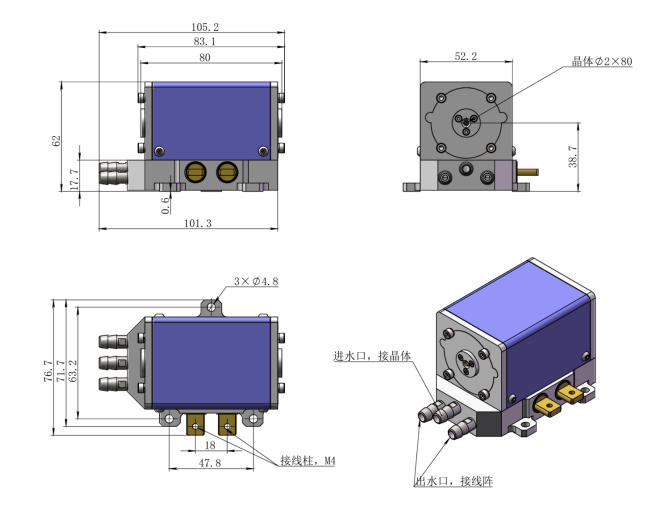
1. DPM-W160-C305-020P 966nm Side-Pumped Module (General-Purpose CW Type)
This product is a side-pumped module with continuous wave (CW) operating mode, mainly positioned for conventional industrial processing and low-to-medium power laser amplifier scenarios.
- Core optical parameters: Pump central wavelength of 966nm, rated pump power of 600W, equipped with φ2mm×80mm laser crystal, pump length >52mm, which adapts to the gain demand of medium and low power solid-state laser systems.
- Integration and electrical parameters: Adopting DPM01-7 standardized package with external dimensions of 105.2×52.2×62mm and optical center height of 38.7mm, it is suitable for conventional laser cavity installation. It is built with 15 laser bars of 50W single bar power, with operating current ≤40A and operating voltage ≤30V, featuring low power supply adaptation threshold.
- Cooling requirements: Cooling water pressure of 0.4~0.6MPa, water flow of 3~5L/min, compatible with conventional industrial water cooling systems.
- Applicable scenarios: Conventional industrial processing scenarios such as laser marking and precision cutting, as well as low-to-medium power laser amplifiers. It is a mature mass-produced, cost-effective general-purpose option.
2. DPM-W2N2-Q537-040P 979nm High-Power Side-Pumped Module (High-Peak QCW Type)
This is a high-power side-pumped module with quasi-continuous wave (QCW) operating mode, specially designed for high-power pulsed laser systems.
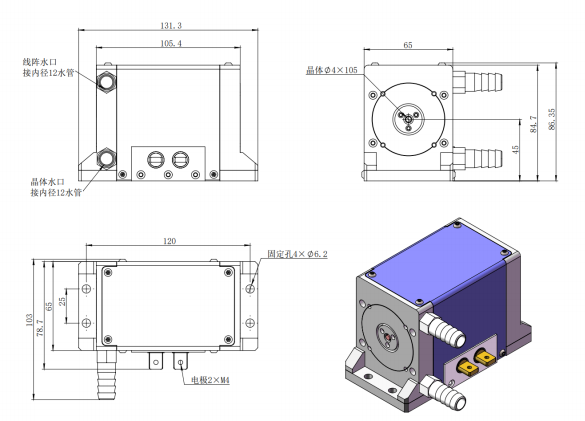
- Core optical parameters: Pump central wavelength of 979nm, peak pump power up to 52000W, equipped with large-size φ4mm×106mm laser crystal and pump length of 74mm, which can provide sufficient high-peak gain input.
- Integration and electrical parameters: Adopting DPM02-7 package structure with external dimensions of 131.3×86.35×78.7mm and optical center height of 45mm, it adapts to high-power laser cavities. It is built with 105 laser bars of 500W single bar power, supporting 500μs pulse width and 20Hz operating frequency, meeting the demand of high-peak pulse output.
- Cooling requirements: Cooling water pressure of 0.4~0.6MPa, water flow of 6~9L/min, ensuring thermal stability under high-power load.
- Applicable scenarios: Industrial processing scenarios such as high-power laser drilling and pulse welding, as well as high-power laser amplifiers, capable of stably outputting high-peak pump energy.
3. GD-8AL5-D70 824nm High-Power Pump Source (Special-Grade High-Peak Type)
This 824nm high-peak-power pump source is custom-designed for special scenarios, with parameter accuracy and reliability optimized for high-end demands.
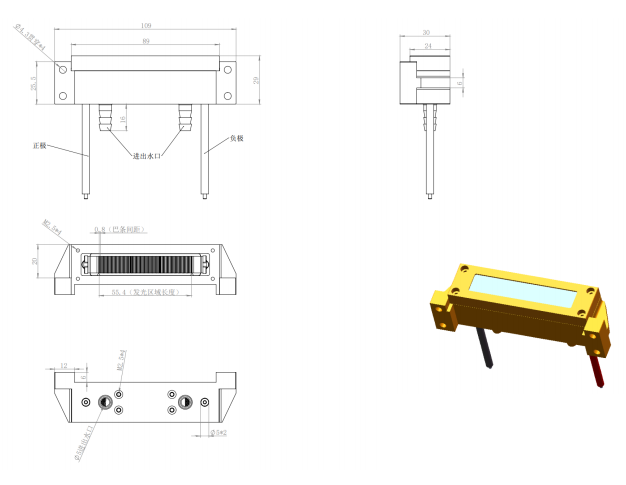
- Core optical parameters: Central wavelength of 824nm, wavelength tolerance controlled within ±1nm, spectral width FWHM <4nm, maximum output power up to 35000W, with high parameter accuracy and good batch consistency.
- Integration and electrical parameters: Built with 70 laser bars with 0.8mm bar pitch, operating current of 450A and operating voltage of 140V, supporting flexible adjustment of 0-100Hz operating frequency and 0-400μs pulse width, adapting to diverse pulse demands.
- Cooling requirements: Cooling water pressure <0.5MPa, water flow of 2-4L/min, with mature and stable thermal management design.
- Applicable scenarios: Scenarios with high requirements for peak power and wavelength accuracy, such as national strategic high-tech equipment and high-end scientific research experiments.
Conclusion
The core of procuring reliable laser pump sources is to first define the parameter boundaries based on application scenarios, and then verify integration adaptability, long-term reliability and supplier service capabilities in sequence. The three recommended products above are all mature models verified by mass production from Shandong Huaguang Optoelectronics, supporting wavelength and power customization, and can cover the pumping demands of most industrial, scientific research and special scenarios. During procurement, you can contact the original manufacturer to confirm adaptability according to your own system design parameters.