What Is VCSEL (Vertical Cavity Surface Emitting Laser)? Definition, Benefits & Applications
Published: 2026-07-23 14:53:38 Views: 69
What Is VCSEL (Vertical Cavity Surface Emitting Laser)?
VCSEL is a miniature laser diode with a vertical resonant cavity structure. It consists of upper and lower DBR reflective mirrors and a thin active light-emitting layer. Current passes through the vertical cavity, and photons oscillate and amplify inside the cavity to form a stable laser beam that emits vertically from the chip surface.
Compared with ordinary edge-emitting lasers, VCSEL features a circular, low-divergence light spot. It supports on-wafer testing, mass production, and array packaging, making it more suitable for compact and high-precision electronic devices.
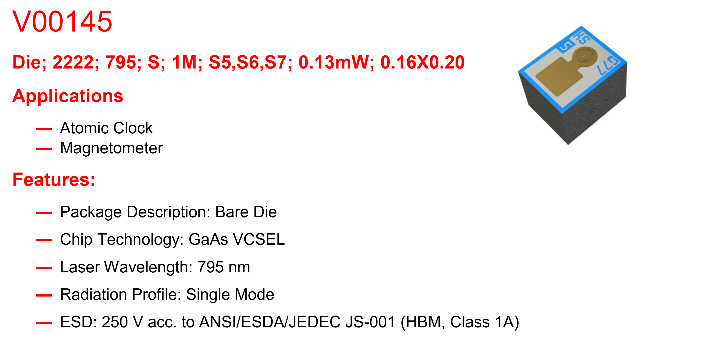
Vixar V00145 795nm/895nm/894nm VCSEL
Core Advantages of VCSEL
- Stable circular laser beam: Easy for optical focusing and sensing calibration
- Low power consumption: Ideal for battery-powered smart devices
- High response speed: Supports high-frequency modulation and high-speed data transmission
- Low cost for mass production: Simple packaging and testing process
- High reliability: Stable performance for long-term continuous operation
Main VCSEL Applications
VCSEL technology covers consumer electronics, industrial sensing, optical communication, and medical fields. Here are its most common scenarios:
1. 3D Sensing & Face Recognition
VCSEL arrays are the key light source for phone facial unlocking, depth cameras, and structured light scanning. It emits uniform infrared light to achieve high-precision 3D modeling and biometric recognition.
2. Wearable Devices & Health Monitoring
Smartwatches and fitness bands use VCSEL for PPG heart rate detection and blood oxygen monitoring. Its low power and high stability ensure accurate long-term health tracking.
3. Short-Reach Optical Communication
850nm VCSEL is widely used in data center optical modules, Ethernet transceivers, and high-speed fiber links to support stable short-distance high-speed data transmission.
4. LiDAR & Industrial Ranging
VCSEL-based ToF (Time of Flight) sensors are applied in industrial ranging, robot obstacle avoidance, and smart vehicle LiDAR systems for fast and precise distance detection.
5. Automotive & Smart Home
Used for in-cabin monitoring, passenger detection, smart device proximity sensing, and infrared scanning for home automation systems.
Conclusion
VCSEL (Vertical Cavity Surface Emitting Laser) is a high-performance, cost-effective laser light source. With unique vertical emission structure, excellent beam quality, and low power design, it dominates 3D sensing, wearable healthcare, optical communication, and industrial ranging fields. As smart devices and optical technology continue to upgrade, VCSEL will maintain irreplaceable market value.