
What Are Solid-State Lasers? Principle, Benefits & Applications
Published: 2026-07-23 15:21:04 Views: 72
What Are Solid-State Lasers?
Solid-state lasers are laser devices that use solid crystal or glass materials doped with rare-earth ions as the light-emitting medium. Typical materials include Nd:YAG, Nd:YVO4, and ruby crystals.
Simply put, the laser energy is generated by exciting the solid medium with a light source such as a laser diode or xenon lamp. After energy amplification inside the resonant cavity, the device outputs a stable, high-energy, concentrated laser beam.
Different from gas lasers and fiber lasers, solid-state lasers feature excellent beam quality, high peak power, and flexible pulse output, making them ideal for fine and high-precision work scenarios.

Nanosecond IS Series II Generation Ultraviolet Solid-State Laser
Core Advantages of Solid-State Lasers
- High precision beam output for micro-processing and fine marking
- High peak power to handle hard material processing
- Compact and stable structure with low failure rate
- Wide wavelength range to fit multiple optical applications
- Long service life and low maintenance cost
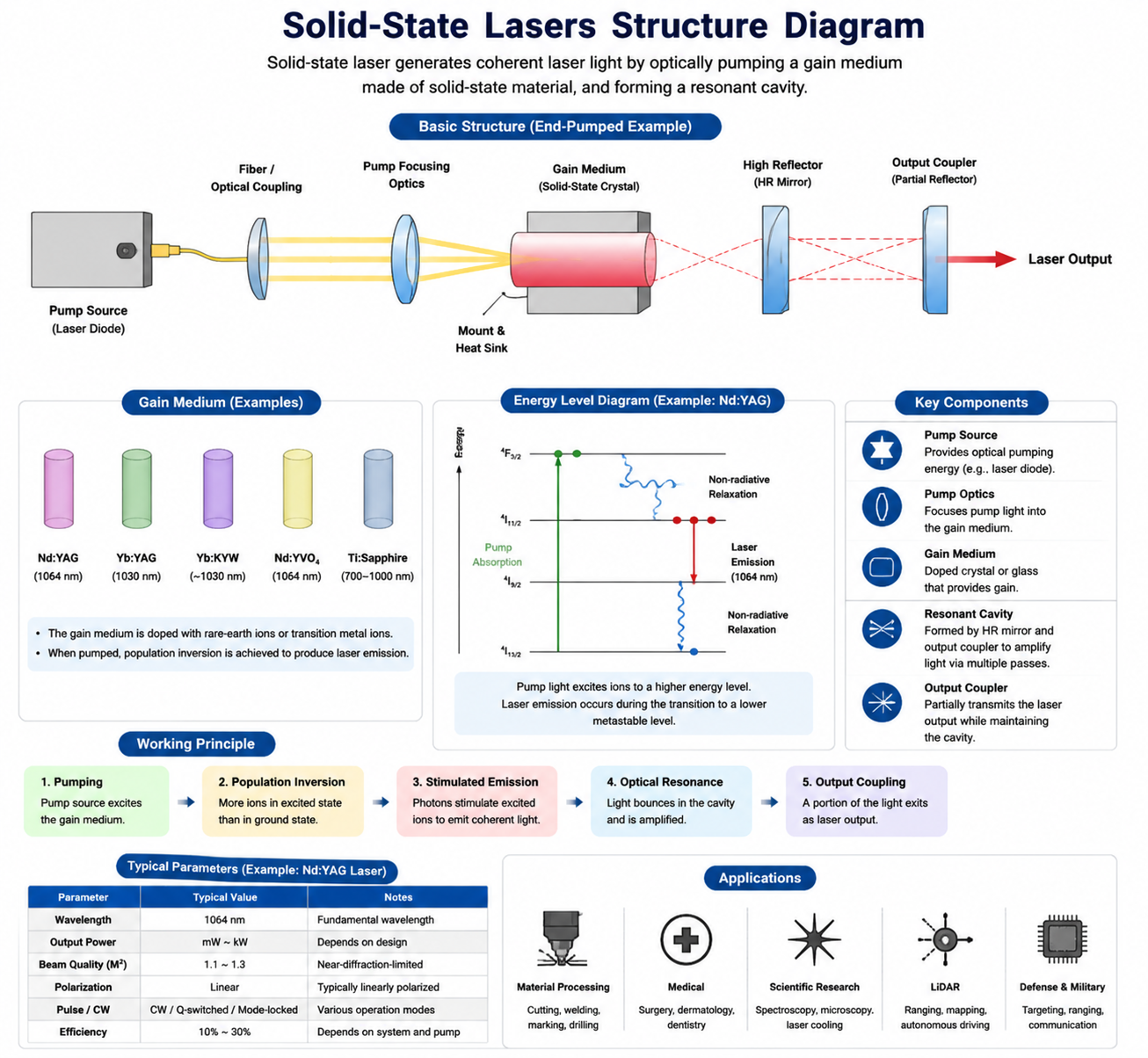
Solid-State Lasers StructureDiagram
Common Applications of Solid-State Lasers
Solid-state lasers are widely adopted across industrial, medical, scientific, and consumer fields. Below are their most typical use cases:
1. Industrial Precision Processing
Solid-state lasers are extensively used for laser marking, engraving, drilling, cutting, and welding. They deliver ultra-fine processing effects on metals, ceramics, and semiconductor materials, which is critical for electronics manufacturing and precision component production.
2. Medical & Beauty Equipment
Thanks to controllable energy output, solid-state lasers are applied in medical surgery, ophthalmology treatment, laser skin therapy, and dental equipment. Their stable energy ensures safe and accurate medical treatment.
3. Scientific Research & Laboratory Optics
They serve as core light sources for spectral analysis, laser detection, optical experiments, and particle research. Their stable beam quality supports high-precision scientific measurement and academic research.
4. LiDAR & Detection Systems
Pulsed solid-state lasers are used in ranging equipment, atmospheric detection, industrial sensing, and vehicle LiDAR systems to realize long-distance and high-accuracy detection.
5. Aerospace & Military Optics
Solid-state lasers feature high stability and strong environmental adaptability, making them suitable for aerospace optical testing, laser communication, and precision targeting systems.
Conclusion
Solid-state lasers are reliable, high-precision laser light sources with unique advantages in beam quality, peak power, and stability. From industrial micro-processing and medical devices to scientific research and detection systems, they continue to be an indispensable core optical component in modern laser technology.




