
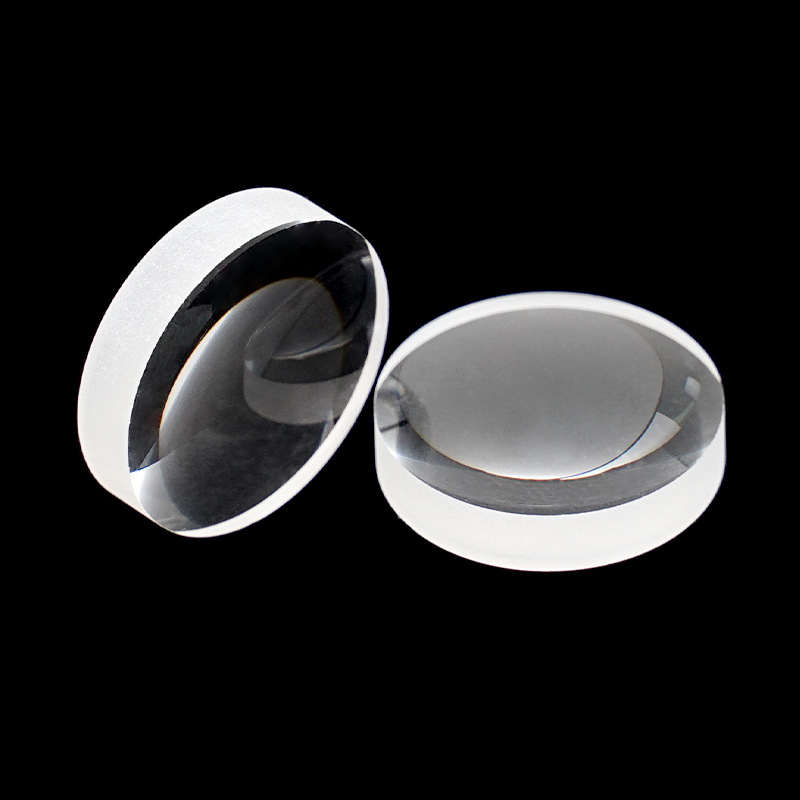
Biconvex Lens
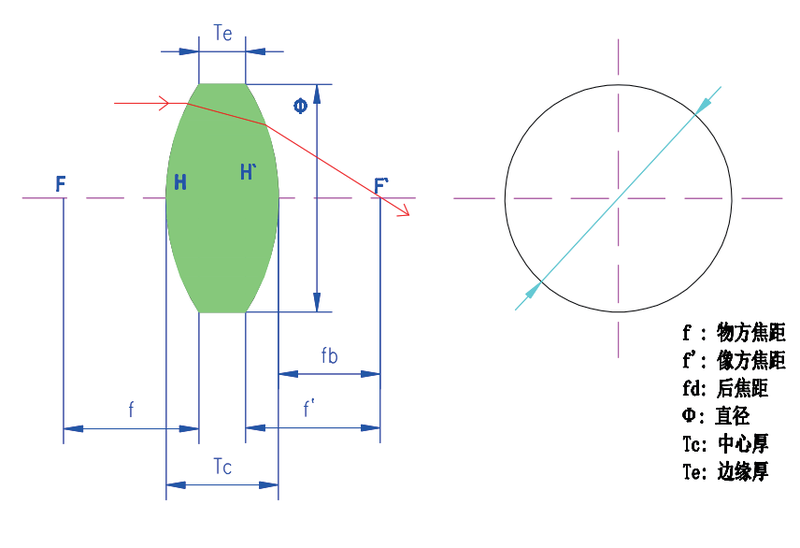
A biconvex lens has two outwardly convex spherical surfaces, usually with equal radii of curvature, a thick center and thin edges. It is a positive or converging lens that focuses parallel rays and is used in imaging, laser systems, microscopes and telescopes. Both surfaces are spherical and convex, with their centers of curvature on opposite sides of the lens. The usually symmetric structure provides positive optical power. It strongly focuses parallel light to form a real image. Compared with a single convex lens, the spherical biconvex design reduces spherical aberration by 30-40% for clearer imaging. It performs well over object to image distance ratios from 0.2:1 to 5:1 and is particularly suitable for 1:1 imaging. Spherical and chromatic aberrations remain and can affect image quality away from the paraxial region.
 Save to Favorites
Overview
Specifications
| Parameter | Value |
|---|---|
| Material [Custom Specifications] | K9;JGS1;CaF2; Ultraclear Glass and Other Materials |
| Size [Custom Specifications] | Customizable |
| Center Thickness Tolerance [Custom Specifications] | ±0.05 mm |
| Decentration [Custom Specifications] | <1 arcmin |
| Focal Length Tolerance [Custom Specifications] | ±1 % |
| Surface Quality [Custom Specifications] | 40/20 |
| Surface Figure [Custom Specifications] | N<3;ΔN<0.5 |
| Size range [Standard Biconvex Lens Specifications] | 3~150 mm |
| Size tolerance [Standard Biconvex Lens Specifications] | -0.03/-0.1 |
Applications
Datasheet
Supplier Information
Related Products
-
Tera3001-SA dual-LENS multidaughterboard coupling equipment Optical Lenses Terawan
The Tera3001-s multidaughterboard automatic alignment platform serves 10G/14G/25G optical transceivers. It mainly aligns lenses in Chip On Board (COB) modules, with single- or dual-channel lens/source alignment, automatic dispensing, and UV curing. The Tera3001-S provides high coupling efficiency, stability, and UPH depending on customer design, plus one-button collision protection and UV protection.
-
355 field lens Optical Lenses Central-laser
355 field lens: large zinc-selenide (ZnSe) focusing lens with a small spot for accurate marking. Imported lens material provides long service life and reduces removal, installation, and alignment. The 355nm scanning field lens is suitable for ultraviolet laser-marking machines.
-
532 field lens Optical Lenses Central-laser
532 field lens: large zinc-selenide (ZnSe) focusing lens with a small spot for accurate marking. Imported lens material provides long service life and reduces removal, installation, and alignment. The 532nm field lens is suitable for green laser-marking machines.
-
CO2 field lens Optical Lenses Central-laser
CO2 field lens: large zinc-selenide (ZnSe) focusing lens with a small spot for accurate marking. Imported lens material provides long service life and reduces removal, installation, and alignment. The 10640nm scanning field lens is suitable for CO2 laser-marking machines.
-
YAG field lens Optical Lenses Central-laser
YAG field lens: large zinc-selenide (ZnSe) focusing lens with a small spot for accurate marking. Imported lens material provides long service life and reduces removal, installation, and alignment. The 1064nm scanning field lens is suitable for fiber laser-marking machines.
Related Articles
Macro channel water-cooled stacked laser diodes integrate dozens of laser bars into one vertical stacked module with large-diameter macro flow cooling channels.
The CNGE 384 uncooled infrared core module is a high-performance core component for thermal imaging systems. Adopting mature uncooled infrared detection technology, it realizes all-weather thermal radiation perception and high-definition imaging without refrigeration equipment.
VCSEL, short for Vertical Cavity Surface Emitting Laser, is a widely used semiconductor laser component in modern optoelectronics. Unlike traditional edge-emitting lasers, VCSEL emits laser light vertically from its chip surface. Thanks to its low power consumption, stable beam quality, low cost, and easy integration, it has become the core light source for 3D sensing, wearable devices, and high-speed optical communication.
Founded in Beijing in 2011, Beijing FJR Opto-electronic Technology Co., Ltd. specializes in R&D, manufacturing and sales of infrared thermal imaging equipment and complete optoelectronic systems.
Loading...
Name
Phone
Organization
Use Case

Database Platform