
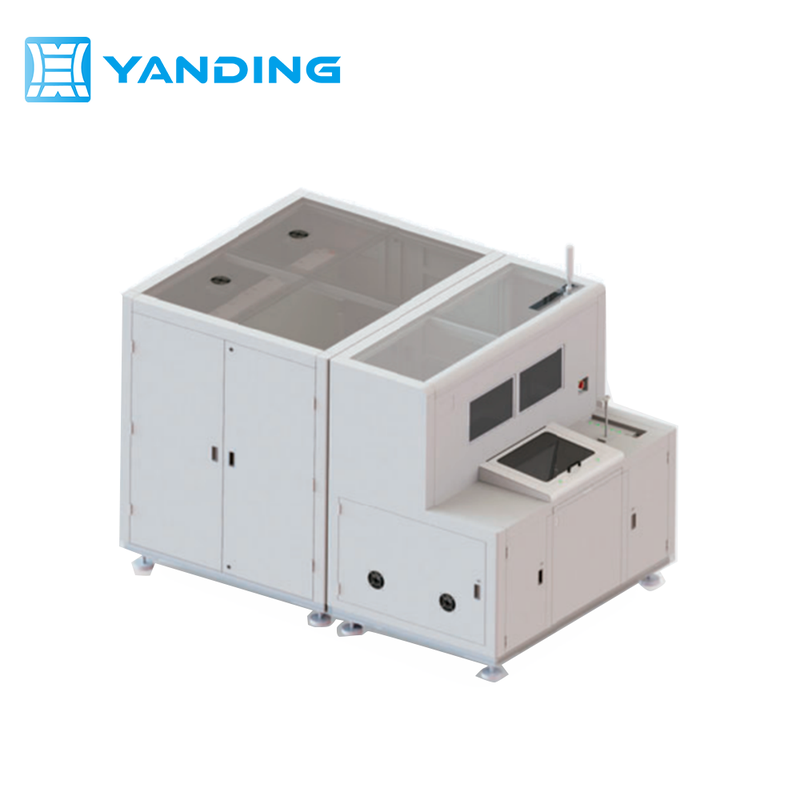
Automated Programmable Intrinsic Parameter Calibration System RT-GCS-F4
RT-GCS-F4 is a highly integrated, automatically programmed intrinsic-calibration system for production lines, combining high-speed image acquisition, precise motion control and efficient image analysis. Motion-control software developed for rapid production testing works with RIQA image-calibration analysis software for automatic camera shooting, acquisition control and high-precision intrinsic calibration. Four high-performance MIG-S2 frame grabbers support simultaneous activation and data transmission for multiple cameras. Bright, stable illumination and a highly flat glass checkerboard chart ensure stable acquisition and accurate, efficient calibration. Broad camera compatibility covers fields of view from 25°~210°. Successfully used on multiple automotive-module production lines, it provides efficient, accurate, automated intrinsic calibration.
 Save to Favorites
Overview
Specifications
| Parameter | Value |
|---|---|
| Total Size | 1960 x 2960 x 1950 mm (long x wide x high) |
| Power Supply | 220V 50Hz 3000W |
| Supporting Models | Mainstream models such as Pinhole/KB/MEI/Ocam, supporting customer custom model |
| Coverage [Fish eyeballs are marked with five-sided bodies.] | >85 % |
Key Features
Datasheet
Please provide your email to download the datasheet.
Invalid email format. Please try again.
Supplier Information
Related Products
-
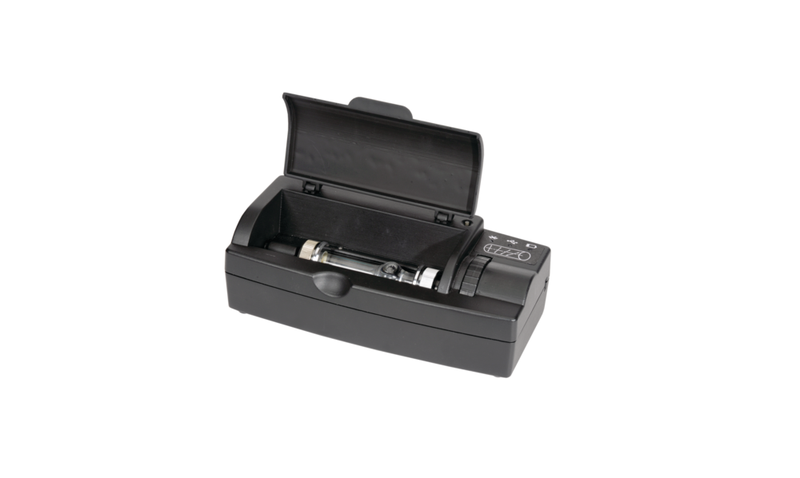 PS-3237 wireless polarimeter
Optical Metrology
Brolight
LED light source: 589 nm Optical-rotation accuracy: ±0.09° Sample-cell length (horizontal direction): 101.3 mm ± 0.8 mm
The PS-3237 wireless polarimeter provides Bluetooth and USB connectivity for analyzing chiral compounds on an iPad®, Chromebook™, Android tablet, or computer. It is ideal for introductory organic-chemistry and biochemistry experiments, where chiral compounds are a major focus. The PASCO wireless polarimeter operates as follows: Plane-polarized light passes through a vertical sample containing a chiral compound, then through an analyzer to a detector. Optical rotation is determined from the angle between the starting position and the position of optimum transmission at the crossed polarizer. Students use rotation data to calculate sample concentration. Specific rotation, the degrees of rotation per gram/milliliter of solution, is an intrinsic property that can distinguish molecules or identify racemic mixtures. In substances with chiral atomic centers, light propagation is anisotropic: Light vibrating in one dimension travels more slowly than light vibrating in another dimension at 90 degrees to it. One component, such as the horizontal component, is slowed, rotating the resultant vibration plane as it passes through the solution. The second polarizer is then rotated until maximum intensity reaches the detector. The angle from its initial to its final orientation is the optical rotation. The polarimeter uses monochromatic light for the following reason: Just as red light is refracted less than violet in a prism, red light is rotated less than orange in an optically active solution, orange less than green, followed by blue and violet. This can be observed with the OS-9477A polarimeter demonstration set: As a crossed polarizer is rotated to transmit the next color through the aligned polarizing arrangement, a Karo syrup solution between two large polarizers changes gradually from red to violet.
-
 Jingli Centering Measurement Instrument Series (Japan) CS-A1100(CS-A1100S)
Optical Metrology
Yuanch
Transmission Centering Measurement Instrument: CS-A1100(CS-A1100S). Uses collimation measurement and an automatic centering navigation system for more accurate and easier centering inspection. Optional software supports statistical analysis and printing. Optional vacuum holding and an automatic rotary stage improve measurement stability for small-aperture lenses. It offers a wide measurement range and good cost effectiveness.
-
Jingli Centering Measurement Instrument Series (Japan) US-A1
Optical Metrology
Yuanch
Reflection Centering Measurement Instrument: US-A1. Developed specifically for small lenses, it uses reflection measurement and a dedicated rotary stage for rapid centering measurement of small-aperture lenses down to φ1mm. It is particularly suitable for endoscope lenses and other small-aperture products.
-
Jingli Centering Measurement Instrument Series (Japan) TR-A1
Optical Metrology
Yuanch
Combined Transmission and Reflection Centering Measurement Instrument: TR-A1. Supports both transmission and reflection measurement modes and a variety of measurement methods. Optional automatic rotation and vacuum holding provide stable measurements.
-
Jingli Centering Measurement Instrument Series (Japan) CS-A3000
Optical Metrology
Yuanch
Transmission Centering Measurement Instrument for Cementing: CS-A3000. Automatically enlarges the display to simplify cementing. Settings can be selected using a touchscreen, with real-time display of centering deviation during operation.
Related Articles
The petrochemical industry features continuous high-risk production, where production equipment operates uninterruptedly under extreme working conditions including high temperature, high pressure, strong corrosion and oxidation.
Driven by the continuous pursuit of higher precision and efficiency in optical communication and optoelectronic device manufacturing, OLCR-1000 Low-Coherence Interferometer, independently developed by Wuhan Guanggu Interconnect Technology Co., Ltd., provides an innovative technical solution for distributed return loss testing of optical fibers and optoelectronic devices.
Driven by the rapid upgrading of intelligent vehicles, optoelectronic sensing technologies represented by laser sensing and infrared thermal imaging have become core pillars for high-level autonomous driving and smart cockpit iteration. Leveraging automotive-grade optoelectronic R&D advantages, Pilot Technology Group launches the VITAL intelligent vehicle solution. By integrating high-power VCSEL laser chips and vehicle infrared night-vision thermal imagers, the system comprehensively enhances vehicle environmental perception and realizes safer, smarter and more comfortable driving experiences.
Fiber lasers and fiber amplification systems require excitation sources with stable wavelength, narrow spectral linewidth and consistent output power.
Loading...
Name
Phone
Organization
Use Case

Database Platform