Application of Infrared Thermal Imagers in the Petrochemical Industry

Published: 2026-08-11 14:40:06 Views: 19

The petrochemical industry features continuous high-risk production, where production equipment operates uninterruptedly under extreme working conditions including high temperature, high pressure, strong corrosion and oxidation. In addition to core petrochemical processing equipment, petrochemical plants are equipped with various auxiliary systems such as power supply, electrical equipment and chemical raw material storage and transportation devices. The complex equipment types and harsh operating environments easily lead to latent faults and safety hazards. To realize early risk detection, ensure continuous and safe production, and extend the service life of key equipment, infrared thermal imagers have become essential inspection tools for equipment operation and maintenance thanks to their non-contact, non-stop, high-efficiency and high-safety testing characteristics.

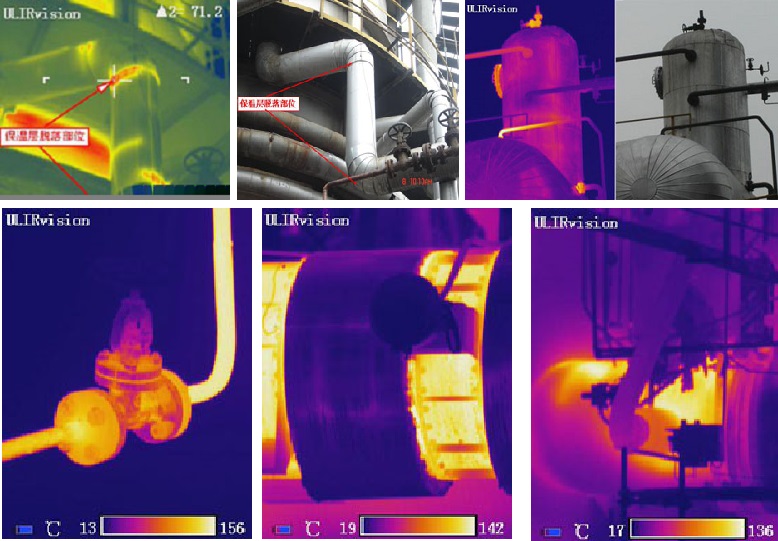
As key transmission facilities in petrochemical production, industrial pipelines are widely used for the transportation of steam, chemical raw materials, finished products and other process media. Most pipelines are equipped with thermal insulation layers to stabilize production processes and reduce energy consumption. During long-term operation, defects such as insulation damage, falling off and medium leakage frequently occur, which are difficult to identify through traditional manual inspection. Adopting infrared thermal imaging technology enables non-contact visualized full-range detection of pipelines, quickly identifying insulation failure and medium leakage without equipment shutdown or disassembly, effectively improving the operation and maintenance efficiency and safety of petrochemical pipe networks.

In the routine inspection of petrochemical industrial pipelines, infrared thermal imagers can accurately identify various typical pipeline faults, with core application scenarios as follows:

1. Pipeline carbon deposition and blockage detection: Internal carbon accumulation will block pipeline passages and cause abnormal local temperature distribution. Infrared thermal imagers can locate blockage points accurately through external thermal imaging, realizing non-destructive fault detection without pipeline drilling or disassembly.

2. Pipeline inner wall wear and corrosion detection: Long-term medium scouring and chemical corrosion will cause wall thinning and material aging on the inner pipeline, resulting in abnormal local heat conduction and heat dissipation. The equipment can capture subtle temperature differences to lock hidden wear and corrosion areas, realizing early prediction of pipeline failure risks.

3. Pipeline crack and medium leakage detection: Pipeline cracks and medium leakage will cause thermal field distortion and form obvious abnormal temperature areas. Infrared imaging technology intuitively presents the thermal field distribution of pipelines, quickly identifying tiny cracks and latent leakage points to avoid safety accidents caused by flammable and explosive medium leakage.

4. Pipeline thermal insulation layer damage detection: For insulation defects such as cracking, falling off, hollowing and aging, infrared thermal imagers can clearly capture heat loss differences in defective areas, accurately determine the scope of insulation failure, and provide reliable data support for pipeline insulation maintenance and energy consumption management.
ImageDescription

Related Products

Image Name Category Manufacturer Parameters Description
  • Non-Contact Type Laser-to-Fiber Coupler - Adapter Interface Fiber Optic Couplers Non-Contact Type Laser-to-Fiber Coupler - Adapter Interface Fiber Optic Couplers Shconnet

    In non-contact laser-to-fiber couplers, there is a certain air gap between the fiber and the coupling lens. This design is very flexible, allowing the use of various types of lenses with various focal lengths. The distance between the fiber and the lens in this coupler can be adjusted to compensate for small changes in laser wavelength. In high-power multimode fiber coupling systems, the distance between the fiber and the lens can be adjusted for defocusing to avoid fiber damage.

  • Non-Contact Type Laser-to-Fiber Coupler - Adapter Interface Fiber Optic Couplers Non-Contact Type Laser-to-Fiber Coupler - Adapter Interface Fiber Optic Couplers Shconnet

    In non-contact laser-to-fiber couplers, there is a certain air gap between the fiber and the coupling lens. This design is very flexible, allowing the use of various types of lenses with various focal lengths. The distance between the fiber and the lens in this coupler can be adjusted to compensate for small changes in laser wavelength. In high-power multimode fiber coupling systems, the distance between the fiber and the lens can be adjusted for defocusing to avoid fiber damage.

  • Non-Contact Type Laser-to-Fiber Coupler - Adapter Interface Fiber Optic Couplers Non-Contact Type Laser-to-Fiber Coupler - Adapter Interface Fiber Optic Couplers Shconnet

    In non-contact laser-to-fiber couplers, there is a certain air gap between the fiber and the coupling lens. This design is very flexible, allowing the use of various types of lenses with various focal lengths. The distance between the fiber and the lens in this coupler can be adjusted to compensate for small changes in laser wavelength. In high-power multimode fiber coupling systems, the distance between the fiber and the lens can be adjusted for defocusing to avoid fiber damage.

  • Non-Contact Type Laser-to-Fiber Coupler - Adapter Interface Fiber Optic Couplers Non-Contact Type Laser-to-Fiber Coupler - Adapter Interface Fiber Optic Couplers Shconnet

    In non-contact laser-to-fiber couplers, there is a certain air gap between the fiber and the coupling lens. This design is very flexible, allowing the use of various types of lenses with various focal lengths. The distance between the fiber and the lens in this coupler can be adjusted to compensate for small changes in laser wavelength. In high-power multimode fiber coupling systems, the distance between the fiber and the lens can be adjusted for defocusing to avoid fiber damage.

  • Non-Contact Type Laser-to-Fiber Coupler - Adapter Interface Fiber Optic Couplers Non-Contact Type Laser-to-Fiber Coupler - Adapter Interface Fiber Optic Couplers Shconnet

    In non-contact laser-to-fiber couplers, there is a certain air gap between the fiber and the coupling lens. This design is very flexible, allowing the use of various types of lenses with various focal lengths. The distance between the fiber and the lens in this coupler can be adjusted to compensate for small changes in laser wavelength. In high-power multimode fiber coupling systems, the distance between the fiber and the lens can be adjusted for defocusing to avoid fiber damage.

Contact Us

Loading...

A global database of 100,000 photonics products helps match you with the right product.

  • Expert Selection
  • Verified Suppliers
  • Quality Assured
AI Parametric Selection
Smart Match · Precise Recs
Enter Specifications
AI Smart Matching
Get Best Matches
Skip Manual Comparison
Find Best Solutions Fast
Select Now →