
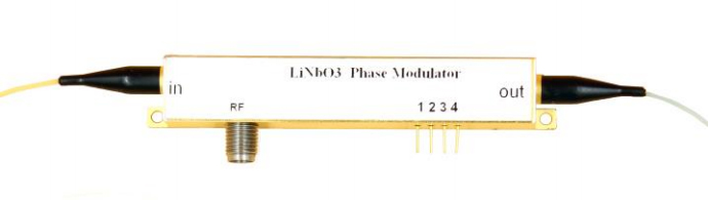
Lithium Niobate Electro-Optic Modulator SCQ-PM-1064-6G
Lithium niobate modulators combine the electro-optic effect of lithium niobate crystals with optoelectronic integration processes. Their high response speed, low insertion loss and low half-wave voltage make them widely used in fiber-optic communications, microwave photonics and fiber-optic sensing. Lithium niobate is a negative uniaxial crystal (no>ne) in the trigonal system with 3m point-group symmetry. This structure gives it favorable pyroelectric, piezoelectric, elasto-optic and electro-optic effects. The electro-optic effect is a pronounced change in material refractive index under a DC or low-frequency electric field: the applied field changes the optical properties of the medium. In some materials the refractive-index change is linear with field strength, known as the linear electro-optic or Pockels effect. It can be understood as second-order nonlinear polarization produced by mixing the incident optical field and DC field. Because it is described by second-order nonlinear susceptibility, it occurs only in crystals without spatial inversion symmetry. In centrosymmetric materials such as liquids or glass, the refractive-index change is proportional to the square of the applied field, known as the quadratic electro-optic or Kerr effect. Like the linear effect, it can be described by nonlinear polarization, in this case of third order. Higher-order electro-optic effects also exist, but are generally much weaker than the first-order effect, so only the linear electro-optic effect needs to be considered in lithium niobate. Our advanced proton-exchange process produces lithium niobate electro-optic modulators with low insertion loss, high modulation bandwidth and low half-wave voltage, mainly for free-space optical communications, cesium atomic time references, pulse generators and quantum optics. Two main types are available: electro-optic intensity modulators and electro-optic phase modulators. Main wavelengths are 780nm, 850nm, 1064nm, 1310nm, 1550nm and 2000nm, with other wavelengths customizable on request.
 Save to Favorites
Overview
Datasheet
Please provide your email to download the datasheet.
Invalid email format. Please try again.
Supplier Information
Related Products
-
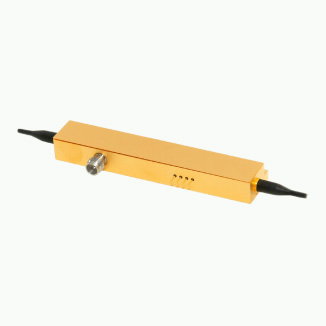 Lithium Niobate Intensity Modulator
EOM
Sdjiliang
Operating wavelength: 1550±10 nm Insertion loss: ≤5 dB Maximum Optical Input Power [APE]: 100(APE)
The lithium niobate (LiNbO3) electro-optic intensity modulator uses a waveguide fabricated by titanium diffusion or proton exchange. It offers low insertion loss, high modulation bandwidth, low half-wave voltage and high damage-threshold power. Applications include space optical communications, pulse generators and quantum optics.
-
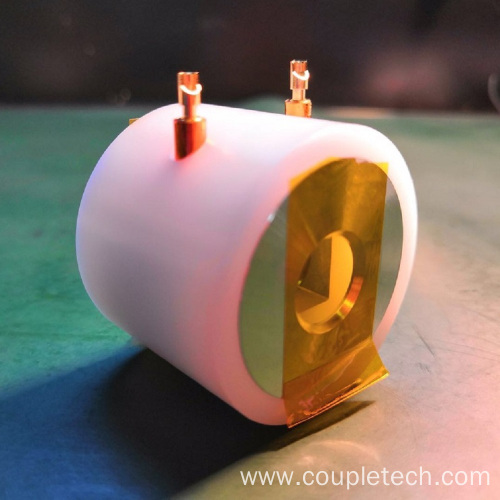 BBO Pockels Cell With Large Aperture CPBPC-12
EOM
Coupletech
Damage Threshold [10ns 10Hz 1064nm]: 600MW/cm2 10ns 10Hz 1064nm Transmission, [@ 1064nm]: >99% @ 1064nm Crystal Size (W X H X L): 12 mm × 12 mm × 20 mm
BBO crystals for nonlinear optics` transparency in the range ~190–3300nm. It has good mechanical properties and is a suitable material for high-power ultraviolet Polarization Optics. If only the Pockels Cell in alignment is being replaced in a Q-switched laser system. Coupletech pockels cell has different kinds of sizes to meet different customers. BBO-based pockels cell are usually used to change the polarization state of light passing through it when a voltage is applied to the electrodes of electro-optic crystals. Coupletech has a comprehensive range of BBO pockels cell for applications in wavelengths from the UV to the IR, including q-switching of the laser cavity, laser cavity dumping and coupling light into and from regenerative amplifiers, and so on. Coupletech can provide large aperture pockels cell such as model No. CPBPC-12. Coupletech is uniquely positioned to design and assemble into housings BBO Crystals in the sizes required for such a sizeable beam diameter, e.g. 12mm or larger.
-
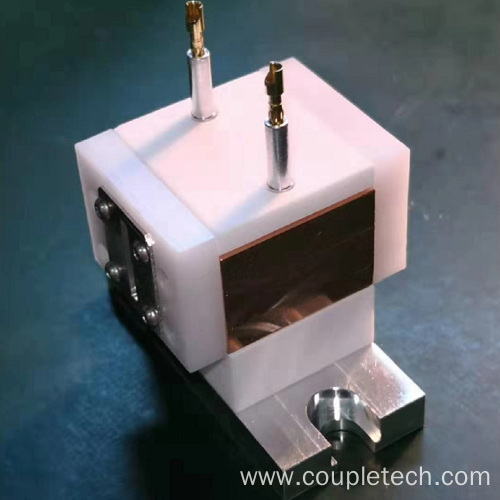 BBO Pockels Cell With Speical Aperture CPBPC-0315L
EOM
Coupletech
Extinction Ratio [beam Diameter 2mm]: >1000:1 Wavefront Distortion [@ 632.8nm]: λ/8 @ 632.8nm Damage Threshold [10ns 10Hz 1064nm]: 300MW/cm2 10ns 10Hz 1064nm
BBO nonlinear crystal`s transparency in the range is from 190 to 3300nm. It has good mechanical properties and is a suitable material for high-power ultraviolet Polarization Optics. BBO Pockels Cell shutter using fast switching of polarization to block and transmit light. Coupletech can provide different sizes of BBO pockels cell to meet different customers. BBO-based pockels cell are usually used to change the polarization state of light passing through it when a voltage is applied to the electrodes of electro-optic crystals. Coupletech has a comprehensive range of BBO pockels cell for applications in wavelengths from the UV to the IR, including q-switching of the laser cavity, laser cavity dumping and coupling light into and from regenerative amplifiers, and so on. Coupletech can provide large aperture pockels cell such as model No. CPBPC-3-15L. For systems where a long and narrow aperture is required but the most special Pockels cell must be used, the convenience of our new CPBPC-0315L is unbeatable. Coupletech is uniquely positioned to design, fabricate, finish, and assemble into housings BBO Crystals in the sizes required for such a speical beam diameter. Applications: High repetition rate DPSS Q-switch Cavity dumping Beam chopper Regenerative amplifiers
-
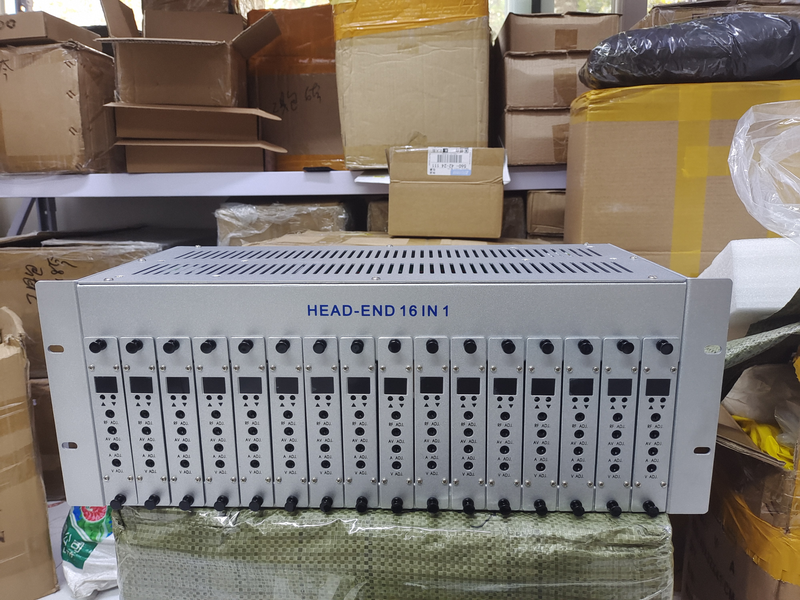 YT-M916 Specification
EOM
Ytdq
Video options-Input level: 0.7~1.4 Radio frequency options-Carrier frequency accuracy: ≤5 kHz Video options-input resistance: 75 Ω
-
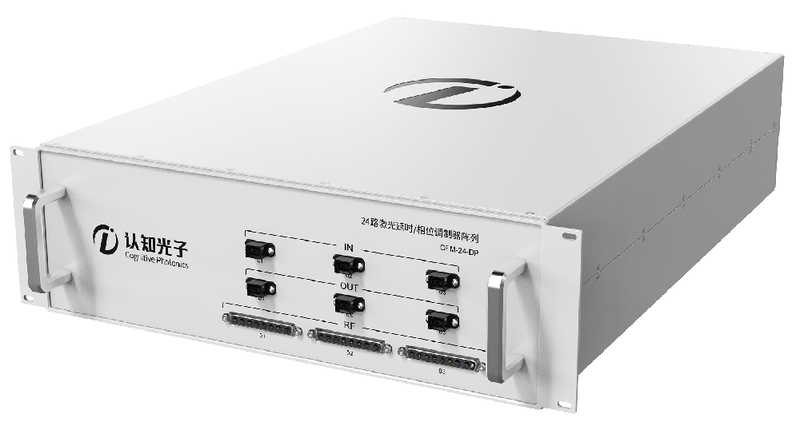 24-Channel Laser Delay/Phase Modulator Array OFM-24-DP
EOM
Cplaser
Optical Characteristics-Laser Wavelength: 1064±2 Optical Characteristics-Insertion Loss: ≤6 dB Optical Characteristics-Polarization Extinction Ratio: >18 (Fast-Axis Cutoff)
Related Articles
Developed by RealLight (Beijing), the R7M high‑power diode laser module belongs to the AW multi‑functional laser product family.
Against the evolving demands for military‑grade hardware, rail transit equipment and heavy‑duty machinery that run under high‑shock vibrating conditions, anti‑loose connectors serve as indispensable hardware for stable power delivery and high‑speed signal transmission.
Raybowlaser, a professional manufacturer of high-power laser chips, has officially launched its upgraded new-generation 1470nm high-performance laser chip. Achieving groundbreaking progress in rated output power and wall-plug efficiency (WPE), this innovative laser chip delivers superior and reliable core light source solutions for medical cosmetology, industrial processing, agricultural applications and scientific research equipment.
For pulsed laser and full-spectrum optical testing, photodiodes and thermopiles have inherent drawbacks. Photodiodes show weak response in infrared band, while thermopiles feature slow response and cannot capture nanosecond narrow pulses.
Loading...
Name
Phone
Organization
Use Case

Database Platform