

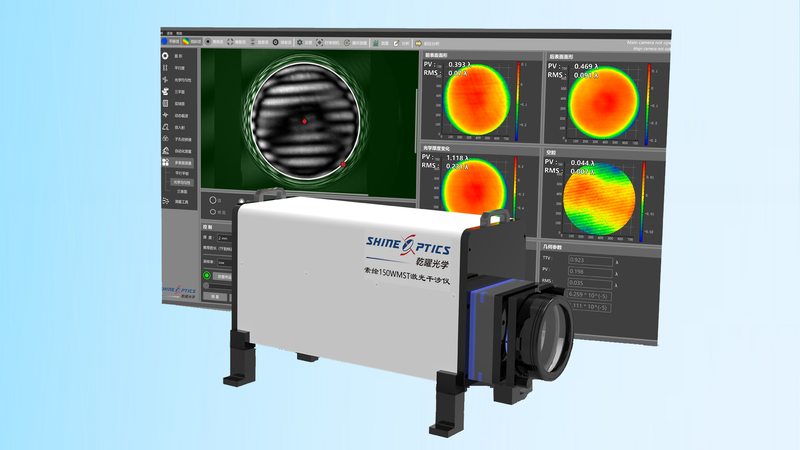
“Suhui” MST Laser Interferometers 素绘MST HD150
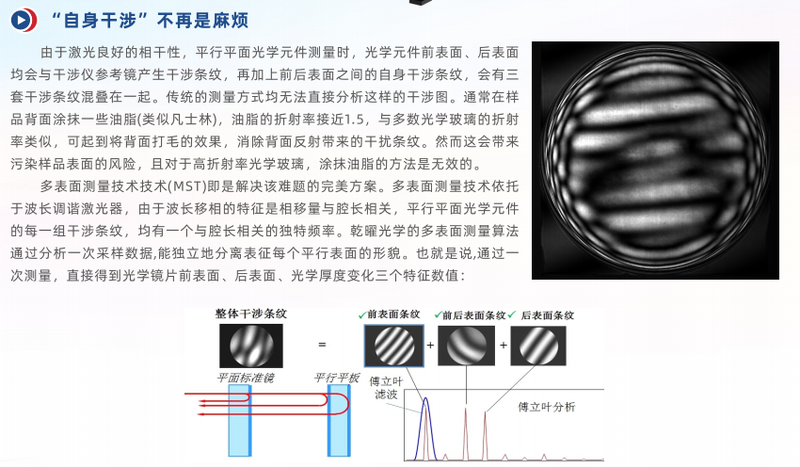
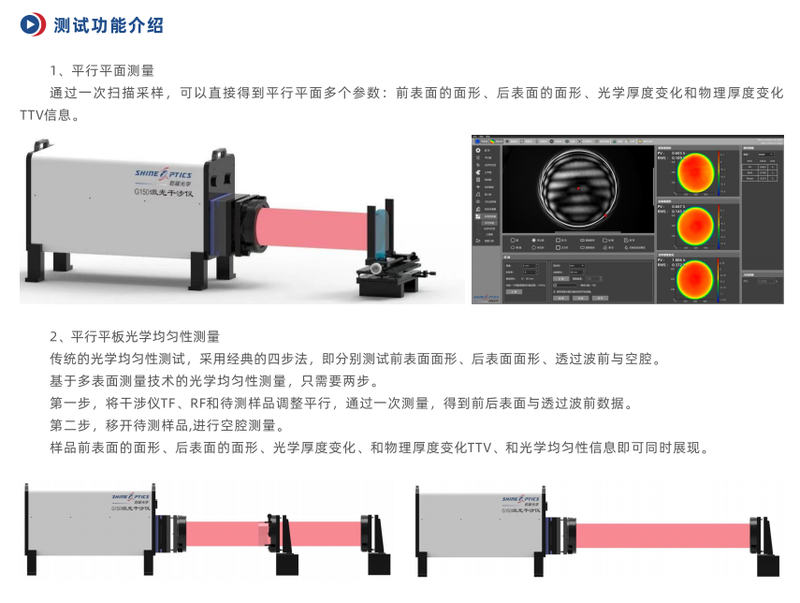
Because lasers are highly coherent, both front and rear surfaces of a parallel optical plate form interference fringes with the interferometer reference, while self-interference between the two surfaces produces another fringe set. The three sets overlap and conventional methods cannot directly analyze the interferogram. Applying grease such as petroleum jelly to the rear surface is common: its refractive index near 1.5 resembles most optical glass, effectively roughening the back surface and suppressing rear-reflection fringes. This risks surface contamination and does not work for high-index glass. Multiple-surface measurement technology (MST) solves this problem using a wavelength-tunable laser. In wavelength phase shifting, phase shift depends on cavity length, so each fringe set has a distinct cavity-length-dependent frequency. The Shineoptics multiple-surface algorithm analyzes one sampled dataset to separate the topography of each parallel surface independently. A single measurement therefore directly yields front-surface figure, rear-surface figure and optical-thickness variation.
 Save to Favorites
Overview
Specifications
| Parameter | Value |
|---|---|
| Measurement Method | Fizeau Interferometry Principle |
| Effective Clear Aperture | 152.4mm(6 inches ) |
| Light Source [Optional switching between point and ring light sources] | Wavelength-tunable laser, center wavelength 632.8nm, coherence length >50m; optional switching between point and ring light sources |
| Camera | Effective imaging resolution 2.4Kx2.4K, frame rate 220fps |
| System Transfer Function ITF [@3.6cycles/mm] | >0.7 @3.6cycles/mm |
| Measurement Mode | Sirius vibration-resistant wavelength phase shifting FT-PSI and multiple-surface separation technology MST |
| RMS Simple Repeatability [2σ] | <λ/10000 |
| RMS Wavefront Repeatability [mean+2σ] | <0.35nm |
| Continuous Zoom Ratio [Fixed Magnification] | 1X Fixed Magnification |
| Phase-Shifting Method | Wavelength phase shifting and MST |
| Alignment Method [AFAS Optional ; Alignment Angle ±2°] | DAS fast digital alignment system, alignment angle ±2°; optional AFAS automatic fringe alignment system enables automatic image location and measurement |
| Pupil Focus Adjustment Range | ±5.5m |
| Optical Center Height [Optional] | 108mm and 220mm Optional |
| Transmission Reference Material | Fused silica; homogeneity better than 5ppm; stress better than 5nm/cm |
| Reflection Reference Material | Glass-Ceramic |
| Small-Aperture Reference Flat PVr [Optional] | PVr: better than λ/20 and λ/40 Optional |
| Small-Aperture Reference Sphere PVr [Optional] | PVr: better than λ/20 and λ/40 Optional |
| Power Supply | 100-240VAC,50/60Hz |
| Dimensions [Length, width, and height] | 844 mm × 386 mm × 488 mm |
| Weight | 50KG |
| Operating Ambient Temperature | 15℃-30℃ |
| Rate of Temperature Change | <0.3℃/h |
| Relative humidity | No Greater Than 70% |
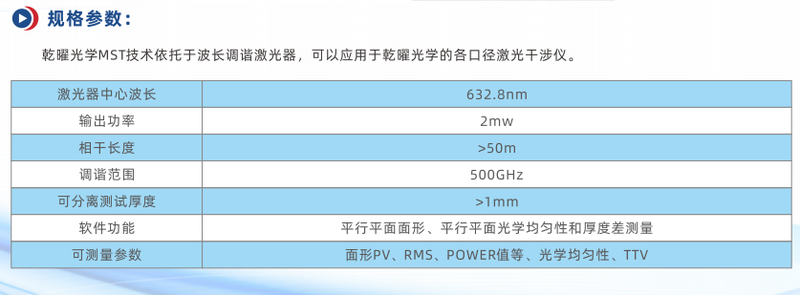
| Output Power | 2mw |
| Tuning Range | 200GHz |
| Separable Test Thickness | >1mm |
| Software Functions | Measurement of parallel-plane surface figure, parallel-plane optical homogeneity, and thickness difference |
| Measurable Parameters | Surface figure PV, RMS, POWER values, etc.; optical homogeneity; TTV |
Key Features
Datasheet
Supplier Information
Related Products
-
G5U-PH Laser Interferometer Interferometers Shineoptics
Test Aperture: Φ5mm Auxiliary Alignment Aperture: Φ30mm Reference Lens Surface Figure Accuracy: λ/20
As phone technology develops, camera holes in 3D and full-screen displays approach curved edges, producing transmitted-wavefront PV values much larger than those of 2D and 2.5D screens. Near these edges, dense interference fringes exceed the resolution of the preceding G10U-PH interferometer and mainstream G10-equivalent products, preventing accurate measurement. The G5U-PH laser interferometer is customized for 3D and full-screen camera-hole inspection, accurately measuring dense fringes and very large aberrations(PV). An imported He-Ne laser and standard air-float vibration-isolation platform provide stable, reliable testing on demanding production floors.
-
Shearing Interferometer Interferometers Shineoptics
This shearing-interferometry instrument provides simple, intuitive assessment of laser-beam parallelism as a reference for laser alignment or laboratory optical-path adjustment. Beam collimation is calculated from fringe rotation relative to a horizontal baseline, while fringe shape reveals the original wavefront's aberration distribution. It is both a beam-collimation tester and a qualitative wavefront analyzer. Principle:a high-quality optical flat of finite thickness and slight wedge angle divides a spatially coherent wavefront into two identical, mutually displaced wavefronts. Coherence produces interference in their overlap (Figure1). Figure1:schematic of shearing interference. The wedge direction is perpendicular to the shear. A perfectly parallel beam produces fringes parallel to the shear; convergence or divergence rotates them (Figure2). Figure2:shearing interferograms for different beam states. Wavefront aberrations bend the fringes in characteristic ways, allowing qualitative identification of aberration type and magnitude. Measurement method: 1. Collimation assessment:observe fringe tilt on the receiving screen as in Figure2. Fringes parallel to the baseline indicate collimation; upward tilt indicates divergence and downward tilt convergence. For a nonparallel beam, the rotation angle gives divergence. Figure3 shows the calculation method. Figure3:beam-divergence calculation. The source introduces formulas for curvature radius and divergence without displaying them in this text. Incident diameter d and wavelength are known; shear is available from catalog specifications. Fringe spacing depends on wavelength and wedge angle and can be read from the catalog or measured. Fringe rotation is measured using an optional graduated receiver. Substitution into equations(1) and(2) yields wavefront curvature radius and divergence. 2. Aberration assessment:compare with the referenced interferograms. Figure4:spherical aberration at different defocus positions, (a)inside focus, (b)at focus, (c)and(d)outside focus. Figure5:coma, (a)without defocus, (b)with slight defocus. Figure6:astigmatism, (a)sagittal shear, (b)tangential shear.
-
Wavelength Phase-Shifting Laser Interferometer for Multisurface Measurement Interferometers Shineoptics
Laser Center Wavelength: 633nm Output Power: 2mw Coherence length: >50m
Because lasers have good coherence, measuring a plane-parallel optical element produces interference fringes between its front surface and the interferometer reference, between its rear surface and the reference, and between the front and rear surfaces themselves. These three fringe sets overlap, and conventional methods cannot directly analyze such an interferogram. A common approach is to coat the sample's rear surface with grease such as petroleum jelly. With a refractive index close to1.5, similar to most optical glasses, the grease acts like a roughened rear surface and removes unwanted rear-surface interference. However, it risks contaminating the sample and is ineffective for high-index optical glass. Multi-surface measurement technology (MST) provides a solution. It uses a wavelength-tunable laser: wavelength-induced phase shifts depend on cavity length, giving each fringe set from a plane-parallel optical element a unique cavity-length-related frequency. By analyzing a single acquired dataset, Shineoptics' multi-surface measurement algorithm independently separates the profiles of the parallel surfaces. A single measurement therefore directly yields three characteristics: front-surface figure, rear-surface figure, and optical-thickness variation.
-
Guyu 300 Spherical Stitching Laser Interferometer Interferometers Shineoptics
Interferometer Aperture: 152mm Maximum Test Aperture: 300mm Light Source: Frequency-Stabilized Helium-Neon Laser
The name Guyu refers to rain nourishing the hundred grains: plentiful, timely rainfall allows grain crops to thrive. Amid unprecedented changes of the past century, Shineoptics named the new product Guyu to express its wish that the company's pioneering spirit and innovation would help Chinese optics overcome foreign product sales bans and achieve independence, and that the Guyu series would become a vital source of the company's continuing progress. The Guyu 300 spherical stitching laser interferometer, released by Shineoptics in 2022, is the first product in the Guyu series. The Guyu 300 uses an integrated air-float vibration-isolation structure. Computer software automatically plans the stitching scheme, and a computer-controlled 5-axis mechanism locates images and automatically performs stitching measurements. Dedicated Sirius stitching-interferometer software then processes the data for high-precision surface-figure error measurement. For applications including lithographic objectives and ultraviolet microscope objectives, the Guyu 300 helps customers measure full-size surface-figure errors of 300mm-aperture convex lenses, hemispherical lenses, and spherical lenses.
-
WLI Interferometers DCGD
Related Articles
Driven by the continuous pursuit of higher precision and efficiency in optical communication and optoelectronic device manufacturing, OLCR-1000 Low-Coherence Interferometer, independently developed by Wuhan Guanggu Interconnect Technology Co., Ltd., provides an innovative technical solution for distributed return loss testing of optical fibers and optoelectronic devices.
icrolight is a high-tech enterprise specializing in the R&D, manufacturing and sales of active and passive photonic devices for microwave photonics, LiDAR ranging, gas sensing, fiber optics and photomedicine.
BEIJING JIEPU TREND supplies YAG+Er:YAG+YAG bonded composite slab laser crystals for high‑power solid‑state laser systems. The monolithic slab consists of two undoped YAG end‑cap layers and a central Er‑doped YAG gain segment. The overall dimension is 9 mm×9 mm×9 mm.
Shanghai Connet Laser Technology Co., Ltd. focuses on technological innovation, delivering cutting-edge photonic products & solutions for industrial lasers, LiDAR, fiber optic sensing, coherent telecom, cold atom physics and precision spectroscopy research & mass manufacturing.
Loading...
Name
Phone
Organization
Use Case

Database Platform