
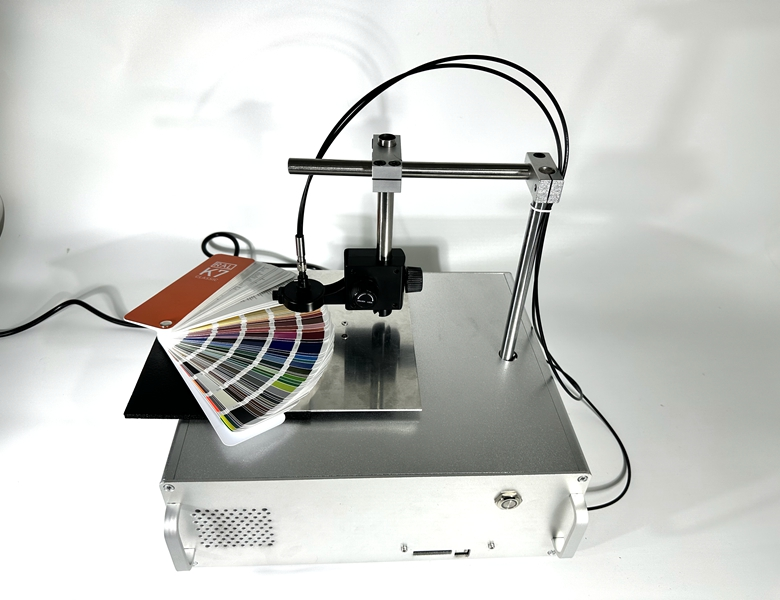
Fully Automatic Two-Dimensional Spectrophotometric Colorimeter (2048 Pixels)
High-precision spectrocolorimeter, 2048 pixels. Conventional instruments have only 24 or 256 pixels; 2048 pixels improve color reproduction. Measurements: 380-780nm spectra at 1nm intervals versus conventional 10nm, repeatability 99%, CIE1931, XYZ, sGRB, LCH, HSV, Yxy, CYMK, xyz and color-rendering index. Colorimetry has 2 types: emissive objects, such as displays/lamps, are measured directly with a spectrometer; nonemissive objects depend on the illuminating source. Pink market lamps make pork look fresh, while sunlight at home changes its appearance. Colors of fabric, cards, paints and coatings therefore require a defined source, typically white 6500K D65 daylight or yellow illuminant A from a halogen bulb. An incorrect source gives inaccurate color. Color printing, physical specimens and automatic colorimeter results are shown. The following figure shows human responses to the three primaries at different wavelengths, representing color sensitivity. 1) 1924 luminous-efficiency function V(λ): λ means wavelength. Before foundational colorimetry, CIE published V(λ) for daylight spectral sensitivity. Two beams at 550nm and 400nm may have equal radiometric intensity but different apparent brightness. If green and blue look equally bright, the blue is brighter. The 1924 function was later found inadequate at the blue spectral end. 2) 1931 RGB color matching: CIE 1931 includes three RGB matching functions. Imagine red, green and blue lamps at precisely known single wavelengths aimed at one wall spot: can their powers be adjusted to match 540nm? The functions answer this, giving the amount of each fixed primary needed in the mixture. Their primary wavelengths are 700nm, 546.1nm and 435.8nm, with r(λ), g(λ), b(λ) plotted below. R, G and B are tristimulus values, the test-light brightnesses needed for a match. A diagram is given instead of the colorimetric equations. Because blue is negative, it cannot physically be used; therefore these primaries cannot exactly match 610nm, though positive red and green can approximate it. Negative values are discussed next. Lowercase rgb gives proportions: matching 400nm requires more blue than red or green. Uppercase RGB gives absolute amounts: almost no primary light is needed to match 400nm. Plotting each rgb value in 3D produces the spectral locus, a curve of chromaticity for each spectral wavelength. 3) CIE XYZ: Congratulations if you are still following; this is the final stage. The 1931 XYZ functions are linear transforms of 1931 RGB, giving convenient mathematical properties. RGB CMFs are rarely used directly in practical modern colorimetry; modern spaces are defined from XYZ. XYZ/RGB are different transforms of the same data: operations and colors can transfer between them. A key idea transforms one function to closely match the 1924 V(λ), so a color's luminance follows from one primary value. Before computers, manual CMF calculations were difficult, motivating functions without negative values. The difficulty is that an all-positive transform requires imaginary primaries unrelated to real colors. In the preceding rg diagram, enclosing every real color in a triangle requires primary coordinates outside real colors. XYZ does this by choosing new X, Y and Z primaries, so Y maps to V and all values are positive. Consider the preceding rg chromaticity space:
 Save to Favorites
Overview
Datasheet
Please provide your email to download the datasheet.
Invalid email format. Please try again.
Supplier Information
Related Products
-
Fourier Spectrometer Fiber SMA-IRF-01 Spectrometers Fiberock
Optical fiber material: Infrared silica fiber Connector Type: SMA905/FC/custom Fiber core count: Single-core
Fourier-transform infrared (FTIR) spectrometers acquire material IR spectra using a transform from time/space to frequency domains, generally with high sensitivity and rapid acquisition. FTIR fibers deliver IR to samples difficult to access directly or return sample light to detectors. They allow flexible sampling of different regions or confined locations where the whole instrument cannot fit. Applications include chemistry, materials, biomedicine, and environmental monitoring. Fiber-linked instruments provide in-situ spectra under original sample conditions, valuable for live chemical-reaction/tissue studies. Selection: 1. Fiber type matches application/wavelength. 2. NA controls collection; higher NA gathers more signal but possibly more source background. 3. Diameter balances intensity/sensitivity and spatial resolution: larger gathers more but resolves less; smaller does the reverse. 4. Length balances loss and layout flexibility. 5. Bend resistance maintains stable transmission under bending/torsion. 6. Coatings/jackets match temperature, humidity, mechanical conditions, corrosion, and heat. 7. Connectors match instrument/probe interfaces for stable coupling. Balanced selection improves accuracy, sensitivity, and reliability.
-
Ocean FX Spectrometer OCEAN-FX-UV-VIS Spectrometers Goldway
Spectral Range: 200 - 850nm Grating: 1 Resolution: 1.638
The new FX series uses a CMOS detector to acquire 4500 spectra per second. Its communication module integrates Ethernet and WiFi. The new spectrometer offers greater sensitivity in the UV-VIS range, with faster analysis for improved performance in food classification, sorting and processing, biosciences and other industries.
-
Ocean FX Spectrometer OCEAN-FX-UV-VIS-ES Spectrometers Goldway
Spectral Range: 200 - 850nm Grating: 1 Resolution: 1.638
The new FX series uses a CMOS detector to acquire 4500 spectra per second. Its communication module integrates Ethernet and WiFi. The new spectrometer offers greater sensitivity in the UV-VIS range, with faster analysis for improved performance in food classification, sorting and processing, biosciences and other industries.
-
Ocean FX Spectrometer OCEAN-FX-VIS-NIR Spectrometers Goldway
Spectral Range: 350 - 1000nm Grating: 3 Resolution: 1.638
The new FX series uses a CMOS detector to acquire 4500 spectra per second. Its communication module integrates Ethernet and WiFi. The new spectrometer offers greater sensitivity in the UV-VIS range, with faster analysis for improved performance in food classification, sorting and processing, biosciences and other industries.
-
Ocean FX Spectrometer OCEAN-FX-VIS-NIR-ES Spectrometers Goldway
Spectral Range: 350 - 1000nm Grating: 3 Resolution: 1.638
The new FX series uses a CMOS detector to acquire 4500 spectra per second. Its communication module integrates Ethernet and WiFi. The new spectrometer offers greater sensitivity in the UV-VIS range, with faster analysis for improved performance in food classification, sorting and processing, biosciences and other industries.
Related Articles
For semiconductor, coating and laboratory vacuum chambers, thermal conductivity gauges suffer large measurement errors caused by gas type and ambient temperature.
Founded in Beijing in 2011, Beijing FJR Opto-electronic Technology Co., Ltd. specializes in R&D, manufacturing and sales of infrared thermal imaging equipment and complete optoelectronic systems.
A microlens array (MLA) is a high-precision optical component composed of hundreds or thousands of tiny, uniformly arranged micro lenses on a single flat substrate. Unlike traditional single lenses that focus one light beam, a microlens array can split, homogenize, and reshape light on a micro scale. It is widely paired with VCSELs, lasers, and image sensors, becoming a core part of modern miniature optical systems.
A laser bar is an array semiconductor laser chip integrated with dozens of emitters, which realizes hundred-watt quasi-continuous output on a single chip. With regular emitter arrangement and controllable fill factor, integrated thermal design and superior wall-plug efficiency compared to single chips, it acts as the core light source for high-power pumping, medical lasers and precision processing.
Loading...
Name
Phone
Organization
Use Case

Database Platform