
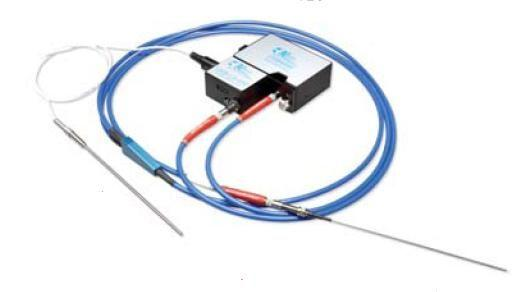
USB4000-FL Series oxygen sensing spectrometer
The USB4000-FL is our next-generation miniature spectrometer platform developed for fluorescence spectrometers! It provides enhanced electronic characteristics for fluorescence measurements, higher optical resolution, and a 10-microsecond integration time. When retrofitted with the L4 detection focusing lens, it increases absorbance and reduces stray light. The high-sensitivity USB4000-FL has a wavelength range of 360–1000 nm and an optical resolution of 10.0 nm (FWHM). The minimum integration time of the USB4000-FL can be set to 10 µs via software to handle short fluorescence periods. The USB4000-FL's programmable processor allows you to change operating parameters in software—control the spectrometer and external excitation sources, and even acquire data from external targets. The USB4000-FL, USB4000-FL-450, and USB-FL-395 are high-sensitivity preconfigured fluorescence spectrometers designed for fluorescence sensing applications. Each fluorescence unit is set in the 360-1000 nm wavelength range, with a 200 µm entrance slit and an L4 detector condenser for enhanced light collection efficiency. USB4000-FL: does not include an excitation source. The USB4000-FL does not contain an excitation light source, allowing flexible selection from a variety of small, low-cost, modular excitation sources, such as Ocean Optics' LED light sources. The excitation source generates pulsed or continuous signals, which are conveniently transmitted to the spectrometer, optical fibers, and sampling accessories. USB4000-FL-450 & USB4000-FL-395: come with an excitation source. The USB4000-FL-450 & USB4000-FL-395 spectrometers have the same configuration as the USB4000-FL, but they additionally include a light source. The USB4000-FL-450 uses a 470 nm LED light source, and the USB4000-FL-395 uses a 395 nm LED light source. When you are equipping the fluorescence spectrometer with a probe, we recommend that the USB4000-FL-450 can use FOXY and HIOXY probes, and the USB4000-FL-395 can use the FOSPOR probe. The spectrometer can power the LED, enabling synchronization and I2C communication functions. Moreover, the light source is also connected to a temperature sensor, with onboard memory that can store temperature and oxygen content calibration coefficients.
 Save to Favorites
Overview
Specifications
| Parameter | Value |
|---|---|
| Dimensions | 89.1 mm × 63.3 mm × 34.4 mm |
| Weight | 190 g |
| Detector | Toshiba TCD1304AP Linear CCD Array |
| Design | f/4, asymmetrical crossed Czerny-Turner optical path |
| Entrance aperture [Slit] | 200 µm slit |
| Grating | #3 grating, 600 line density, 360-1100nm bandwidth, blaze wavelength 500 nm |
| Fiber connector [0.22 numerical aperture fiber] | SMA905 with 0.22 numerical aperture fiber |
| Input focal length | 42 mm |
| Output focal length | 68 mm |
| Wavelength Range | 360~1100 nm |
| Optical resolution (FWHM) | ~10.0 nm FWHM |
| Signal-to-noise ratio [Full Signal] | 300:1 (full signal) |
| A/D | 16-bit |
| Dark noise [RMS] | 50RMS counts |
| Corrected linearity | >99.8 % |
| Stray light [600nm] | <0.05 % at 600 nm |
| Stray light [435 nm] | 0.10 % at 435 nm |
| Power Consumption [5 VDC] | 250 mA @ 5 VDC |
| Data transfer speed [Full scan to memory; USB2.0] | 5 ms |
| Data transfer speed [Full scan to memory; USB1.1] | 18 ms |
| Data transfer speed [Full scan to memory; serial port] | 300 ms |
| Input/Output | 8 digital, programmable general-purpose input/output ports |
| Operating System | USB port: Windows 98/Me/2000/XP, Mac OS X and Linux Serial port: any 32-bit Windows operating system |
| Computer interface [480 Mbps (USB1.1 compatible); RS-232 (2-wire) @ 115.2 K baud] | USB 2.0 @ 480 Mbps (USB1.1 compatible); RS-232 (2-wire) @ 115.2 K baud |
| Peripheral interface | SPI (3-wire); I2C inter-integrated circuit |
| Detection Range | 360-1000nm |
| Pixel | 3648 pixels |
| Pixel size | 8 μm × 200 μm |
| Pixel well depth | 100,000 electrons |
| Sensitivity [400 nm] | 130 photons/count |
| Sensitivity [600 nm] | 60 photons/count |
| Grating Selection | Grating #3 - groove density of 600 lines per mm, wavelength range 360-1000nm, peak wavelength 500 nm |
| HC-1 grating selection | Not selectable |
| Detector focusing mirror selection | Optional, L4 |
| OFLV filter option | OFLV-200-850; OFLV-350-1000 |
| Order-sorting filter option | Longpass OF-1 filter |
| Collimating mirror Focusing mirror | Standard or SAG+UPG |
| UV-enhanced window | Optional, UV4 |
| Wavelength range [Depending on grating selection] | Based on grating selection 360-1000 nm |
| Integration time | 10 microseconds to 65 minutes |
| Dynamic range [System] | 2 x 10⁸ (system) |
| Dynamic range [Single detection] | 1300:1 single detection |
| Analog channel | None |
| Power supply rise time | <5 s |
| Automatic zeroing | Yes |
| Trigger modes | 5 modes |
| Filtering function | Yes |
| Connector | 22-pin connector |
| Optical resolution (FWHM) | 10.0 nm FWHM |
| Data transfer speed [Full scan to memory; USB2.0] | 4 ms |
| Operating System | USB port: Windows 98/Me/2000/XP, Mac OS X and Linux; any 32-bit Windows operating system with a serial port |
| Computer interface [480 Mbps (USB1.1 compatible); RS-232 (2-wire) @ 115.2 Kb] | USB 2.0 @ 480 Mbps (USB1.1 compatible); RS-232 (2-wire) @ 115.2 Kb |
| Peripheral interface | SPI (3-wire); I 2 C inter-integrated circuit |
Key Features
Datasheet
Please provide your email to download the datasheet.
Invalid email format. Please try again.
Supplier Information
Related Products
-
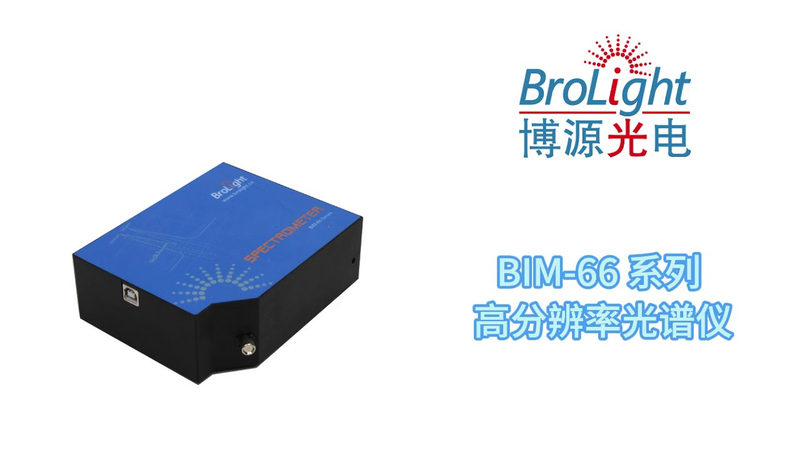 BIM-6602A series high-resolution spectrometers UV-NIR BIM-6602A-15
Spectrometers
Brolight
Fiber Connectors [BIM-6602A: Parameter Specifications]: SMA905 Detector [BIM-6602A: Parameter Specifications]: Hamamatsu S11639, Line-Array CMOS Detector Pixel [BIM-6602A: Parameter Specifications]: 2048 Pixels, Each Pixel 14μm×200μm
The BIM-6602A series spectrometer uses a high-resolution optomechanical structure in a compact, portable design, with resolution as fine as 0.08 nm. Interchangeable gratings adjust optical resolution and spectral range. Upgraded circuitry provides a 10000:1 dynamic range, minimum integration time of 0.5 milliseconds, and 600:1 signal-to-noise ratio for weak-signal detection. RS232 communication and improved interference resistance make it ideal for industrial and scientific applications.
-
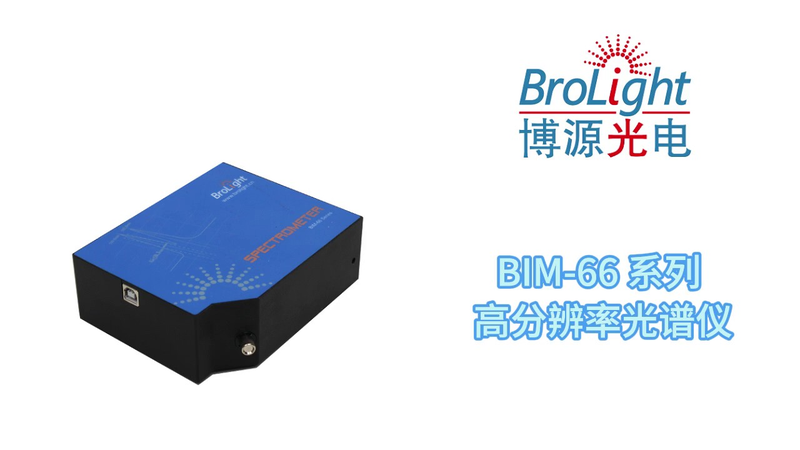 BIM-6602A series high-resolution spectrometers UV-NIR BIM-6602A-16
Spectrometers
Brolight
Fiber Connectors [BIM-6602A: Parameter Specifications]: SMA905 Detector [BIM-6602A: Parameter Specifications]: Hamamatsu S11639, Line-Array CMOS Detector Pixel [BIM-6602A: Parameter Specifications]: 2048 Pixels, Each Pixel 14μm×200μm
The BIM-6602A series spectrometer uses a high-resolution optomechanical structure in a compact, portable design, with resolution as fine as 0.08 nm. Interchangeable gratings adjust optical resolution and spectral range. Upgraded circuitry provides a 10000:1 dynamic range, minimum integration time of 0.5 milliseconds, and 600:1 signal-to-noise ratio for weak-signal detection. RS232 communication and improved interference resistance make it ideal for industrial and scientific applications.
-
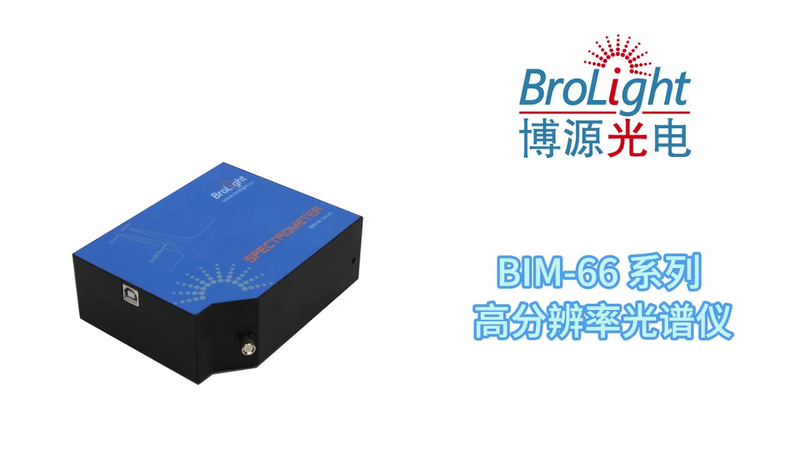 BIM-6602A series high-resolution spectrometers UV-NIR BIM-6602A-17
Spectrometers
Brolight
Fiber Connectors [BIM-6602A: Parameter Specifications]: SMA905 Detector [BIM-6602A: Parameter Specifications]: Hamamatsu S11639, Line-Array CMOS Detector Pixel [BIM-6602A: Parameter Specifications]: 2048 Pixels, Each Pixel 14μm×200μm
The BIM-6602A series spectrometer uses a high-resolution optomechanical structure in a compact, portable design, with resolution as fine as 0.08 nm. Interchangeable gratings adjust optical resolution and spectral range. Upgraded circuitry provides a 10000:1 dynamic range, minimum integration time of 0.5 milliseconds, and 600:1 signal-to-noise ratio for weak-signal detection. RS232 communication and improved interference resistance make it ideal for industrial and scientific applications.
-
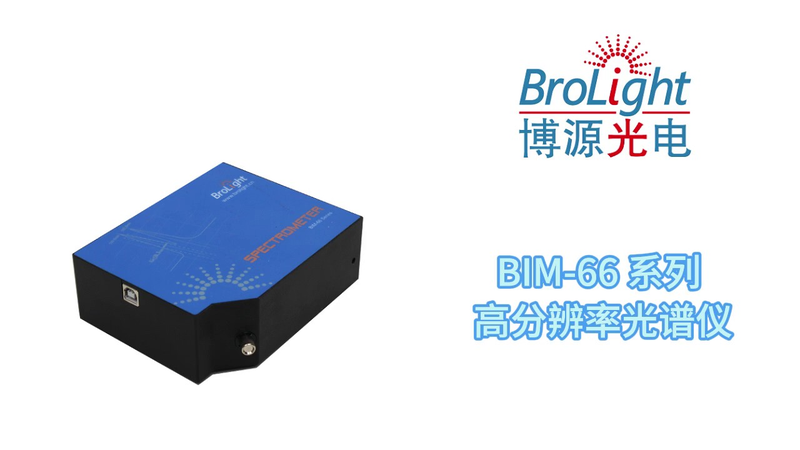 BIM-6602A series high-resolution spectrometers UV-NIR BIM-6602A-18
Spectrometers
Brolight
Fiber Connectors [BIM-6602A: Parameter Specifications]: SMA905 Detector [BIM-6602A: Parameter Specifications]: Hamamatsu S11639, Line-Array CMOS Detector Pixel [BIM-6602A: Parameter Specifications]: 2048 Pixels, Each Pixel 14μm×200μm
The BIM-6602A series spectrometer uses a high-resolution optomechanical structure in a compact, portable design, with resolution as fine as 0.08 nm. Interchangeable gratings adjust optical resolution and spectral range. Upgraded circuitry provides a 10000:1 dynamic range, minimum integration time of 0.5 milliseconds, and 600:1 signal-to-noise ratio for weak-signal detection. RS232 communication and improved interference resistance make it ideal for industrial and scientific applications.
-
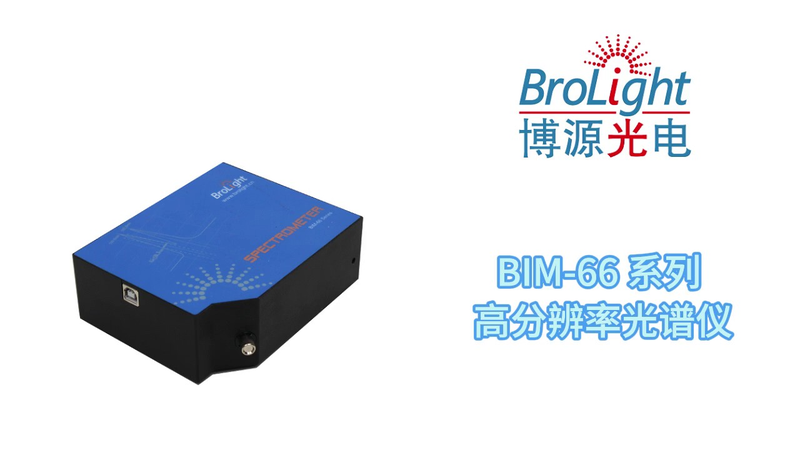 BIM-6602A series high-resolution spectrometers UV-NIR BIM-6602A-19
Spectrometers
Brolight
Fiber Connectors [BIM-6602A: Parameter Specifications]: SMA905 Detector [BIM-6602A: Parameter Specifications]: Hamamatsu S11639, Line-Array CMOS Detector Pixel [BIM-6602A: Parameter Specifications]: 2048 Pixels, Each Pixel 14μm×200μm
The BIM-6602A series spectrometer uses a high-resolution optomechanical structure in a compact, portable design, with resolution as fine as 0.08 nm. Interchangeable gratings adjust optical resolution and spectral range. Upgraded circuitry provides a 10000:1 dynamic range, minimum integration time of 0.5 milliseconds, and 600:1 signal-to-noise ratio for weak-signal detection. RS232 communication and improved interference resistance make it ideal for industrial and scientific applications.
Related Articles
The petrochemical industry features continuous high-risk production, where production equipment operates uninterruptedly under extreme working conditions including high temperature, high pressure, strong corrosion and oxidation.
Driven by the continuous pursuit of higher precision and efficiency in optical communication and optoelectronic device manufacturing, OLCR-1000 Low-Coherence Interferometer, independently developed by Wuhan Guanggu Interconnect Technology Co., Ltd., provides an innovative technical solution for distributed return loss testing of optical fibers and optoelectronic devices.
Driven by the rapid upgrading of intelligent vehicles, optoelectronic sensing technologies represented by laser sensing and infrared thermal imaging have become core pillars for high-level autonomous driving and smart cockpit iteration. Leveraging automotive-grade optoelectronic R&D advantages, Pilot Technology Group launches the VITAL intelligent vehicle solution. By integrating high-power VCSEL laser chips and vehicle infrared night-vision thermal imagers, the system comprehensively enhances vehicle environmental perception and realizes safer, smarter and more comfortable driving experiences.
Fiber lasers and fiber amplification systems require excitation sources with stable wavelength, narrow spectral linewidth and consistent output power.
Loading...
Name
Phone
Organization
Use Case

Database Platform