icrolight's self-developed NbAs detector results were published in Advanced Science
Published: 2026-08-10 11:28:36 Views: 68
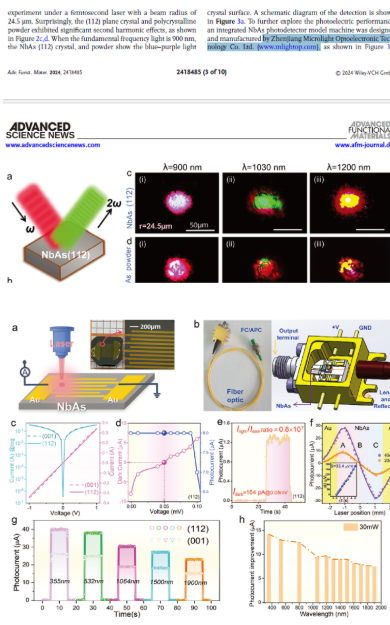
Recently, the key laboratory of Functional Crystal Materials of Tianjin University has published a cutting-edge research paper titled Enhanced Second-Harmonic Generation in Quadratically Nonlinear Weyl Semimetal NbAs for Broadband Photodetection Applications on Advanced Science, a top-tier international academic journal. Focusing on the technical bottlenecks of nonlinear photodetection, the research innovatively proposes a novel detection scheme based on bulk Weyl semimetal crystals, opening up a new technical route for the iterative upgrading of high-performance broadband photodetectors.

In the field of nonlinear photodetection, the traditional R&D of quadratically nonlinear photodetectors (QNPDs) has long been confined to two-dimensional materials with high second-order nonlinear polarizability, while largely ignoring the application potential of bulk nonlinear optical (NLO) crystals. Restricted by phase matching technical barriers and large-scale manufacturing challenges, the efficient engineering application of bulk NLO crystals has remained a core industrial technical pain point. Weyl semimetal crystals feature unique inversion symmetry breaking and excellent second-order nonlinear polarization properties. However, the frequency conversion limitation caused by low transmittance has long hindered the practical application of zero-bandgap absorption crystal detectors.
To address the above industrial challenges, this study develops a high-efficiency QNPD based on bulk NbAs crystals. With an ultra-high refractive index of approximately 5.0, NbAs crystals can stimulate intense second-harmonic effects, achieving a 50% laser reflection enhancement on the crystal surface. Efficient second-harmonic generation (SHG) can be stably realized without traditional phase matching technology, completely breaking the technical shackles of conventional devices. Multiple performance tests verify the outstanding comprehensive performance of the novel QNPD. It achieves a rectification ratio exceeding 107 and a low dark current of 164 pA, delivering enhanced photoresponse across an ultra-broad spectral range of 355 nm–1900 nm. The device obtains a peak responsivity of 4.1 mA W⁻¹ at 355 nm with a detectivity of 0.8×10¹⁰ Jones, representing an 88% performance improvement compared with traditional linear NbAs (001) photodetectors. This research innovatively applies the second-harmonic characteristics of bulk Weyl semimetal crystals to nonlinear photodetection, pioneering a new direction for the structural design and performance optimization of high-performance QNPDs.
Notably, the integrated NbAs photodetector adopted in this research is fully designed and fabricated by Zhenjiang Mlight Optoelectronic Technology Co., Ltd. (www.mlightop.com). As a professional manufacturer of optoelectronic devices, Mlight Optoelectronics has successfully overcome the difficulties in integrated fabrication of NbAs crystal devices through mature crystal device processing technology, precise structural design capability and strict performance control system. The company accurately meets the high-precision and high-stability requirements of scientific research experiments, providing core hardware support for the publication of top-tier journal achievements and facilitating critical breakthroughs in the research of crystal optoelectronic properties.
Moving forward, Mlight Optoelectronics will continue to focus on core tracks such as photoelectric detection and nonlinear optical devices, adhering to continuous technological innovation and process iteration. The company is committed to in-depth industry-university-research cooperation with domestic and foreign universities, research institutes and scientific research teams. It will continuously provide high-performance, high-reliability and customized cutting-edge optoelectronic device solutions to empower innovative basic research and engineering applications of optoelectronics, and promote the technical breakthrough and industrial transformation of more scientific research achievements.