Why 976nm EEL Pump Lasers Overtake 915nm as Mainstream Solution for Fiber Lasers
Published: 2026-08-20 10:21:43 Views: 83
Ytterbium‑doped fiber serves as the core energy‑conversion component inside a fiber laser. Pump light emitted by laser diodes is coupled into the gain fiber, and energy is transferred to signal laser beams via ytterbium ion energy‑level transition for power amplification. Two dominant pump wavelengths, 915 nm and 976 nm, have been widely adopted over decades. With the rapid progress of pump chip and wavelength‑locking technology, 976 nm edge‑emitting laser (EEL) pumps have gradually surpassed the 915 nm route and become the new industry mainstream. Shenzhen Lemon Photonics Technology Co., Ltd keeps developing high‑performance pump chips for fiber laser manufacturers.
The performance gap between the two solutions originates from the intrinsic absorption spectrum of ytterbium‑doped fiber. The 976 nm band delivers a much higher absorption coefficient. Under identical fiber length, pump energy can be absorbed more thoroughly by gain media. To achieve the same absorption efficiency, far shorter active fiber is required for a 976 nm‑pumped system. Shorter ytterbium‑doped fiber helps shrink system footprint and suppress unwanted nonlinear optical effects.
Economically, the absorption coefficient at 976 nm is 2‑3 times higher than that of 915 nm. Consumption of high‑cost ytterbium‑doped specialty fiber can be significantly reduced. Practical engineering results indicate that a 976 nm pumping scheme can cut ytterbium‑doped fiber consumption by roughly 40 %, bringing down overall bill‑of‑material costs.
Despite its inherent advantages in efficiency and cost, 915 nm pumps once dominated the market for many years, mainly because of the extremely narrow absorption bandwidth at 976 nm.

The full width at half maximum of ytterbium absorption peak near 976 nm is only a few nanometers. Early pump diodes had a wavelength thermal drift coefficient around 0.3 nm/℃. A temperature fluctuation of 5‑10 ℃ was enough to shift the pump wavelength out of the effective absorption window, resulting in severe efficiency drop and unstable output power. In contrast, the absorption spectrum at 915 nm spans 30‑40 nm, so wavelength drift barely affects absorption performance. When thermal control technology was immature and workshop temperature fluctuated drastically, choosing 915 nm for guaranteed stability was a practical engineering compromise.
Nowadays, thermal‑drift‑related bottlenecks that once blocked large‑scale deployment of 976 nm pumps have been well resolved with two core technical improvements.
First, fiber Bragg grating FBG wavelength‑locking technology. Wavelength‑selective FBG components are integrated at the laser output end, firmly anchoring emission wavelength near 976 nm. Even when chip junction temperature changes, wavelength drift is strictly limited.
Second, new‑generation low‑thermal‑drift pump chips. Optimized chip designs reduce the wavelength temperature coefficient down to approximately 0.07 nm/℃. Wavelength variation caused by ambient temperature is greatly minimized, and thermal management requirements drop to conventional levels.
Benefiting from wavelength‑locking techniques and low‑drift chip design, modern 976 nm pump sources deliver both high conversion efficiency and industrial‑grade long‑term stability. Industry data shows that 976 nm pumps captured a market share of 52 % in fiber laser applications in 2025, surpassing the 915 nm solution for the first time.
Nevertheless, the 976 nm scheme is not a universal replacement for every application. For ultra‑high‑power fiber lasers above 10 kW, an all‑976 nm pumping architecture faces two major physical limitations: stimulated Raman scattering (SRS) and thermally‑induced mode instability (TMI). Excessive signal power density triggers Raman energy loss, while accumulated heat inside gain fiber causes transverse mode coupling and degraded beam quality.
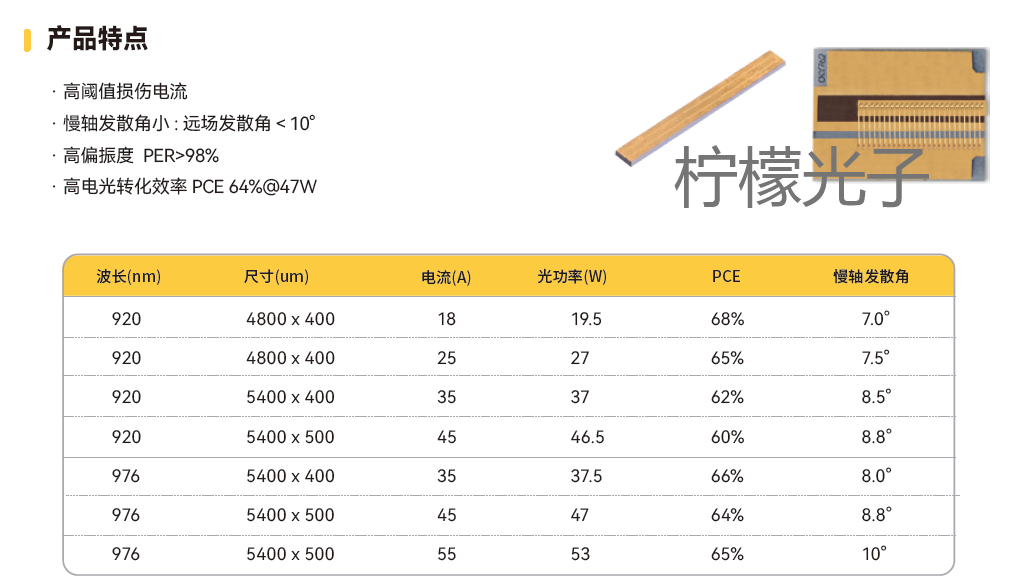
To solve this problem, a hybrid pumping strategy has been widely adopted for multi‑kilowatt lasers. The pre‑amplification stage is pumped at 915 nm, leveraging its broad absorption spectrum to provide stable baseline gain. The main power amplification section uses 976 nm pumps for highly efficient energy extraction. This hybrid configuration achieves an optimal balance between long‑term reliability and electro‑optical conversion efficiency.
The technical migration from 915 nm to 976 nm reflects continuous engineering optimization between efficiency and stability. Restricted by early thermal‑control hardware, the 915 nm solution was preferred for its spectral stability. After wavelength‑locking and low‑drift chip technology matured, the high‑absorption advantages of 976 nm pumps were fully unlocked, and cost‑reduction benefits drove its market‑leading position. The development trend for fiber lasers remains clear: manufacturers keep pursuing higher conversion efficiency and lower total‑cost‑of‑ownership on the premise of guaranteed industrial‑level operational stability. The popularization of the 976 nm pump route perfectly illustrates this industry logic.