

Single-Layer Magnesium Fluoride Coating
Single-layer magnesium-fluoride coatings. Magnesium fluoride is among the earliest and most common high-performance optical-coating materials. Changchun Longze Precision Optical Instrument Co., Ltd. has years of coating-process experience and a high-quality, economical, practical system. Contact us for reliable supply. AR coatings offer low index (N=1.38), low loss, 120nm-8000nm transmission, high mechanical strength, and high laser damage threshold, particularly for UV optics. Vacuum evaporation forms hard, durable coatings. Key factors: since establishment, the company has developed economical practical techniques and a mature coating system, providing single-layer AR coatings to requirements. 1. Thickness/uniformity: thickness governs wavelength-dependent AR effects; uniformity affects stability/reliability. 2. Raw-material form: powder contains many pores and crystal water. Premelting/coating may cause disproportionation producing magnesium oxide and hydrogen fluoride. Pores/outgassing abruptly reduce vacuum or cause splashing, extending cycles, lowering quality, and raising index. Pressed flakes have fewer pores but residual gas/crystal water still cause outgassing, splashing, and index deviations. Crystalline material receives low-temperature vacuum pretreatment and high-temperature degassing for uniform structure and minimal outgassing/splashing/unwanted reactions. 3. Evaporated mass: good raw materials are essential for ideal thickness d=λ/4N and AR performance. Actual evaporated mass, distinct from nominal amount, is linear with thickness d. 4. Source: choose evaporation for material properties. For small particles or low-melting materials such as magnesium fluoride, resistive evaporation is easier to control than electron beams and avoids contamination. 5. Placement: substrates near rotating-holder centers receive thicker, more uniform coatings than edge substrates. The company uses effective solutions and strictly tests every coated optic with professional equipment. Contact: talia@clzoptics.com.
 Save to Favorites
Overview
Specifications
| Parameter | Value |
|---|---|
| Surface Reflectance Before Coating [Uncoated Glass] | 4% |
| Surface Reflectance After Coating [Uncoated Glass] | 1.3% |
| Refractive Index [K9] | 1.52 |
| Surface Reflectance Before Coating [K9] | 4.25% |
| Surface Reflectance After Coating [K9] | 1.3% |
| Refractive Index [BK7] | 1.517 |
| Surface Reflectance Before Coating [BK7] | 4.25% |
| Surface Reflectance After Coating [BK7] | 1.3% |
| Refractive Index [Sapphire] | 1.77 |
| Surface Reflectance Before Coating [Sapphire] | 4.93% |
| Surface Reflectance After Coating [Sapphire] | 1.8% |
Applications
Datasheet
Please provide your email to download the datasheet.
Invalid email format. Please try again.
Supplier Information
Related Products
-
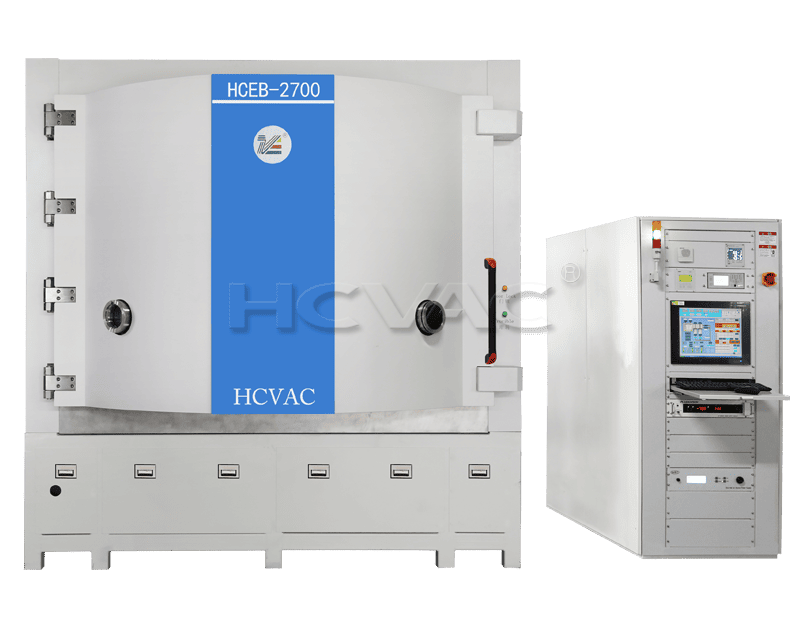 Large electron-beam evaporation optical coating equipment HCEB-2700
Optical Coatings
Hcvac
Chamber dimensions [Customizable (Data for Reference Only)]: Φ2700 x H1850 Load capacity [Customizable (Data for Reference Only)]: 5.3 m2 Structure [Customizable (Data for Reference Only)]: Vertical, front-opening door, SUS304 stainless steel
This series was developed for mass-production market needs. Production-proven equipment offers high productivity and the lowest ownership cost for cost-optimized volume production of optical components. It can produce AR, UV/IR cutoff filters, AF, hard coatings, decorative coatings, ITO coatings, bandpass filters and HR coatings. Equipped with an electron gun, pocket-type, kidney-shaped or annular crucibles and an impedance-type evaporation source. Optical or quartz-crystal thickness monitoring enables automatic control of deposition rate and coating processes. Optional RF/Kaufman-type/Hall-type ion sources. AR coatings (substrate glass transmittance >91.5%): in the 420-680nm band, single-sided average transmittance >95% and reflectance less than 0.5% (average); double-sided average transmittance >98% and reflectance less than 0.5% (average). AS/AF coating test standards: initial contact angle 115±5°; steel-wool abrasion test using 0000# steel wool over 10*10mm, 40 strokes/min, load 1Kg: contact angle greater than 100° after 5000 reciprocating rubbing cycles; eraser test using a 6mm-diameter eraser, 25 strokes/min, load 1Kg: contact angle greater than 100° after 2500 reciprocating rubbing cycles. Note: glass test samples must be precision-polished glass specifically for touchscreen cover plates, with a clean, smooth surface.
-
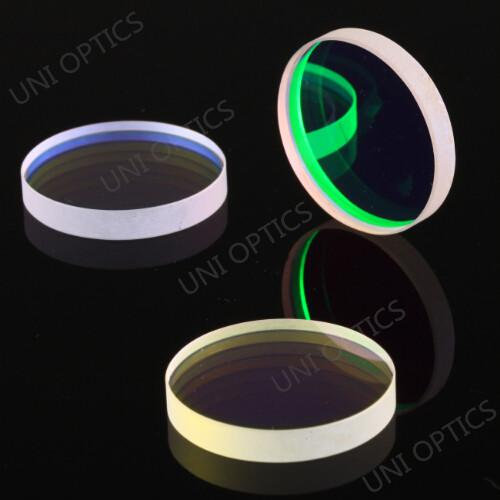 Antireflection-coated sapphire window
Optical Coatings
Uni-lens
Abbe number: 72.24 Birefringence [Visible light orthogonal to the optical axis]: 0.008 Clear Aperture Dimension: ≥90%
Sapphire windows retain high strength at elevated temperatures, with good thermal properties and excellent transparency. They resist common acids and alkalis at temperatures up to 1000°C and hydrogen fluoride below 300°C. These properties support use in harsh environments requiring optical transmission from vacuum ultraviolet to near infrared.
-
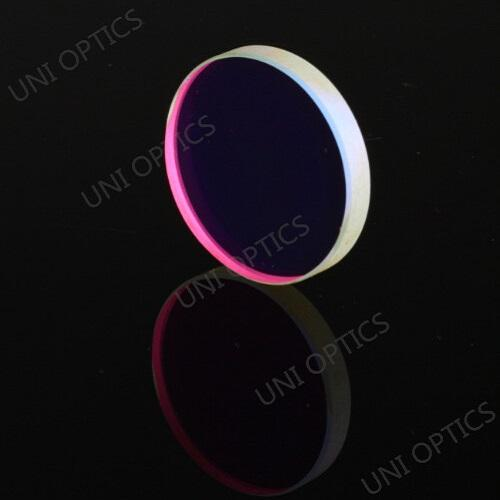 BK7 antireflection-coated window
Optical Coatings
Uni-lens
Material [Question 1 in the body text]: N-BK7, Schott borosilicate Dimensional Tolerance [Standard; No unit stated in the table]: +0.0/-0.2 Thickness Tolerance [Standard; No unit stated in the table]: ±0.2
BK7 windows are the most common window type, with good performance in visible and near-infrared bands. BK7 windows are ideal where transmitted-beam deviation must be minimized and are suitable for AR coatings.
-
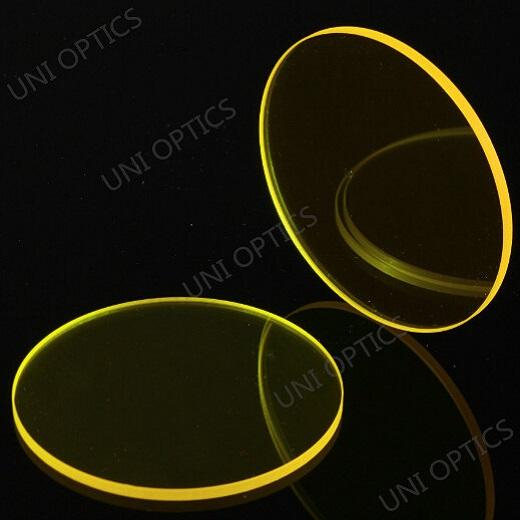 Antireflection-coated colored-glass window
Optical Coatings
Uni-lens
Material: Color Glass Type(Cut-off Glass, Absorption-Selective Glass, Neutral Glass) Dimensional Tolerance: +0.0, -0.1 Thickness Tolerance: ±0.1 mm
Colored glass modifies the spectral characteristics of optical radiation for scientific experiments and industrial applications requiring such changes. Colored-glass filters can be combined to modify the passband or increase attenuation.
-
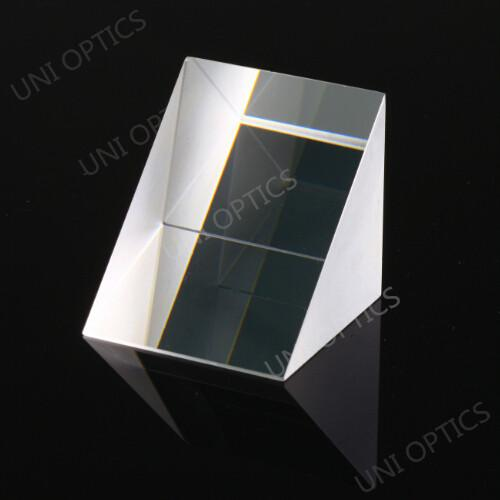 Right-angle prism with broadband antireflection-coated hypotenuse
Optical Coatings
Uni-lens
Available materials [Series supply]: N-BK7, UV fused silica or other optical glass Dimensional Tolerance [Standards]: +0/-0.2 Dimensional Tolerance [Processing Upper Limit]: +0/-0.05
Right-angle prisms commonly alter optical paths or redirect beams by 90°. Designed with a 90° angle, they produce inverted or reversed left-handed images depending on orientation. Using two together is ideal for image or beam displacement. Also called mirror-image reflecting prisms.
Related Articles
The ElFys PD25s series photodetectors adopt ElFys‑patented Black Silicon Induced Junction technology, delivering excellent spectral response spanning deep‑ultraviolet, visible and near‑infrared bands for diverse high‑precision photometry applications. Sub‑variants including H, M, HG and MG are optimised for low‑capacitance, low‑dark‑current and high‑reverse‑bias guard‑ring operations respectively. Multiple packaging configurations are available to satisfy various system‑design requirements.
Fomoptic delivers integrated one‑stop optical solutions covering precision optical fabrication and custom vacuum coating services. Supported by complete processing production lines, comprehensive metrology equipment and experienced engineering team, we provide full‑chain customized components, ranging from blank shaping, ultra‑precision polishing to thin‑film coating, for laser systems, infrared imaging, industrial optics and scientific‑research projects.
Wuhan Optical Valley Interlink Technology Co., Ltd. was founded in 2013 by a technical team from Huazhong University of Science and Technology.
For semiconductor, coating and laboratory vacuum chambers, thermal conductivity gauges suffer large measurement errors caused by gas type and ambient temperature.
Loading...
Name
Phone
Organization
Use Case

Database Platform