

Mirror
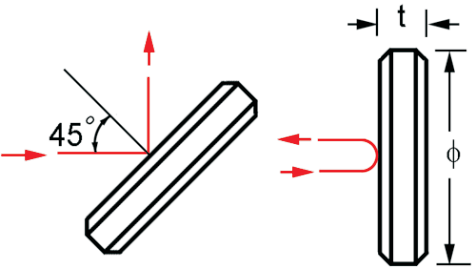
An optical mirror is an optical component that utilizes the principle of light reflection. By applying a coating on its surface, it enables the light to be reflected in a specific direction. It changes the propagation direction of the incident light while minimizing the absorption or scattering of light energy. The reflective surface is typically made of materials with high reflectivity, such as aluminum, silver, gold, or multilayer dielectric films. Depending on the application, it can be designed in various geometric shapes, including plane, spherical, and parabolic. It is widely used in astronomical telescopes, laser physics and spectroscopy, laser processing equipment, and optical inspection.
 Save to Favorites
Overview
Specifications
| Parameter | Value |
|---|---|
| Material | N-BK7, H-K9L, Fused Silica, etc. |
| Diameter Tolerance [+0.0/-0.2 (General), +0.0/-0.02 (High Precision)] | +0.0/-0.2 (General), +0.0/-0.02 (High Precision) |
| Thickness Tolerance [±0.2 (General), ±0.005 (High Precision)] | ±0.2 (General), ±0.005 (High Precision) |
| Clear Aperture [>80% (Small Size), >95% (Large Size)] | >80% (Small Size), >95% (Large Size) |
| Flatness [per 25mm@633nm;λ (General), λ/10 (High Precision)] | λ (General), λ/10 (High Precision) |
| Incidence Angle | 0deg or 45deg |
| Surface Quality [60/40 (General), 10/5 (High Precision)] | 60/40 (General), 10/5 (High Precision) |
| Parallelism [3 min. (General), 3 sec. (High Precision)] | 3 min. (General), 3 sec. (High Precision) |
| Coating | Dielectric coated HR, or metal coated Al, Ag, Au etc. |
Key Features
Datasheet
Please provide your email to download the datasheet.
Invalid email format. Please try again.
Supplier Information
Related Products



Related Articles
Driven by the continuous pursuit of higher precision and efficiency in optical communication and optoelectronic device manufacturing, OLCR-1000 Low-Coherence Interferometer, independently developed by Wuhan Guanggu Interconnect Technology Co., Ltd., provides an innovative technical solution for distributed return loss testing of optical fibers and optoelectronic devices.
icrolight is a high-tech enterprise specializing in the R&D, manufacturing and sales of active and passive photonic devices for microwave photonics, LiDAR ranging, gas sensing, fiber optics and photomedicine.
BEIJING JIEPU TREND supplies YAG+Er:YAG+YAG bonded composite slab laser crystals for high‑power solid‑state laser systems. The monolithic slab consists of two undoped YAG end‑cap layers and a central Er‑doped YAG gain segment. The overall dimension is 9 mm×9 mm×9 mm.
Shanghai Connet Laser Technology Co., Ltd. focuses on technological innovation, delivering cutting-edge photonic products & solutions for industrial lasers, LiDAR, fiber optic sensing, coherent telecom, cold atom physics and precision spectroscopy research & mass manufacturing.
Loading...
Name
Phone
Organization
Use Case

Database Platform