

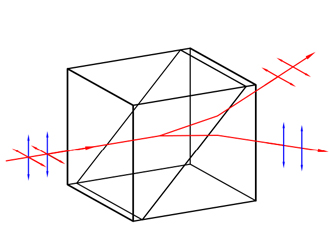
Wollaston Polarizer
Wollaston polarizer is designed to separate unpolarized light beam into two orthogonally polarized ordinary and extraordinary components which are symmetrically deflected from axis of initial propagation. This kind of performance is attractive for laboratory experiments as both ordinary and extraordinary beams are accessible. Wollaston polarizers are used in spectrometers also can be used as polarization analyzers or beamsplitters in optical setups. MgF2 GRP: Wavelength Range 130-7000nm a-BBO GRP: Wavelength Range 190-3500nm Quartz GRP: Wavelength Range 200-2300nm YVO4 GRP: Wavelength Range 500-4000nm Surface Quality: 20/10 Scratch/Dig Beam Deviation: < 3 arc minutes Wavefront Distortion: <λ/4@633nm Damage Threshold: >200MW/cm2@1064nm, 20ns, 20Hz Coating: P Coating or AR Coating Mount: Black Anodized Aluminium
 Save to Favorites
Overview
Key Features
Datasheet
Please provide your email to download the datasheet.
Invalid email format. Please try again.
Supplier Information
Related Products
-
K9 Glass Linear Polarizer 90% Polarization Efficiency for Precision Optical Applications X-P25F3S6901B Polarization Optics Vyoptics
Material: K9 Optical Glass Dimensions: 100mm × 2mm Minimum Polarization Ratio: ≥ 90%
Enhance your optical system performance with our **K9 Optical Polarizer (100mm × 2mm)**, designed for high precision light control and superior polarization efficiency. Manufactured from high-quality **K9 optical glass**, this polarizer delivers a **minimum polarization ratio of 90%**, making it ideal for laser systems, imaging instruments, optical testing, and research applications. The durable material and precision polishing ensure excellent transmission and long-term stability in demanding environments. Material | K9 Optical Glass | Size | 100mm × 2mm | Minimum Polarization | ≥ 90% An optical polarizer, also known as a polarizing filter or polarization optic, is a precision optical element used to control the direction of light vibration. It transmits only light waves in a selected polarization state, helping to reduce reflection and enhance contrast. Our K9 glass polarization element provides high transmission, stable performance, and minimal wavefront distortion, ideal for professional optical and laser systems. Product Name: K9 Optical Polarizer / Linear Polarizing Filter Q1: What is the difference between a polarizer and a polarization filter? Both terms describe optical components that control light vibration. A polarization filter can vary in coating or design, but both perform the same function of polarizing light. Q2: Why choose a K9 glass polarizing optic? K9 optical glass offers high transparency, low internal stress, and superior polishing quality, making it a reliable material for precision optics. Q3: Can this polarizing component be used with laser systems? Yes, our K9 polarization element works effectively with low- to medium-power laser and imaging systems. Q4: Do you provide custom polarizing optics? Yes. We offer custom-made polarization components including size, coating, and mount design based on your requirements. Q5: How to choose the right polarization element? Consider your wavelength range, desired polarization ratio, and optical setup. Our engineers can recommend the right polarizing optic for your application.
-
Linear Polarizer Optical Element for Laboratory Instruments and Imaging Equipment X-VP26F3CW3001 Polarization Optics Vyoptics
Material: B270 Diameter: 12.5mm Thickness: 2.00mm
A linear polarizer is an optical component that transmits light with a selected polarization direction while reducing light polarized in other directions. It is widely used in optical measurement, imaging systems, laboratory instruments, and polarization experiments. VY Optics offers linear polarizers with different dimensions, materials, transmission ranges, and optical specifications according to project requirements. A linear polarizer is an optical component that selectively transmits light according to its polarization direction. It allows light polarized along a preferred axis to pass through while reducing the transmission of light with other polarization orientations. Linear polarizers are used in optical instruments, imaging systems, laboratory equipment, and polarization measurement setups. Their performance depends on the polarizing material, operating wavelength, transmission, and extinction ratio. Light can contain electric field oscillations in different directions. A linear polarizer selectively transmits the component aligned with its transmission axis while attenuating the perpendicular component. When two linear polarizers are placed in the same optical path, their relative angular orientation affects the transmitted intensity. As a result, they can be used to study polarization behavior and adjust light levels in suitable optical systems. How to Select a Suitable Linear Polarizer: The correct linear polarizer depends on the optical system and its required performance. Consider these parameters before selecting a product. Operating wavelength or spectral range. Required transmission and extinction ratio. Polarizer dimensions and clear aperture. Material and environmental requirements. Transmission axis orientation and mounting method. Surface quality and any required optical coating. For this reason, providing a technical drawing or a complete specification list helps determine a suitable polarizer configuration. Linear Polarizer Manufacturing OptionsVY Optics supports optical component manufacturing based on customer specifications. Product feasibility depends on the selected polarizing material, dimensions, spectral range, and required optical performance. Customers can provide drawings or technical requirements for evaluation. Our team can review the requested dimensions, transmission range, extinction ratio, and mounting details before quotation. Frequently Asked QuestionsCan linear polarizers be manufactured in different sizes?Available dimensions depend on the product design and manufacturing process. Please provide your required size, clear aperture, wavelength range, and optical performance specifications for evaluation.
-
Optical Glass Polarizer for Laser Imaging Measurement and Scientific Applications X-P22F3X9101 Polarization Optics Vyoptics
High precision glass polarizers designed for efficient polarization control and light management in optical systems. These optical glass polarizers provide excellent transmission characteristics, high polarization efficiency, and stable optical performance for laser systems, imaging equipment, scientific instruments, optical measurement devices, and photonic applications. Custom dimensions, coatings, and wavelength ranges are available. A glass polarizer is an optical component designed to control the polarization state of light. It selectively transmits light waves with a specific polarization direction while reducing or blocking unwanted polarized components. Glass polarizers are widely used in optical systems, laser equipment, and scientific instruments. Why Use Optical Glass Polarizers?Glass polarizers help improve optical performance by enhancing contrast, reducing glare, and controlling light polarization. They are commonly used in laser systems, imaging devices, optical measurement equipment, and photonic applications where precise light management is required. People Also Ask (FAQs): What industries use optical glass polarizers?Glass polarizers are widely used in photonics, laser technology, optical testing, scientific research, and imaging systems.
-
Polarizing Beamsplitter Polarization Optics Optowide
A polarizing beamsplitter coating is controlled so that, when incidence meets the Brewster-angle condition, s-polarized reflectance approaches1, p-polarized transmission approaches1, and P-polarized reflectance approaches0. Light incident from air has difficulty meeting this condition because of air's relatively low refractive index, so the coating must be enclosed in a cemented prism. The coating splits S and P components according to specified transmission/reflection ratios. Good polarization characteristics support combination or separation of polarization components across visible, near-infrared, and communications C+L broadband wavelengths.
Related Articles
Driven by the continuous pursuit of higher precision and efficiency in optical communication and optoelectronic device manufacturing, OLCR-1000 Low-Coherence Interferometer, independently developed by Wuhan Guanggu Interconnect Technology Co., Ltd., provides an innovative technical solution for distributed return loss testing of optical fibers and optoelectronic devices.
icrolight is a high-tech enterprise specializing in the R&D, manufacturing and sales of active and passive photonic devices for microwave photonics, LiDAR ranging, gas sensing, fiber optics and photomedicine.
BEIJING JIEPU TREND supplies YAG+Er:YAG+YAG bonded composite slab laser crystals for high‑power solid‑state laser systems. The monolithic slab consists of two undoped YAG end‑cap layers and a central Er‑doped YAG gain segment. The overall dimension is 9 mm×9 mm×9 mm.
Shanghai Connet Laser Technology Co., Ltd. focuses on technological innovation, delivering cutting-edge photonic products & solutions for industrial lasers, LiDAR, fiber optic sensing, coherent telecom, cold atom physics and precision spectroscopy research & mass manufacturing.
Loading...
Name
Phone
Organization
Use Case

Database Platform