
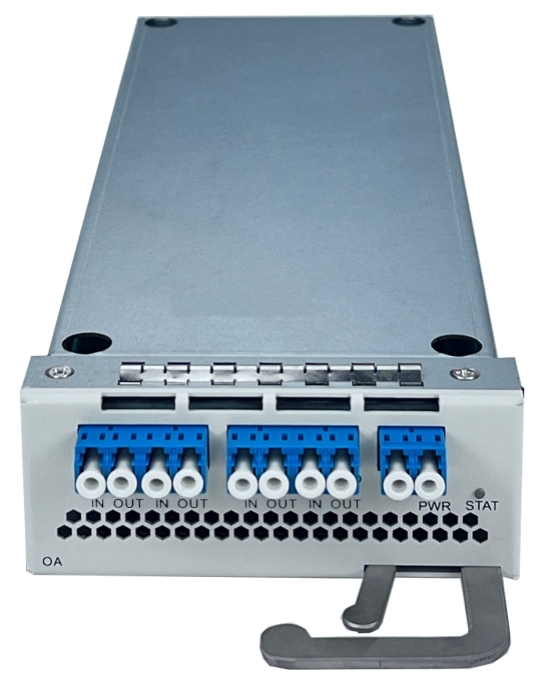
OA Optical Amplifier Board (Terminal Station)
The EDFA board directly regenerates multiwavelength optical signals without optical-electrical-optical conversion, extending transmission distance. Used with DWDM multiplexers/demultiplexers, it enables wavelength-division transmission, particularly in long-haul trunks, metropolitan and access networks and SDH/PDH systems.
 Save to Favorites
Overview
Specifications
| Parameter | Value |
|---|---|
| BA Amplifier - Number of Channels [@ 100GHz] | 48CH @ 100GHz |
| BA Amplifier - Wavelength Range | 1528.38~1567.54 nm |
| BA Amplifier-Control Type [Gain adjustable] | AGC |
| BA Amplifier-Operating Mode | Gain Locking |
| BA Amplifier - Amplifier Type [Erbium-Doped Fiber Amplifier] | EDFA |
| BA Amplifier-Channel Gain Range [Not below This Range] | 8~18 dB |
| BA Amplifier-Maximum Optical Output Power per Wavelength [Full-Channel Average] | 4 dBm |
| BA Amplifier-Maximum Total Optical Output Power [EOL value / BOL value; maximum total output power must remain at least 21dBm throughout the life cycle] | N+21(EOL Value ) N+21.5(BOL Value ) |
| BA Amplifier -NF Value [G=8 / G=12 / G=16~18; tested at gain slope -1; NF is the worst result among multiwavelength measurements] | G=8, ≤12.5 G=12,≤9.1 G=16~18,≤6.5 |
| BA Amplifier - Gain Flatness [At T=0; tested across any gain and input range.] | <1.5 |
| BA Amplifier-Multichannel Gain Slope [Typical: - 1; Adjustable Increment: 0.2dB] | -3~0 dB/40nm |
| BA Amplifier - Polarization-Dependent Loss | <0.5 |
| BA Amplifier-Optical Input Power Detection Range | -18~+13 dBm |
| BA Amplifier-Optical Output Power Detection Range [As measured by the output-port power meter] | -2~22 dBm |
| BA Amplifier-Input/Output Reflection Coefficient | <-30 |
| BA Amplifier-Gain Stability | ±0.5 dB |
| BA Amplifier - Input / Output Optical Power Detection Accuracy [Accuracy = difference between power measured at the power-meter front-panel port and power reported at the monitoring point.] | ±0.5 dB |
| BA Amplifier-Optical Output Power Stability | ±0.5 dB |
| BA Amplifier-Time from Pump Startup to Stable Output Power | <100 |
| BA Amplifier-Add/Drop-Wavelength Transient Response Time | <1 |
| BA Amplifier-Add/Drop-Wavelength Transient Gain Ripple [@48 wavelength channels with 47 dropped] | -1~1 dB |
| PA1 Amplifier - Number of Channels [@ 100GHz] | 48CH @ 100GHz |
| PA1 Amplifier - Wavelength Range | 1528.38~1567.54 nm |
| PA1 Amplifier-Control Type [Gain adjustable] | AGC |
| PA1 Amplifier-Operating Mode | Gain Locking |
| PA1 Amplifier - Amplifier Type [Erbium-Doped Fiber Amplifier] | EDFA |
| PA1 Amplifier-Channel Gain Range | 15~25 dB |
| PA1 Amplifier-Maximum Optical Output Power per Wavelength [Full-Channel Average] | 4 dBm |
| PA1 Amplifier-Maximum Total Optical Output Power [EOL value / BOL value; maximum total output power must remain at least 21dBm throughout the life cycle] | ≥+21(EOL Value ) ≥+21.5(BOL Value ) |
| PA1 Amplifier -NF Value [G=15 / G=16 / G=17 / G=19 / G=20~22 / G=23~25; tested at gain slope -1; NF is the worst result among multiwavelength measurements] | G=15, ≤ 8.1 G=16, ≤7.3 G=17, ≤6.6 G=19, ≤6.4 G=20~22,≤5.8 G=23~25,≤5.5 |
| PA1 Amplifier - Gain Flatness [Test Value at T=0 within Any Gain and Input Range] | <1.5 |
| PA1 Amplifier-Multichannel Gain Slope [Typical: -1; Adjustable Increment: 0.2dB] | -3~0 dB/40nm |
| PA1 Amplifier - Polarization-Dependent Loss | <0.5 |
| PA1 Amplifier-Optical Input Power Detection Range | -28~+6 dBm |
| PA1 Amplifier-Optical Output Power Detection Range [As measured by the output-port power meter] | -2~22 dBm |
| PA1 Amplifier-Input/Output Reflection Coefficient | <-30 |
| PA1 Amplifier-Gain Stability | ±0.5 dB |
| PA1 Amplifier - Input / Output Optical Power Detection Accuracy | ±0.5 dB |
| PA1 Amplifier-Optical Output Power Stability | ±0.5 dB |
| PA1 Amplifier-Time from Pump Startup to Stable Output Power | <100 |
| PA1 Amplifier-Add/Drop-Wavelength Transient Response Time | <1 |
| PA1 Amplifier-Add/Drop-Wavelength Transient Gain Ripple [@48 wavelength channels with 47 dropped] | - 1~1 dB |
| PA2 Amplifier - Number of Channels [@ 100GHz] | 48CH @ 100GHz |
| PA2 Amplifier - Wavelength Range | 1528.38~1567.54 nm |
| PA2 Amplifier-Control Type [Gain adjustable] | AGC |
| PA2 Amplifier-Operating Mode | Gain Locking |
| PA2 Amplifier - Amplifier Type [Erbium-Doped Fiber Amplifier] | EDFA |
| PA2 Amplifier-Channel Gain Range | 22~35 dB |
| PA2 Amplifier-Maximum Optical Output Power per Wavelength [Full-Channel Average] | 4 dBm |
| PA2 Amplifier-Maximum Total Optical Output Power [EOL value / BOL value; maximum total output power must remain at least 21dBm throughout the life cycle] | ≥+21(EOL Value ) ≥+21.5(BOL Value ) |
| PA2 Amplifier -NF Value [G=22 / G=24 / G=25 / G=27 / G=28~35; tested at gain slope -1; NF is the worst result among multiwavelength measurements] | G=22, ≤8 G=24, ≤7 G=25, ≤6.1 G=27, ≤5.9 G=28~35,≤5.5 |
| PA2 Amplifier - Gain Flatness [Test Value at T=0 within Any Gain and Input Range] | <1.5 |
| PA2 Amplifier-Multichannel Gain Slope [Typical: - 1; Adjustable Increment: 0.2dB] | -3~0 dB/40nm |
| PA2 Amplifier - Polarization-Dependent Loss | <0.5 |
| PA2 Amplifier-Optical Input Power Detection Range | -35~6 dBm |
| PA2 Amplifier-Optical Output Power Detection Range [As measured by the output-port power meter] | -2~22 dBm |
| PA2 Amplifier-Input/Output Reflection Coefficient | <-30 |
| PA2 Amplifier-Gain Stability | ±0.5 dB |
| PA2 Amplifier - Input / Output Optical Power Detection Accuracy | ±0.5 dB |
| PA2 Amplifier-Optical Output Power Stability | ±0.5 dB |
| PA2 Amplifier-Time from Pump Startup to Stable Output Power | <100 |
| PA2 Amplifier-Add/Drop-Wavelength Transient Response Time | <1 |
| PA2 Amplifier-Add/Drop-Wavelength Transient Gain Ripple [@48 wavelength channels with 47 dropped] | - 1~1 dB |
| Board Dimensions | 100(W)×40(H)×266(D)(mm) |
| Environmental Requirements - Operating temperature | -5℃ ~ 45℃ |
| Storage temperature | -40℃ ~ 80℃ |
| Relative Humidity | 5% ~ 95% Non-condensing |
| Safety and EMC | Complies with FCC, UL, CE, TUV, CSA standards |
| Power consumption | <25W |
| Weight | <1KG |
Key Features
Datasheet
Please provide your email to download the datasheet.
Invalid email format. Please try again.
Supplier Information
Related Products
-
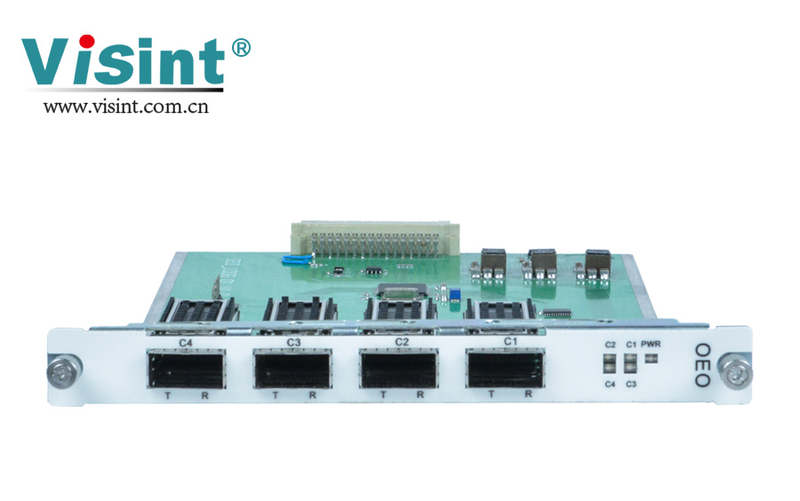 100G OEO
Optical Transport Equipment
Visint
Maximum Line-Card Capacity: 2*100G Bidirectional Transmission 4*100G Unidirectional Transmission Wavelength Range: CWDM:1271~1611nm、 Multimode :850nm、1310nm DWDM:C-Band(100GHZ or 50GHZ) Service Access Type: SDH、SAN、SONET、ETHERNET、OTN
The 100G OEO amplifier card from Huixinte Communications regenerates 100G optical signals through optical-electrical-optical conversion, providing reamplification, reshaping and retiming. It converts to standard DWDM wavelengths and works with DWDM multiplexers/demultiplexers. Applications include SDH, SAN, SONET, ETHERNET, OTN and data-center interconnects, addressing limited fiber resources and high transmission loss.
-
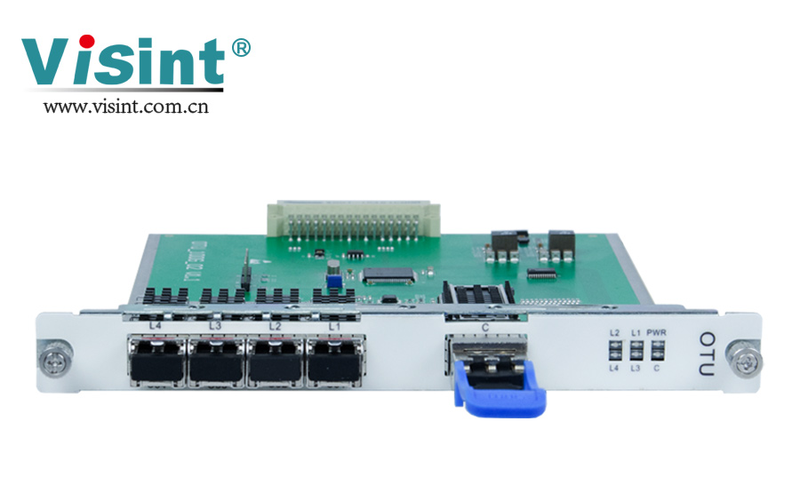 100G OTU
Optical Transport Equipment
Visint
Maximum Line-Card Capacity: 1*100G Bidirectional Transmission 1*100G Unidirectional Transmission Wavelength Range: DWDM:C-Band(100GHZ or 50GHZ) Service Access Type: 100GE、OTU4
The 100G OTU card is a 100G fiber-link service access module developed by Huixinte Communications. It provides 3R regeneration (reamplification, reshaping and retiming) at any protocol rate from 103.125Gbit/s~111.81Gbit/s and converts signals to standard DWDM wavelengths. With DWDM multiplexers/demultiplexers, it enables WDM transmission for links with limited fibers and high loss.
-
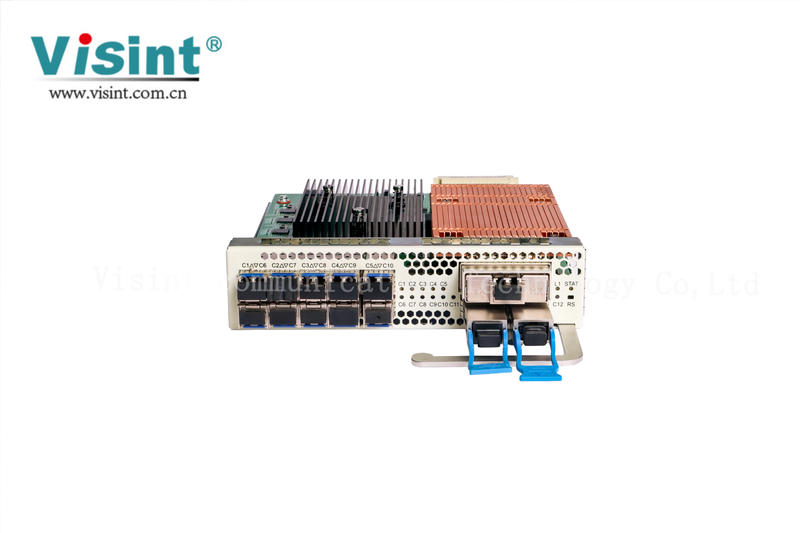 10*10G + 100G 200G TMUX Board
Optical Transport Equipment
Visint
Maximum Line-Card Capacity: a)10*10G Bidirectional Transmission +1*100G Bidirectional Transmission b)2*100G Bidirectional Transmission Wavelength ( Frequency ) Range: DWDM:1529.16nm-1567.14nm(191.3THz-196.05THz) Modulation Method [@100G / @200G;@100G;DP-16QAM@200G;DP-8QAM@200G;DP-QPSK@200G]: DP-QPSK@100G;DP-16QAM@200G;DP-8QAM@200G;DP-QPSK@200G
The 200G TMUX card converts either 10*10G SFP+ + 1*100G QSFP28 or 2*100G QSFP28 to 200G CFP2 DCO. The wavelength-tunable CFP2 DCO coherent module works with DWDM multiplexers/demultiplexers for wavelength-division multiplexed transmission, providing a high-quality solution for links with limited fiber resources and high fiber-line loss.
-
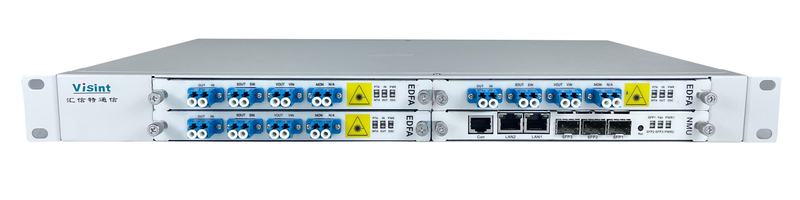 1U Integrated Transmission Platform Vispace 1000-1U
Optical Transport Equipment
Visint
Mechanical Parameters-Overall Dimensions: Width * Height * Depth =440*42*285mm Mechanical Parameters-Fully Configured Weight: ≤10KG Operating environment - Operating temperature: -10℃– 60℃
The Vispace 1000-1U integrated transmission platform is independently developed and manufactured to meet diverse market needs, greater integration and unified network management. Its standard 19-inch, 1U chassis fits most racks. Four slots accommodate 3 service boards and 1 network-element manager, normally in slot 4; that slot also accepts a service board when management is unnecessary. Mixed boards include OTU wavelength conversion, OEO regeneration, ETU optical/electrical conversion, OLP line protection, OBP bypass protection, OSS optical switching, ODM multiplexing/demultiplexing, OADM add/drop, EDFA amplification and DCM dispersion compensation. 2 rear power slots and all boards support hot swapping. Dual power slots support AC/DC, configured to customer needs.
-
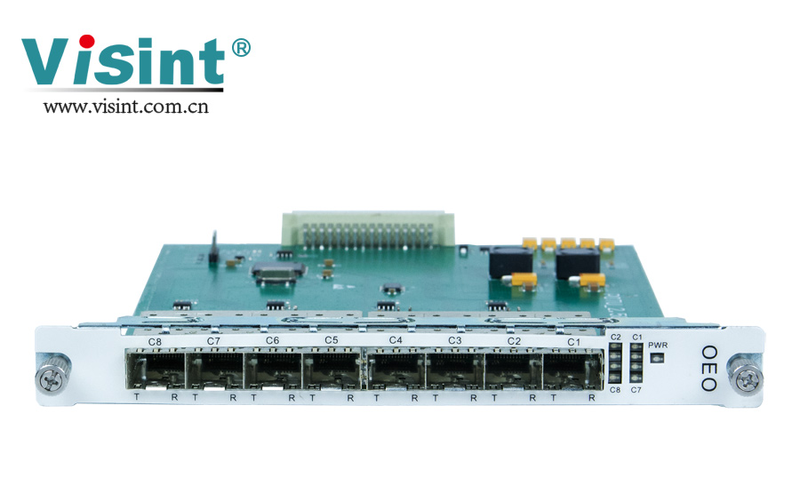 2.5G OEO
Optical Transport Equipment
Visint
Maximum Line-Card Capacity: 4*2.488G bidirectional or 8*2.488G unidirectional transmission Wavelength Range: CWDM:1271~1611nm、 Multimode :850nm、1310nm DWDM:C-Band(100GHZ or 50GHZ) Service Access Type: PDH、SDH:STM-1/STM-4/STM-16 SONET:OC-3/OC-12/OC-48、FE、GE、1G、2G、CPRI 1~3、POS、FICON、ESCON
The 2.5G OEO amplifier board developed by Huixinte Communications amplifies and reshapes signals during optical transmission. It saves fiber resources and networking costs, addresses excessive transmission distance and is widely used for long-distance transmission on trunk networks.
Related Articles
Electro-optic deflectors (EODs) are optical devices used to steer or deflect light beams by applying an electric field to a specialized optical crystal. Unlike mechanical beam steering systems that rely on moving mirrors, electro-optic deflectors enable high-speed, non-mechanical beam control with exceptional precision and responsiveness. They are widely used in laser scanning, optical communications, microscopy, laser printing, spectroscopy, and scientific research, where rapid and accurate laser beam positioning is essential.
The 850 nm and 940 nm infrared narrow‑bandpass filters launched by Innovation Photoelectric are core optical components specially designed for day‑and‑night security cameras. They effectively eliminate image interference during visible‑light and infrared‑illumination switching, delivering stable round‑the‑clock monitoring performance.
Within cutting‑edge ultrafast photonics research, asynchronous optical sampling (ASOPS) and synchronous sampling serve as fundamental technologies for terahertz excitation detection, coherent Raman imaging and other time‑resolved spectroscopy experiments.
Shanghai Connet Laser Technology Co., Ltd. focuses on technological innovation, delivering cutting-edge photonic products & solutions for industrial lasers, LiDAR, fiber optic sensing, coherent telecom, cold atom physics and precision spectroscopy research & mass manufacturing.
Loading...
Name
Phone
Organization
Use Case

Database Platform