
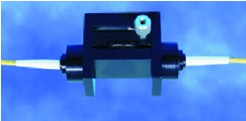
Manual Tunable Fiber Filter
Tunable optical filters are used to pass or block specific wavelengths in an optical path, and therefore have wide applications. Our tunable fiber filters use a thin-film structure: the beam from the input fiber is first collimated, passes through the tunable filter, and is then refocused into the output fiber. The manually tunable fiber filter is equipped with a manual tuning knob used to change the angle of incidence between the beam and the filter, thereby selecting different wavelengths. Combined with a broadband light source, a manually tunable fiber filter can form a narrow-linewidth broadband tunable source. The linewidth of an optical filter is defined as Full Width at Half Maximum (FWHM). Standard fiber filters have smooth, rounded transmission spectra, because the fiber filter is determined by a single Fabry-Perot resonant cavity, which consists of two mirrors and a fixed air gap. The wavelength that the optical filter can pass is selected by adjusting the distance between the two mirrors. The spectral shape produced by this F-P cavity filter is called a Lorentzian line. The spectrum produced by a single F-P cavity is a narrow-linewidth, peaked spectrum; flat-top filters can be obtained by cascading multiple F-P cavities. Cascading multiple F-P cavities produces flat-top, bandpass-type filter spectra, the falling edges of the filter spectral line become steep, and wavelengths outside the passband can be effectively suppressed. For more information, please contact our sales staff. The input/output of tunable fiber filters can use single-mode fiber, multimode fiber, or polarization-maintaining fiber. The wavelength range can be selected within 400nm~1625nm. Polarization-maintaining fiber filters use Panda-type PM fiber. If other types of PM fiber are needed, please contact our sales staff.
 Save to Favorites
Overview
Specifications
| Parameter | Value |
|---|---|
| Tunable Range | Standard product 50 nm |
| Accuracy | <0.1nm (typical) |
| Wavelength/Temperature Drift | <0.002nm/°C |
| Tolerable Optical Power | 200mW: standard product |
Applications
Datasheet
Supplier Information
Related Products
-
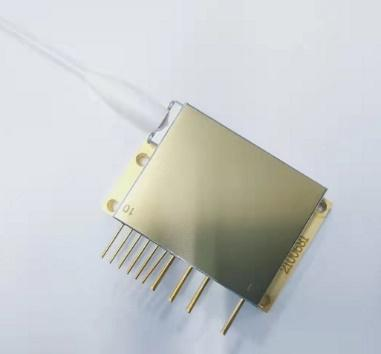 Fibre-coding semiconductor lasers FH-1430-8E
Fiber Optics
Haucore
Fibre-coding semiconductor lasers FH-1430-8E
Fiber Optics
Haucore
spectral width: 3.5
Wavelength/ Wavelength 808 & 980 nm; Fibre power/ Outlook Power 15 & 15W; fibre core/ Fiber Core 400 m; fibre numerical aperture/ Fiber NA 0.22
-
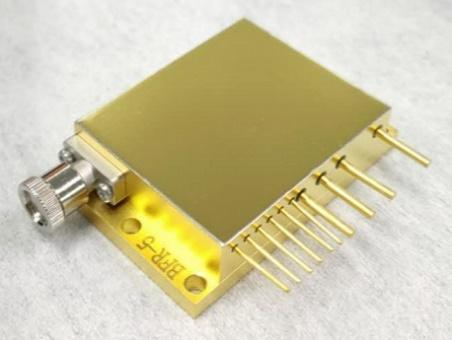 Fibre-coding semiconductor lasers FH-2212-CA
Fiber Optics
Haucore
Fibre-coding semiconductor lasers FH-2212-CA
Fiber Optics
Haucore
Electricity conversion efficiency: 24%
Wavelength/ Wavelength 650 & 450 & 980 nm; Fibre power/ Outlook Power 0.5 & 4 & 8W; fibre core/ Fiber Core 200 m; fibre-optic numerical aperture/ Fiber NA 0.22
-
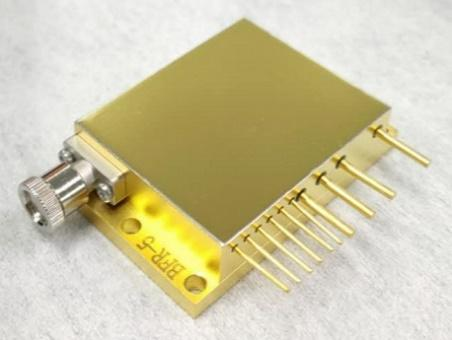 Fibre-coding semiconductor lasers FH-3229-CA
Fiber Optics
Haucore
Fibre-coding semiconductor lasers FH-3229-CA
Fiber Optics
Haucore
Electricity conversion efficiency: 19% (Symbol: WPE)
Wavelength/ Wavelength 650&808&915&980nm; Fibre power/output Power 0.3&9&10&10W; fibre core/Fiber Core 400mm; fibre numerical aperture/Fiber NA 0.22
-
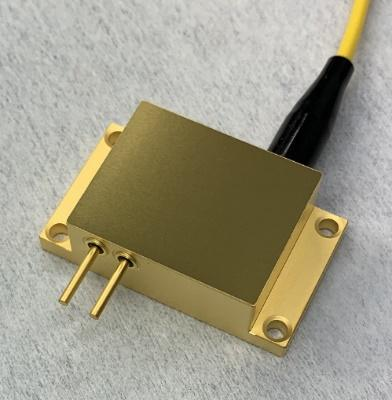 Fibre-coding semiconductor lasers FH-6102-S2
Fiber Optics
Haucore
Fibre-coding semiconductor lasers FH-6102-S2
Fiber Optics
Haucore
Central wavelength: 655 / 660 / 665 nm
Wavelength/ Wavelength 660 nm; Fibre power/ Outlook Power 2W; fibre core/ Fiber Core 105 m; fibre numerical aperture/ Fiber NA 0.22
-
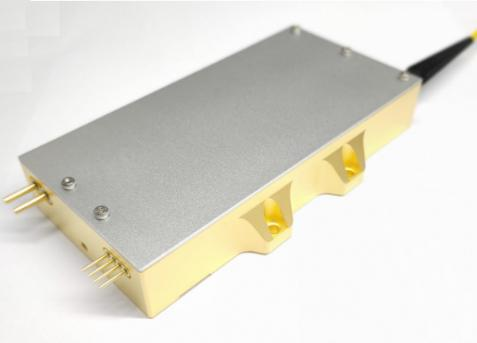 Fibre-coding semiconductor lasers FH-6115-SA
Fiber Optics
Haucore
Fibre-coding semiconductor lasers FH-6115-SA
Fiber Optics
Haucore
Wavelength/ Wavelength 660 nm; Fibre power/ Outlook Power 15W; fibre core/ Fiber Core 105 mm; fibre numerical aperture/ Fiber NA 0.2
Related Articles
Wuhan Optics Valley Quantum Technology Co., Ltd. is a leading domestic developer of high‑speed semiconductor optical chips and photodetector components. Our product portfolio covers InGaAs avalanche photodiode bare dies and PIN photodetector chips designed for fiber‑optic communication
Developed by RealLight (Beijing), the R7M high‑power diode laser module belongs to the AW multi‑functional laser product family.
As a core precision optical component for wavelength screening, frequency locking and spectral demodulation, optical etalons are widely used in high-end scientific research and precision laser equipment.
FiDAR, the fiber‑optic radar vehicle positioning and tracking system developed by Jianhe Bafang, is a high‑sensitivity distributed fiber‑sensing solution designed for intelligent traffic road monitoring. It outputs real‑time spatial coordinates of every vehicle across the full road section around‑the‑clock, delivering a brand‑new sensing technology for vehicle‑road cooperation, smart highway construction and urban traffic management.
Loading...
Name
Phone
Organization
Use Case

Database Platform