

High-Borosilicate Glass
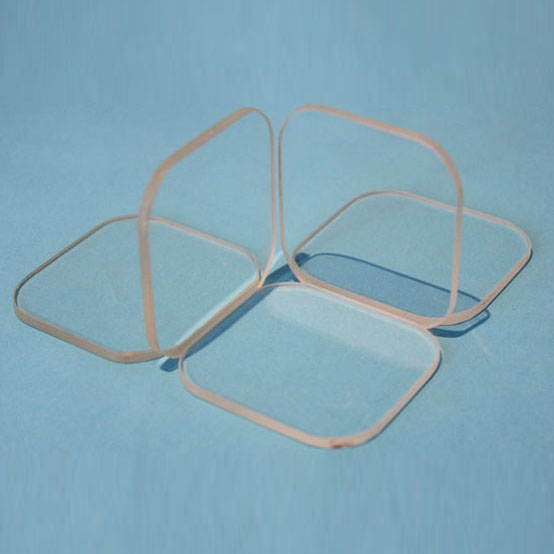
High-borosilicate glass has an expansion coefficient of 3.3×10⁻⁶K-1 and can be tempered for high-temperature windows operating within 450℃. It is described as among the better heat-resistant products. Mainly float-produced, it allows large sheets, generally up to 750×1200, with larger sizes as technology improves. Uses include new/special technical glass in electrophoresis, microscopic fluidics, photovoltaics, high-temperature/high-pressure/acid-alkali-resistant sight glasses, microwave ovens, fireplaces and chemical piping. Low- and high-borosilicate glasses differ in thermal expansion and chemical composition, including silica/boron-oxide content. Brand: 景盛光学. Type: borosilicate glass. Dimensions are customized.
 Save to Favorites
Overview
Specifications
| Parameter | Value |
|---|---|
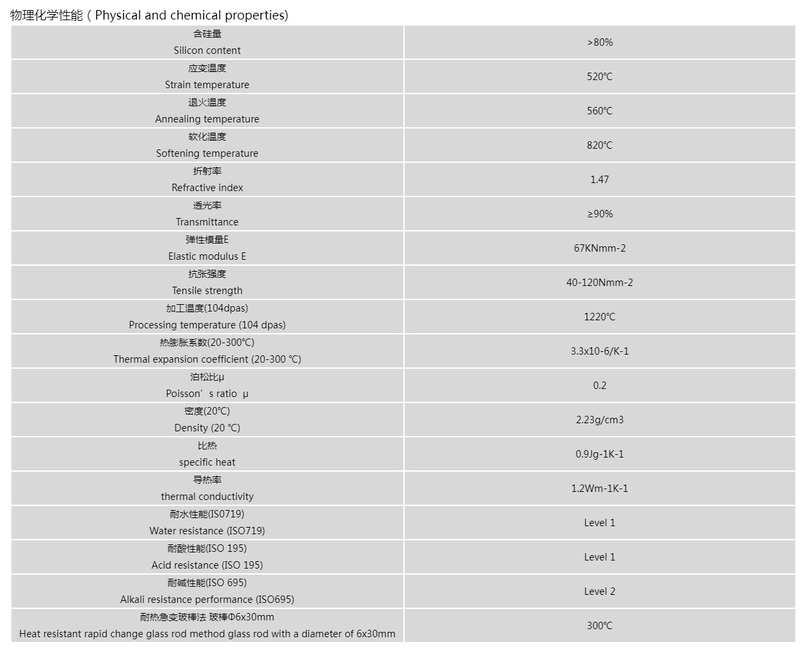
| Silicon Content | >80 % |
| Strain Temperature | 520 °C |
| Annealing Temperature | 560 °C |
| Softening Temperature | 820 °C |
| Refractive Index | 1.47 |
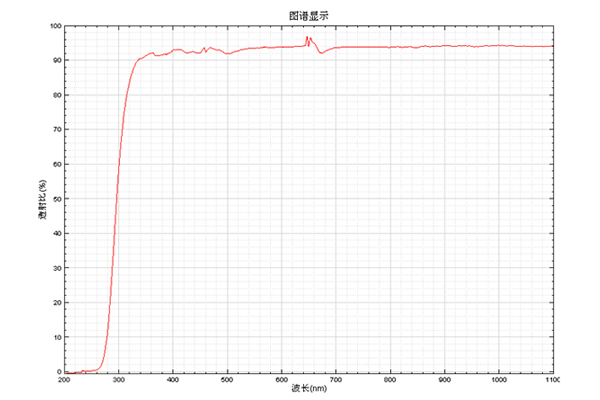
| Transmittance | ≥90 % |
| Elastic Modulus E | 67 KNmm-2 |
| Tensile Strength | 40-120 Nmm-2 |
| Processing Temperature (104dpas) [Source 104dpas Retained without Inferring Exponent] | 1220 °C |
| Thermal Expansion Coefficient [20-300°C; Original Compound Unit Expression Retained] | 3.3x10⁻⁶/K-1 |
| Poisson's Ratio μ | 0.2 |
| Density [20°C] | 2.23 g/cm3 |
| Specific Heat | 0.9 Jg-1K-1 |
| Thermal Conductivity | 1.2 Wm-1K-1 |
| Water Resistance [ISO719] | Level 1 |
| Acid Resistance [ISO 195] | Level 1 |
| Alkali Resistance [ISO 695] | Level 2 |
| Thermal Shock Resistance by Glass Rod Method [Glass Rod Φ6x30mm] | 300 °C |
Datasheet
Please provide your email to download the datasheet.
Invalid email format. Please try again.
Supplier Information
Related Products
-
 Zinc Selenide (ZnSe) Lens
Optical Material
Szgladsome
Design Wavelength: 10.6nm Focal Length Tolerance: ±1% Outline Tolerance: +0.0/-0.1mm
Zinc selenide has low absorption for infrared wavelengths and can transmit visible light, making it the preferred material for manufacturing infrared lenses, windows, output couplers, and beam expanders.
-
 Infrared Anti-Reflection AR8000-14000nm + DLC (Chalcogenide Glass)
Optical Material
Mirhz
Average transmittance Tavg [8000~14000nm]: Tavg≥80%
AR8000-14000+DLC
-
 AR8000-14000nm+DLC Infrared Antireflection Sensing Element
Optical Material
Mirhz
Average transmittance Tavg [8000~14000nm]: Tavg≥80%
AR8000-14000+DLC
-
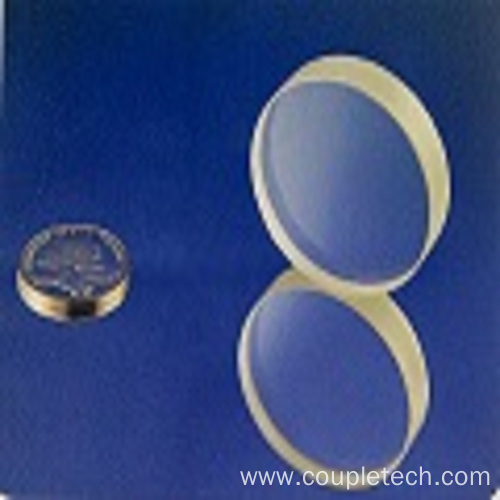 Barium Fluoride BaF2 Crystal Windows
Optical Material
Coupletech
Surface Quality: 20/10 Maximum Of Material Diameter Φ: Φ180mm Clear Aperture: 85%
Barium Fluoride BaF2(IR) Crysta is transparent from the ultraviolet to the infrared, from 150-200nm to 11-11.5 μm, and can be used as a material to make optical components such as lenses. BaF2 IR Crystal is used in Optical Windows for infrared spectroscopy, in particular in the field of fuel oil analysis. BaF2's transmittance at 200nm is relatively low (0.60), but at 500nm it goes up to 0.96-0.97 and stays at that level until 9 μm, then it starts falling off (0.85 for 10 μm and 0.42 for 12 μm). The refractive index is about 1.46 from 700nm to 5 μm. BaF2 IR Crystal is used as a preopacifying agent and in enamel and glazing frits production. BaF2 IR Crystal is also used in metallurgy, as molten bath for refining aluminum. BaF2 IR Viewport Windows for Infrared Thermography at 8 μm to 14 μm. Various optics for IR and VUV application, using our Optical Lenses of BaF2 ; Good quality BaF2 scintillation crystal; Good quality BaF2 crystal blank materials; oem service for good quality BaF2 crystals. Coupletech are the manufacturer and processor of Calcium Fluroide, with rohs environmental protection requirements. Also provide other Optical Elements such as: Optical Filters, beamsplitter, Optical Mirrors and optical prism.
-
 Calcium Fluoride CaF2 Crystal Windows
Optical Material
Coupletech
Surface Quality: 20/10 Clear Aperture: 85% Maximum Of Material Diameter Φ: Φ375mm
Calcium Fluoride (CaF2) crystal has excellent transmission in the UV, they are often used to make windows from below 150 nm and extending throughout the visible range. The material of CaF2 IR Windows are relatively soft and somewhat hygroscopic, Polished surfaces are stable and will last several years under normal conditions,so polishing and coating during processing are more critical. Coupletech provides CaF2 IR crystal shows good optical and thermo-mechanical properties, can be used for Optical Windows, Optical Mirrors , Optical Lenses, Optical prisms within a wide range from 130nm to 9μm. CaF2 has optical properties of isotropy, low absorption and low refractive index, which made Calcium Fluoride (CaF2) gain the unique advantages in the application of high power lasers. CaF2 IR viewport Windows for Infrared Thermography at 8μm to 10μm; Various optics for IR & VUV application. Using Coupletech Calcium Fluoride CaF2 crystal materials; Good quality CaF2 crystal blank materials; OEM service for good quality CaF2 crystals. Coupletech also provides other Optical Elements such as : Optical Filters and Beamsplitter.
Related Articles
Driven by the rapid upgrading of intelligent vehicles, optoelectronic sensing technologies represented by laser sensing and infrared thermal imaging have become core pillars for high-level autonomous driving and smart cockpit iteration. Leveraging automotive-grade optoelectronic R&D advantages, Pilot Technology Group launches the VITAL intelligent vehicle solution. By integrating high-power VCSEL laser chips and vehicle infrared night-vision thermal imagers, the system comprehensively enhances vehicle environmental perception and realizes safer, smarter and more comfortable driving experiences.
A laser bar is an array semiconductor laser chip integrated with dozens of emitters, which realizes hundred-watt quasi-continuous output on a single chip. With regular emitter arrangement and controllable fill factor, integrated thermal design and superior wall-plug efficiency compared to single chips, it acts as the core light source for high-power pumping, medical lasers and precision processing.
Widely adopted in small home appliances, industrial instruments, smart toys and atomization devices, the 0603 patch emerald green LED serves as a core status-indicating optical component.
Polycom Photonics Co., Ltd focuses on the R&D and mass production of high-stability, narrow-linewidth laser sources for optical sensing applications. The company provides cost-effective and high-precision optical sensing lasers with a wavelength coverage from 689nm to 2350nm. Featuring accurate wavelength control and outstanding spectral stability, these laser products are widely applied in atomic spectrum detection, element precision measurement and professional optoelectronic sensing systems.
Loading...
Name
Phone
Organization
Use Case

Database Platform