
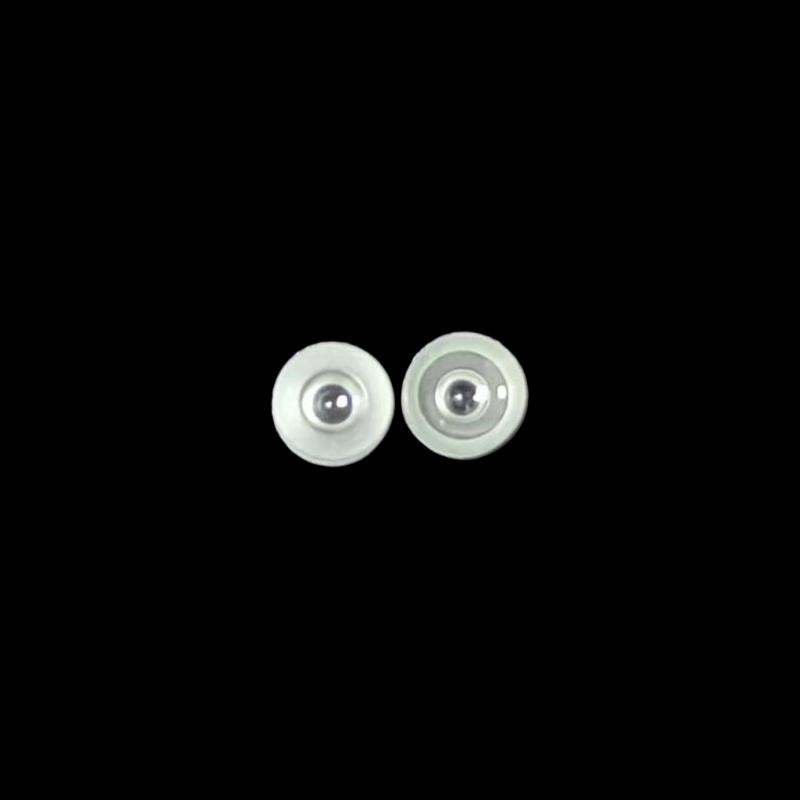
Outer Diameter 3.98mm Biconcave Lens
A biconcave lens has two concave spherical surfaces and negative focal length, with symmetric equal-radius or asymmetric unequal-radius forms. It diverges/expands beams or corrects spherical aberration, distortion and field curvature from plano-convex/biconvex lenses in ultraminiature optics. The source describes directionally optimized divergence: facing the concave spherical surface toward incident light minimizes aberrations and gives uniform divergence. It cannot form an imaging system alone and must combine with positive elements. A compact 3.98mm diameter offers stable optics. CA is generally ≥3.58mm, stated as over 90% of diameter. A standard ultrafine chamfer <0.1mm×45° prevents chipping/scratching during clamping, ultrasonic cleaning and chip bonding without consuming excess optical-path space. Uses include fiber attenuators, miniature ranging/expansion, minimally invasive medical optics, wearable IR sensing and miniature-spectrometer calibration requiring tight space and beam-control accuracy.
 Save to Favorites
Overview
Specifications
| Parameter | Value |
|---|---|
| Lens Types | Biconcave Lens |
| Diameter Range | 1.2mm-50mm |
| Outer Diameter Tolerance | +0/-0.01mm |
| Thickness Tolerance (Thickness Deviation) | ±0.01mm |
| Surface Finish | 10/5~80/50 |
| Eccentricity Error | 1'~5’ |
Datasheet
Please provide your email to download the datasheet.
Invalid email format. Please try again.
Supplier Information
Related Products
-
 Antireflection-Coated Lens Element
Optical Lenses
Nyyingrui
-
 Antireflection-Coated Lens Element P
Optical Lenses
Nyyingrui
-
 Antireflection-Coated Lens Element B
Optical Lenses
Nyyingrui
-
 Antireflection-Coated Lens Element E
Optical Lenses
Nyyingrui
-
 Antireflection-Coated Lens Element L
Optical Lenses
Nyyingrui
Related Articles
As a core precision optical component for wavelength screening, frequency locking and spectral demodulation, optical etalons are widely used in high-end scientific research and precision laser equipment.
Shanghai Connet Laser Technology Co., Ltd. focuses on technological innovation, delivering cutting-edge photonic products & solutions for industrial lasers, LiDAR, fiber optic sensing, coherent telecom, cold atom physics and precision spectroscopy research & mass manufacturing.
A solid-state laser is one of the most common and reliable laser types used in modern industry, medical equipment, and scientific research. Unlike gas or fiber lasers, it uses solid materials as its gain medium to generate stable, high-brightness laser beams. Thanks to its high precision, long lifespan, and compact structure, solid-state lasers have become a mainstream solution for high-precision laser processing and optical systems.
Driven by worldwide energy‑structure transformation, the lithium‑ion battery industry is expanding rapidly as green, high‑efficiency energy‑storage devices gain surging global market demand. With years‑long dedication to intelligent manufacturing, Han’s Laser Lithium‑battery Intelligent Equipment has accumulated solid R&D strength and rich practical experience. By integrating multiple cutting‑edge technologies, the company delivers high‑efficiency, eco‑friendly and sustainable lithium‑ion battery production lines, bringing revolutionary upgrades to the new‑energy battery sector.
Loading...
Name
Phone
Organization
Use Case

Database Platform