
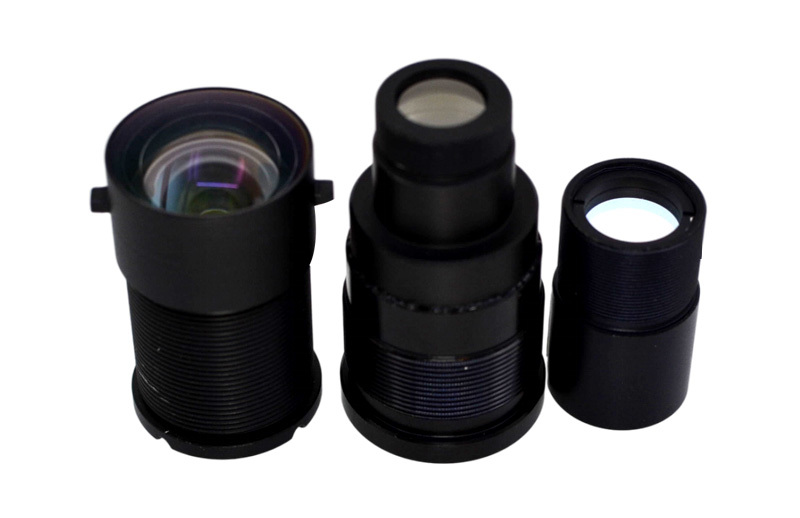
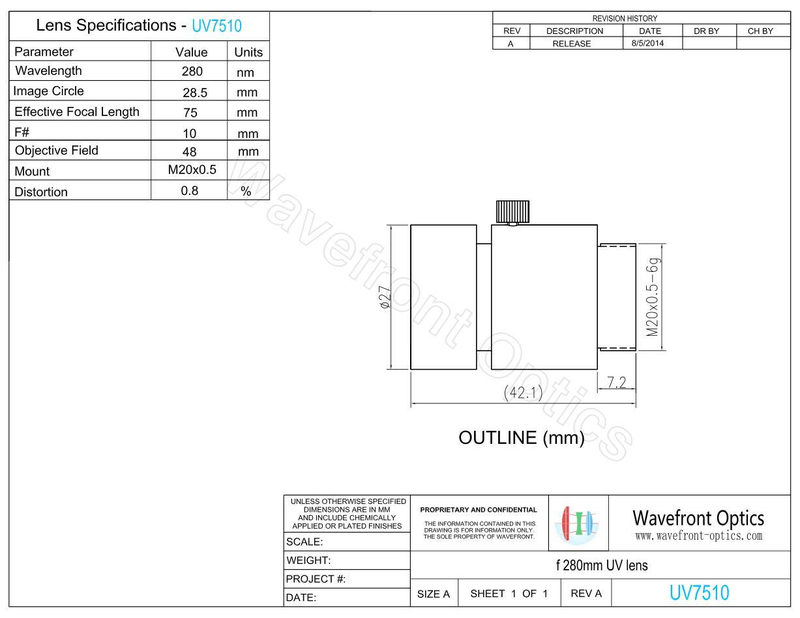
f280mm UV Lens UV7510
The description states that solar radiation at 200–280nm is completely absorbed by ozone while crossing the atmosphere; lower-atmosphere scattering and ground-level ozone also absorb it, creating a natural dark region near the ground with almost no naturally occurring solar-blind UV signals. UV systems require chromatic correction over their spectral range. Allocating optical power using material dispersion is important, but few UV materials and small dispersion differences make correction difficult. High SNR requires a large relative aperture. Correcting such systems calls for high-index materials, whereas UV-transmitting materials have indices below 1.46. More transmitting elements or thicker lenses are therefore needed, lowering transmission and partly offsetting the optical gain from the large aperture.
 Save to Favorites
Overview
Specifications
| Parameter | Value |
|---|---|
| EFL | 75 mm |
| Wavelength | 280 nm |
| F# | 10.0 |
Applications
Datasheet
Please provide your email to download the datasheet.
Invalid email format. Please try again.
Supplier Information
Related Products
-
 Antireflection-Coated Lens Element
Optical Lenses
Nyyingrui
-
 Antireflection-Coated Lens Element P
Optical Lenses
Nyyingrui
-
 Antireflection-Coated Lens Element B
Optical Lenses
Nyyingrui
-
 Antireflection-Coated Lens Element E
Optical Lenses
Nyyingrui
-
 Antireflection-Coated Lens Element L
Optical Lenses
Nyyingrui
Related Articles
Raybowlaser, a professional manufacturer of high-power laser chips, has officially launched its upgraded new-generation 1470nm high-performance laser chip. Achieving groundbreaking progress in rated output power and wall-plug efficiency (WPE), this innovative laser chip delivers superior and reliable core light source solutions for medical cosmetology, industrial processing, agricultural applications and scientific research equipment.
Electro-optic deflectors (EODs) are optical devices used to steer or deflect light beams by applying an electric field to a specialized optical crystal. Unlike mechanical beam steering systems that rely on moving mirrors, electro-optic deflectors enable high-speed, non-mechanical beam control with exceptional precision and responsiveness. They are widely used in laser scanning, optical communications, microscopy, laser printing, spectroscopy, and scientific research, where rapid and accurate laser beam positioning is essential.
Founded in 2004, Wuhan Union Optic Inc. is a National Specialized, Refined, Unique & Innovative "Little Giant" high-tech enterprise located in Wuhan East Lake High-Tech Development Zone.
Precise spectral screening is essential for high-precision medical detection, spectroscopic analysis and intelligent imaging systems. Tailored for visible and near-infrared spectral separation, the SP900 shortpass optical filter delivers high-efficiency light transmission and deep infrared blocking performance. It effectively eliminates stray light interference, improves signal-to-noise ratio (SNR), and serves as a core optical component for biomedical instruments, scientific analysis equipment and machine vision systems.
Loading...
Name
Phone
Organization
Use Case

Database Platform