
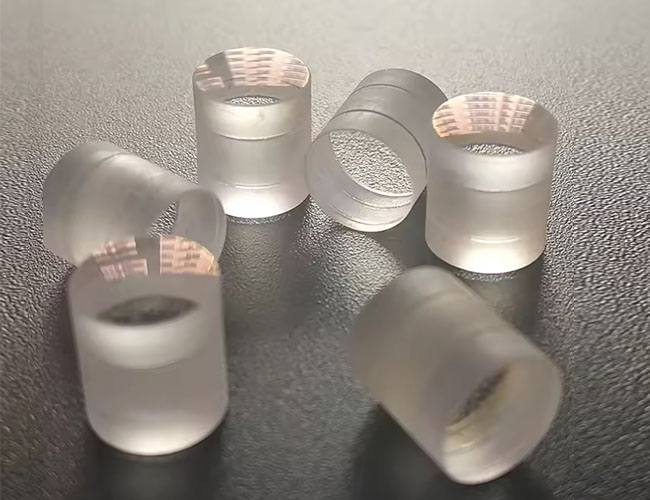
N-F2 / N-BK7 / N-F2 Triplet Lenses
N-BK7(H-K9L) nd:1.516800 vd:64.20 ρ(g/cm³):2.52 N-F2(H-F4) nd:1.620050 vd:36.35 ρ(g/cm³):2.67 How are materials selected for triplet achromatic lenses? The choice of material for triplet achromatic lenses is critical and directly affects chromatic aberration correction and optical performance. The following are the main considerations and selection methods: 1. Dispersion characteristics Abbe number: choose a material with a large difference in Abbe number, usually one piece of low dispersion material (corona glass, high Abbe number) and the other piece of high dispersion material (flint glass, low Abbe number) to effectively correct for color differences. 2. Refractive index Refractive index matching: selection of materials with different refractive indices to help correct spherical aberration and other aberrations. Typically, a high index material is used for positive lenses and a low index material is used for negative lenses. 3. Optical properties Transmittance: the material should have high transmittance in the working band to minimize light loss. Homogeneity: the material should be optically homogeneous to avoid affecting the imaging quality. 4. Mechanical and thermal properties Mechanical strength: the material should have sufficient mechanical strength to withstand the stresses of processing and use. Thermal stability: the coefficient of thermal expansion and thermal stability of the material should be suitable for the working environment to avoid temperature changes affecting the performance. 5. Cost and availability Cost: select materials that cost less while meeting performance requirements. Availability: materials should be easily accessible to ensure sustainability in production and maintenance. 6. Processing performance Processing difficulty: the material should be easy to process and polish to ensure the surface accuracy and finish of the lens. Relative Partial Dispersions N-BK7(H-K9L): Ps,t: 0.3071; N-BK7(H-K9L): P's,t: 0.3049; N-F2(H-F4): Ps,t: 0.2379; N-F2(H-F4): P's,t: 0.2346 N-BK7(H-K9L): PC,s: 0.5588; N-BK7(H-K9L): P'C',s: 0.6038; N-F2(H-F4): PC,s: 0.4919; N-F2(H-F4): P'C',s: 0.5305 N-BK7(H-K9L): Pd,C: 0.3073; N-BK7(H-K9L): P'd,C': 0.2562; N-F2(H-F4): Pd,C: 0.2934; N-F2(H-F4): P'd,C': 0.2439 N-BK7(H-K9L): Pe,d: 0.2386; N-BK7(H-K9L): P'e,d: 0.2370; N-F2(H-F4): Pe,d: 0.2366; N-F2(H-F4): P'e,d: 0.2334 N-BK7(H-K9L): Pg,F: 0.5359; N-BK7(H-K9L): P'g,F': 0.4761; N-F2(H-F4): Pg,F: 0.5885; N-F2(H-F4): P'g,F': 0.5211 N-BK7(H-K9L): Pi,h: 0.7499; N-BK7(H-K9L): P'i,h: 0.7447; N-F2(H-F4): Pi,h: 0.9570; N-F2(H-F4): P'i,h: 0.9438 Abnormal Dispersions N-BK7(H-K9L): △PC,t: 0.0171; N-BK7(H-K9L): △PC,s: 0.0052; N-F2(H-F4): △PC,t: 0.0122; N-F2(H-F4): △PC,s: 0.0042 N-BK7(H-K9L): △PF,e: -0.0006; N-BK7(H-K9L): △Pg,F: -0.0005; N-F2(H-F4): △PF,e: 0.0002; N-F2(H-F4): △Pg,F: 0.0047
 Save to Favorites
Overview
Datasheet
Please provide your email to download the datasheet.
Invalid email format. Please try again.
Supplier Information
Related Products
Related Articles
Laser pump sources are the core energy input component of solid-state lasers and laser amplifiers, and their performance directly determines the output power, beam quality and service life of the entire laser system. In scenarios such as industrial processing, scientific research experiments and high-end equipment, improper pump source selection will not only result in substandard system performance, but also bring a series of problems such as rapid device degradation and high operation and maintenance costs. This article sorts out the core selection logic and key pitfalls of pump source procurement, and provides selection references based on mature, mass-produced high-reliability products to help purchasers efficiently screen suitable products.
Widely adopted in small home appliances, industrial instruments, smart toys and atomization devices, the 0603 patch emerald green LED serves as a core status-indicating optical component.
An infrared transmitter (IR transmitter) is a basic electronic component that sends invisible infrared light signals for short-range wireless control. It is widely used in daily electronics, smart home devices, and industrial equipment due to its low cost, low power consumption, and stable performance.
Fluoride crystal glass and K9 optical glass are two core optical substrates widely used in precision optical systems, laser equipment and photoelectric scientific research.
Loading...
Name
Phone
Organization
Use Case

Database Platform