
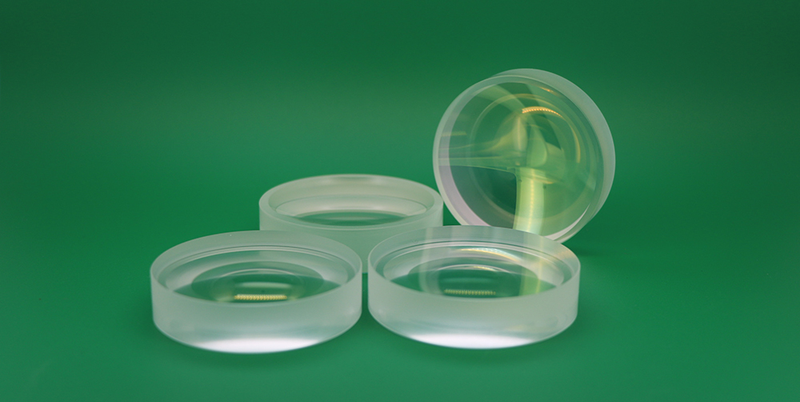
Plano-Concave Lens
Plano-concave lenses. Concave lenses, also called negative spherical lenses, are thin at the center and thick at the edge, with inward-curving surfaces. They diverge light: parallel rays emerge as if coming from a virtual focus on the incident side. Manufacturing involves grinding, polishing, edging, and coating, followed by strict inspection of radius of curvature, local fringes, surface finish, centration, focal length, and other parameters to ensure required optical performance. Longze Optics offers a broad catalog for rapid delivery of standard sizes/focal lengths, using materials including quartz, optical glass, and silicon. They are widely used in laser beam shaping, optical cutting, and optical detection. When one concave lens cannot meet advanced laser requirements, the company recommends combining it with other optics. Longze Optics provides custom plano-concave lenses from customer designs, drawings, and specifications. The source's incomplete wording refers to meeting complex requirements or producing fused-silica, N-BK7, 1064nm, silicon, and other plano-concave lenses. Strict parameter control ensures precise designs for each batch of custom fused-silica, N-BK7, 1064nm, and other optical-system plano-concave lenses. Contact the company for details. Glossary keywords: Endoscope—an inspection instrument combining traditional optics, ergonomics, precision mechanics, modern electronics, mathematics, and software, with image sensors, optical lenses, illumination, and mechanical devices. It enters the stomach through the mouth or the body through other natural openings. It can show lesions not visible on X-rays; for example, doctors can observe gastric ulcers or tumors and plan treatment. Optical imaging—technology that captures and presents images using optical principles. Precision lens systems focus reflected, refracted, or scattered light to form realistic, clear images at an image plane. Optical-signal coupling—the source describes an optocoupler comprising an LED and photosensitive element. An electrical input drives the LED; the receiver converts emitted light into a corresponding electrical signal. Electrical isolation reduces signal interference and effects of high voltage on low-voltage circuits. Axicon—a lens with a conical rather than spherical or cylindrical surface, developed for special needs such as nondiffracting beams and long-distance focusing. Bessel beam—a nondiffracting beam whose transverse field is described by a Bessel function of the first kind. Its transverse field is described as remaining undiffracted during propagation, with self-reconstruction, and maintaining its profile over longer distances than a same-size Gaussian beam. Optical detection—receiving laser light and measuring output characteristics. The system converts changes in received laser signals into electrical signals, transforming optical into electrical information for different processing methods and detection purposes.
 Save to Favorites
Overview
Applications
Datasheet
Please provide your email to download the datasheet.
Invalid email format. Please try again.
Supplier Information
Related Products
Related Articles
Laser pump sources are the core energy input component of solid-state lasers and laser amplifiers, and their performance directly determines the output power, beam quality and service life of the entire laser system. In scenarios such as industrial processing, scientific research experiments and high-end equipment, improper pump source selection will not only result in substandard system performance, but also bring a series of problems such as rapid device degradation and high operation and maintenance costs. This article sorts out the core selection logic and key pitfalls of pump source procurement, and provides selection references based on mature, mass-produced high-reliability products to help purchasers efficiently screen suitable products.
Widely adopted in small home appliances, industrial instruments, smart toys and atomization devices, the 0603 patch emerald green LED serves as a core status-indicating optical component.
An infrared transmitter (IR transmitter) is a basic electronic component that sends invisible infrared light signals for short-range wireless control. It is widely used in daily electronics, smart home devices, and industrial equipment due to its low cost, low power consumption, and stable performance.
Fluoride crystal glass and K9 optical glass are two core optical substrates widely used in precision optical systems, laser equipment and photoelectric scientific research.
Loading...
Name
Phone
Organization
Use Case

Database Platform