Biconcave Lens

Biconcave Lens

Supplier
CLZ-Optics
Category
Optical Lenses
Origin
China

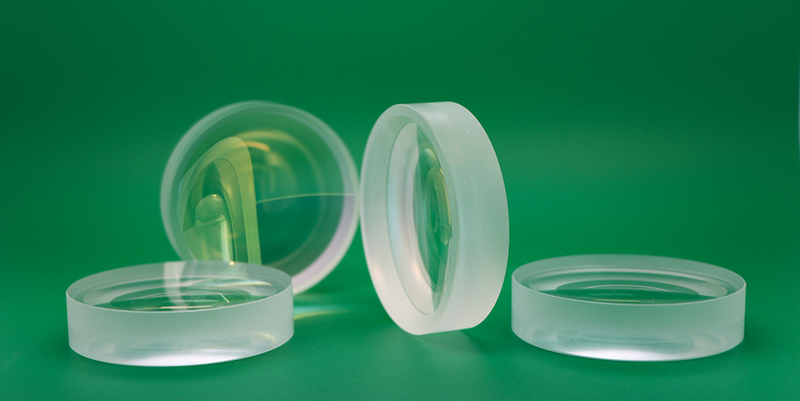
Biconcave lenses. Structure/principle: negative spherical lenses with negative focal lengths, symmetric concave spherical surfaces, thin centers, and thick edges. Parallel rays refract outward rather than converge as in convex lenses. Negative focal length/divergence arise from both concave surfaces; backward ray extensions meet at a virtual focus and cannot form real images. AR coatings match operating bands in instruments, electronics, and energy equipment. Visible-to-mid-IR uses include lasers, imaging, illumination, camera lenses, laser windows, fiber modules, and solar panels for divergence, path compensation, and aberration correction. Symmetric surfaces balance spherical aberration in symmetric diverging systems such as expanders; asymmetric curvature compensates specific aberrations. Functions include beam expansion/collimation, diameter control, projection/instrument path correction, focal-length adjustment, and aberration correction, with farsightedness correction given as an example. Compared with plano-concave lenses, symmetric biconcave structures offer greater divergence efficiency and suit symmetric paths. Catalog materials include N-BK7 or equivalent and fused silica. N-BK7 covers visible/NIR; fused silica covers UV/visible/NIR. 1. Symmetry/divergence: two concave surfaces and thin centers/thick edges give negative focal length set by curvature. Two refractions diverge parallel rays as if from a virtual focus behind the lens. 2. Aberration/path optimization: adjusting curvature-radius ratios compensates spherical/chromatic aberrations. In expanders/projectors, biconcave lenses enlarge beams or collimate divergence and improve symmetry.

Request a Quote Download Datasheet
Save to Favorites Save to Favorites

Overview

Biconcave lenses. Structure/principle: negative spherical lenses with negative focal lengths, symmetric concave spherical surfaces, thin centers, and thick edges. Parallel rays refract outward rather than converge as in convex lenses. Negative focal length/divergence arise from both concave surfaces; backward ray extensions meet at a virtual focus and cannot form real images. AR coatings match operating bands in instruments, electronics, and energy equipment. Visible-to-mid-IR uses include lasers, imaging, illumination, camera lenses, laser windows, fiber modules, and solar panels for divergence, path compensation, and aberration correction. Symmetric surfaces balance spherical aberration in symmetric diverging systems such as expanders; asymmetric curvature compensates specific aberrations. Functions include beam expansion/collimation, diameter control, projection/instrument path correction, focal-length adjustment, and aberration correction, with farsightedness correction given as an example. Compared with plano-concave lenses, symmetric biconcave structures offer greater divergence efficiency and suit symmetric paths. Catalog materials include N-BK7 or equivalent and fused silica. N-BK7 covers visible/NIR; fused silica covers UV/visible/NIR. 1. Symmetry/divergence: two concave surfaces and thin centers/thick edges give negative focal length set by curvature. Two refractions diverge parallel rays as if from a virtual focus behind the lens. 2. Aberration/path optimization: adjusting curvature-radius ratios compensates spherical/chromatic aberrations. In expanders/projectors, biconcave lenses enlarge beams or collimate divergence and improve symmetry.

Applications

Medical imaging: flexible endoscopes use biconcave lenses to spread illumination evenly through narrow digestive/vascular spaces, with fibers/microlenses improving clarity. Retinal instruments expand fundus scan fields to improve lesion detection. VR/AR: lightweight headsets combine biconcave lenses/waveguides to spread microdisplay light, widen FOV, and reduce fatigue. Consumer electronics: ultrathin multicamera phone modules use them with other lenses to correct wide-angle distortion/chromatic aberration and improve edges. Laser projectors spread beams for uniform spots and reduced edge dimming. Autonomous driving/LiDAR: solid-state lidar expands coverage for short-range resolution, such as blind spots. Environmental monitoring: aerosol lidar spreads transmit beams to reduce scattered-light echo interference and improve particle detection. Laser processing: prediverging powerful beams before focusing improves uniformity and reduces thermal damage. Art/interactive installations: motorized rotation/translation dynamically changes spot shape/size for light sculptures or immersive projections. Education: demonstrate virtual foci/divergence and negative focal lengths. Virtual images lie on the object side near the lens, useful where real images are unnecessary, such as visual aids. Compensation/correction: compound microscope/camera groups combine concave/convex lenses to cancel spherical/chromatic aberration, such as achromatic doublets. Laser collimators first diverge beams with biconcave lenses, then collimate with convex lenses to expand diameter, widely used in expanders. Diffusion/homogenization: LED backlights use them for uniform LCD illumination; cutting/welding spreads high-energy beams to lower local density and prevent ablation. Virtual imaging/simulation: teaching simulates virtual images, while optical tests combine biconcave lenses with planes for camera-focus calibration.

Datasheet

Please provide your email to download the datasheet.

Your name
Email Address

Invalid email format. Please try again.

Send Request

Supplier Information

CL
CLZ-Optics
View Supplier →
Changchun Longze Precision Optical Instrument Co., Ltd., established in 2012, specializes in the processing and manufacturing of precision optical components. Its products are applied in fields such as optical imaging instruments, optical testing instruments, medical instruments, and laser instruments. With excellent quality and exquisite craftsmanship, it has won wide acclaim from customers at home and abroad. Adhering to the concept of 'fine products, dedicated to quality' and strictly following the ISO9001 quality certification system, the company possesses advanced inspection equipment such as ZYGO interferometers, Agilent Cary 5000 spectrophotometers, etc., ensuring each product meets specifications. Its products are widely exported to developed markets like the US, EU, and Japan. Main products include precision optical lenses, optical domes, filters, mirrors, optical windows, prisms, assembly, and coatings, used in various commercial, medical, scientific research, imaging systems, and laser systems.

Request a Quote

Our team responds within 24–48 hours
Biconcave Lens
CLZ-Optics · Optical Lenses
Direct from Manufacturer
Your inquiry will be sent directly to the manufacturer
Photonics Source Platform
We handles the inquiry on your behalf
Your information is protected and will never be shared without consent.
Contact Us

Loading...

GetExperimental Plan

Name

Phone

+86

Organization

Use Case

AI Parametric Selection
Smart Match · Precise Recs
Enter Specifications
AI Smart Matching
Get Best Matches
Skip Manual Comparison
Find Best Solutions Fast
Select Now →