
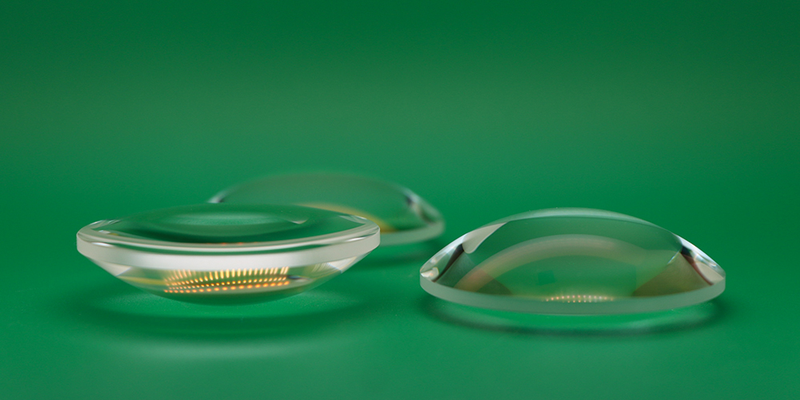
Biconvex Lens
Biconvex lenses have two outward-curving faces that converge light through refraction. For parallel input, the first face bends rays toward the center and the second increases convergence to the focus. Power depends on both radii and refractive index; greater curvature and index strengthen focusing. They are basic focusing and imaging elements. Light refracts on entering from air and again on exiting. Surface shape and refractive indices determine the path, described in the source as producing convergence or divergence. Longze Optics offers catalog and custom biconvex lenses for varied applications and systems, made to customer drawings or specifications. Materials including optical glass and fused silica, sizes, precision machining, and coatings can be tailored to requirements.
 Save to Favorites
Overview
Applications
Key Features
Datasheet
Please provide your email to download the datasheet.
Invalid email format. Please try again.
Supplier Information
Related Products
Related Articles
Laser pump sources are the core energy input component of solid-state lasers and laser amplifiers, and their performance directly determines the output power, beam quality and service life of the entire laser system. In scenarios such as industrial processing, scientific research experiments and high-end equipment, improper pump source selection will not only result in substandard system performance, but also bring a series of problems such as rapid device degradation and high operation and maintenance costs. This article sorts out the core selection logic and key pitfalls of pump source procurement, and provides selection references based on mature, mass-produced high-reliability products to help purchasers efficiently screen suitable products.
Widely adopted in small home appliances, industrial instruments, smart toys and atomization devices, the 0603 patch emerald green LED serves as a core status-indicating optical component.
An infrared transmitter (IR transmitter) is a basic electronic component that sends invisible infrared light signals for short-range wireless control. It is widely used in daily electronics, smart home devices, and industrial equipment due to its low cost, low power consumption, and stable performance.
Fluoride crystal glass and K9 optical glass are two core optical substrates widely used in precision optical systems, laser equipment and photoelectric scientific research.
Loading...
Name
Phone
Organization
Use Case

Database Platform