
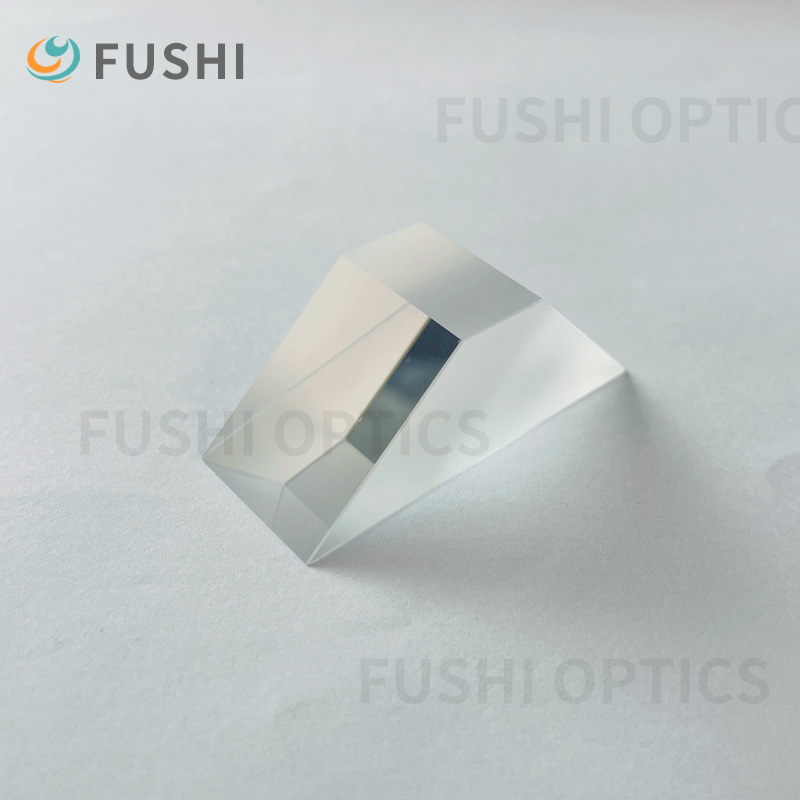
Dove Prism TJFSGXGDWLJ2010-4
A Dove Prism rotates images while preserving path direction. It inverts images by 180°, and rotating about its axis rotates the image by twice that angle. Metallic versions can replace retroreflectors. Comparison, Dove versus right-angle prism: parallel input/output versus 90°/180° turning; pure rotation versus mirroring/inversion; active rotational orientation versus fixed mounting; precision rotation mechanism versus static installation without moving parts. Material considerations and paired coating notes: wavelength choice, UV fused silica or IR Si/Ge, paired with AR coatings such as 355 nm laser coatings; refractive index affects rotation and displacement and must match the system, again paired with AR coatings such as 355 nm coatings; temperature stability favors low-expansion fused silica, paired with metallic aluminum/silver coatings when used as mirrors; BK7 suits ordinary use while crystals cost more and require precision processing, again paired with metallic mirror coatings.
 Save to Favorites
Overview
Specifications
| Parameter | Value |
|---|---|
| Uncoated Dove Prism - Dimensions A | 20.00 mm × 28.28 mm × 80 mm × 20 mm |
| Uncoated Dove Prism - Coating Specifications | Uncoated |
| Uncoated Dove Prism - Material | H-K9L finely annealed optical glass |
| Uncoated Dove Prism - Dimensional Error | +0.0/-0.2 |
| Uncoated Dove Prism - Surface Figure | Wavelength/4 @ 632.8nm |
| Uncoated Dove Prism - Surface Quality | 60/40 |
| Uncoated Dove Prism - Bevel | 0.25~0.5mmX45° |
Applications
Key Features
Datasheet
Please provide your email to download the datasheet.
Invalid email format. Please try again.
Supplier Information
Related Products
-
 Polarizing Beamsplitter Prism
Prisms
Hjgdkeji
-
 Pentaprism
Prisms
Hjgdkeji
-
 Rhomboid Prism
Prisms
Hjgdkeji
-
 Trapezoidal Stepped Polyhedron
Prisms
Hjgdkeji
-
 Prism
Prisms
Bxoptic
Materials: Colorless optical glass, laser crystals, fused silica, radiation-resistant glass, UV and IR materials, such as: SiO₂, CaF₂, BaF₂, ZnSe, ZnS, Ge, Si, Al₂O₃, etc. Shape Range: 3~500 Shape Tolerance: ±0.005 ~±0.2
Related Articles
Driven by the rapid upgrading of industrial automation, high-precision displacement sensing technology has become a core foundation of intelligent manufacturing.
Widely adopted in small home appliances, industrial instruments, smart toys and atomization devices, the 0603 patch emerald green LED serves as a core status-indicating optical component.
Raybowlaser, a professional manufacturer of high-power laser chips, has officially launched its upgraded new-generation 1470nm high-performance laser chip. Achieving groundbreaking progress in rated output power and wall-plug efficiency (WPE), this innovative laser chip delivers superior and reliable core light source solutions for medical cosmetology, industrial processing, agricultural applications and scientific research equipment.
A solid-state laser is one of the most common and reliable laser types used in modern industry, medical equipment, and scientific research. Unlike gas or fiber lasers, it uses solid materials as its gain medium to generate stable, high-brightness laser beams. Thanks to its high precision, long lifespan, and compact structure, solid-state lasers have become a mainstream solution for high-precision laser processing and optical systems.
Loading...
Name
Phone
Organization
Use Case

Database Platform