
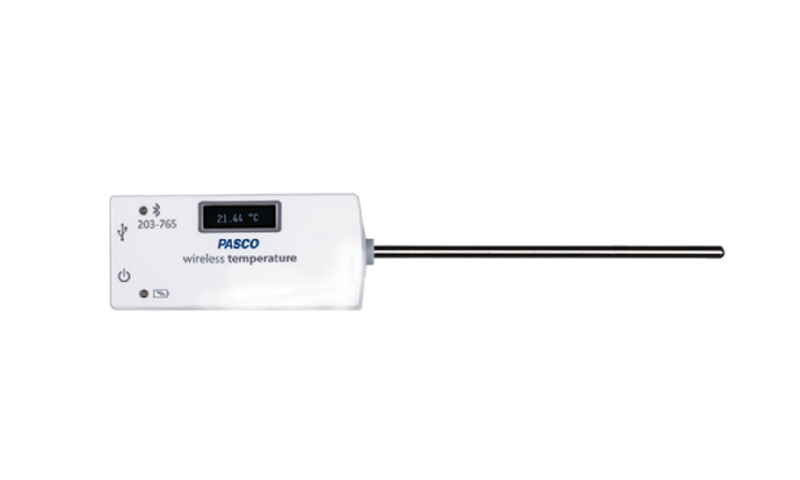
PS-4201 wireless digital-display temperature sensor
The PS-4201 wireless temperature sensor with digital display adds a numerical readout, letting users see live readings without additional software even when exploring outdoors in bright light. It retains high-quality live wireless temperature-data transmission, allowing continuous monitoring, recording, and graphing on almost any device. It suits many experiments and activities, accurately measuring subtle but significant temperature changes from chemical reactions, convection, and human skin temperature. Overview: We continue to improve our wireless temperature sensor with digital display. A new bright organic light-emitting diode (OLED) display shows live readings without additional software, even outdoors in bright light. When class ends but an experiment must continue, students can set the sensor to log autonomously for days, weeks, or even months, then download the data for later analysis. This durable wireless sensor has a stainless-steel probe for demanding applications and a built-in rechargeable battery charged through a standard USB-C cable. It suits many experiments and activities, accurately measuring subtle but significant temperature changes from chemical reactions, convection, and human skin temperature.
 Save to Favorites
Overview
Specifications
| Parameter | Value |
|---|---|
| Automatic power-off function | Automatic shutdown after 1 hour |
| Weight | Approximately 42 g |
| Measurement Range | -40 - 125 ºC |
| Resolution | 0.01 ºC |
| Accuracy | ±0.5 ºC |
| Maximum Sampling Rate | 10 Hz |
| Splash-protection rating | IPX4 (resists splashing water from any direction) |
| Probe material | 316 corrosion-resistant stainless steel |
| Probe diameter | 0.19 in (5.0 mm) |
| Probe length | 4.7 in (120 mm) |
| Response Time [Time to reach 63% of the target value following a step change in temperature] | 5.1 s to reach 63% of the target value following a step change in temperature |
| Connection Method | Bluetooth 5.2 |
| Data Logging Function | Present |
| Battery Type | Rechargeable lithium-ion battery |
Applications
Key Features
Datasheet
Please provide your email to download the datasheet.
Invalid email format. Please try again.
Supplier Information
Related Products
-
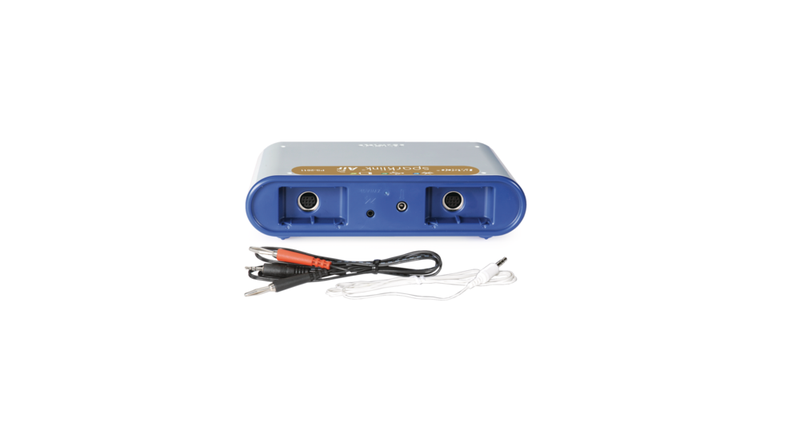 PS-2011 dual-channel Bluetooth interface
Sensors
Brolight
Interface Type: USB or Bluetooth 2.0 Interface: 4 (2 PASPORT interfaces, 1 voltage interface, 1 temperature interface)
The PS-2011 SPARKlink dual-channel Bluetooth interface lets teachers and students connect their devices by USB or Bluetooth to any of more than 70 PASPORT sensors in the PASCO range. Data are acquired with SPARKvue or PASCO Capstone. Teachers and students can use desktop or laptop computers running either program, or Bluetooth-enabled iOS or Android devices running the SPARKvue app. Note: SPARKlink Air connects to Google Chromebooks by USB but does not support Bluetooth connection to them.
-
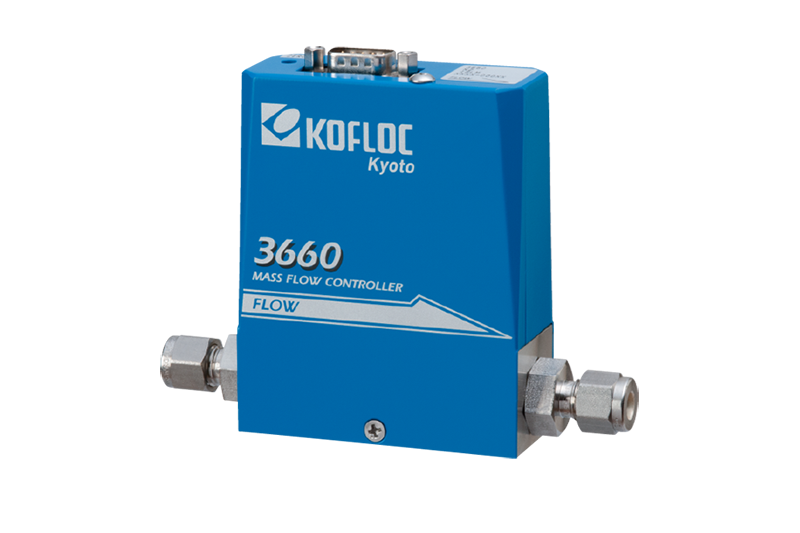 Gas mass flow controllers-3660 series
Sensors
Csl-vacuum
Flow-rate range [Different flow units at the two ends retained as in the source, without conversion]: 10SCCM~100SLM Gas/fluid: N2, AIR, H2, HE, AR, O2, CO2, etc. Electrical connection: Dsub 9-pin
An internal sensor measures gas flow in real time and compares it with the setpoint. The controller rapidly actuates a regulating valve, forming a closed loop that stabilizes actual flow precisely at the target.
-
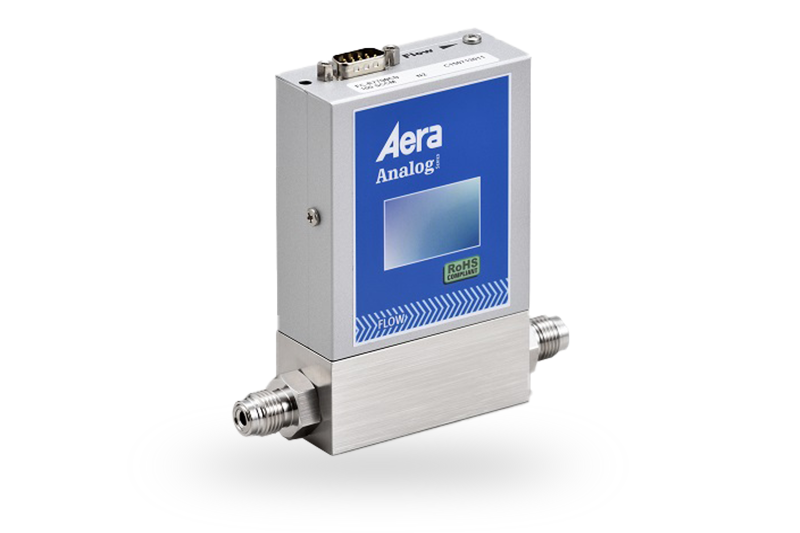 Gas mass flow controllers FC-R7700CD series
Sensors
Csl-vacuum
Flow-rate range [Different flow units at the two ends retained as in the source, without conversion]: 10SCCM~200SLM Gas/fluid: N2, AIR, H2, HE, AR, O2, CO2, etc. Electrical connection: Dsub 9-pin
An internal sensor measures gas flow in real time and compares it with the setpoint. The controller rapidly actuates a regulating valve, forming a closed loop that stabilizes actual flow precisely at the target.
-
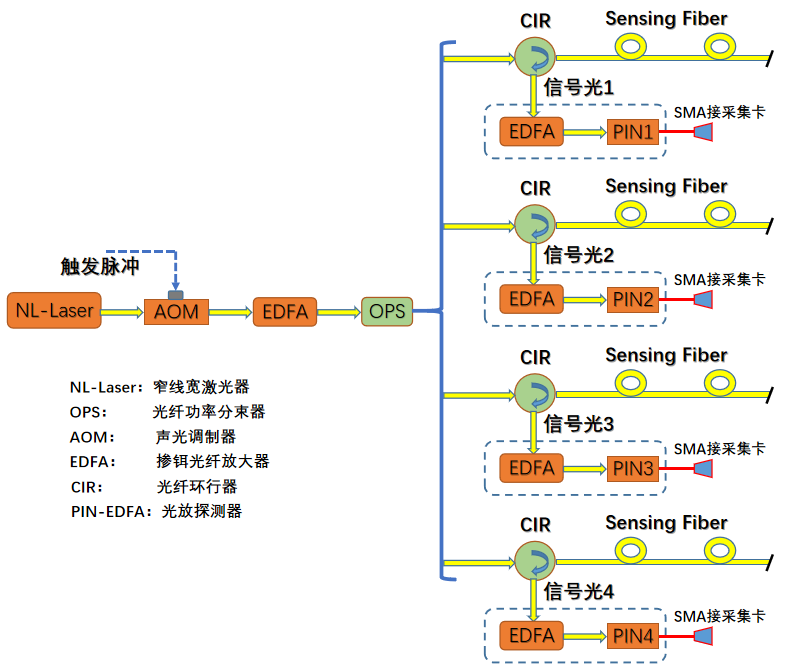 Fully integrated 4-channel DVS optical module
Sensors
Oe-photonics
Sensing distance: typical:20 km Number of detection channels: 4 channels Modulation mode: External modulation
For multichannel, fully integrated distributed vibration sensing (DVS), the DVS-AOM-L series uses an ultra-narrow-linewidth laser with optimized optomechanical/electrical integration. Serial-port parameter configuration, high integration, environmental-interference resistance, compact size, and convenience are provided. Sharing a narrow-linewidth laser reduces multichannel costs, particularly for demanding sensing applications. Custom solutions and specifications are available to sensor-equipment manufacturers.
-
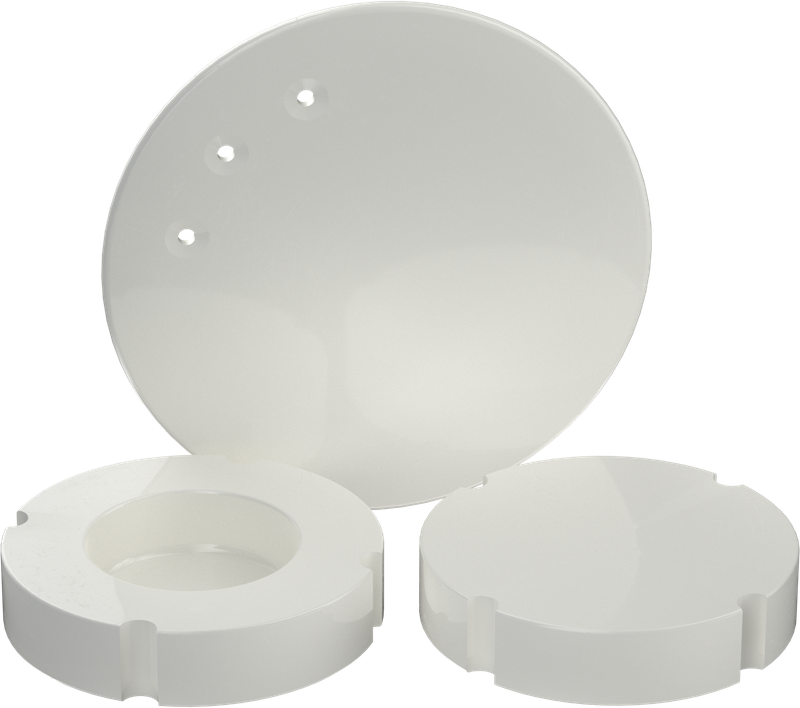 Ceramic pressure sensor
Sensors
Cctc
Ceramic parts for pressure sensors.
Related Articles
The ElFys PD25s series photodetectors adopt ElFys‑patented Black Silicon Induced Junction technology, delivering excellent spectral response spanning deep‑ultraviolet, visible and near‑infrared bands for diverse high‑precision photometry applications. Sub‑variants including H, M, HG and MG are optimised for low‑capacitance, low‑dark‑current and high‑reverse‑bias guard‑ring operations respectively. Multiple packaging configurations are available to satisfy various system‑design requirements.
Fomoptic delivers integrated one‑stop optical solutions covering precision optical fabrication and custom vacuum coating services. Supported by complete processing production lines, comprehensive metrology equipment and experienced engineering team, we provide full‑chain customized components, ranging from blank shaping, ultra‑precision polishing to thin‑film coating, for laser systems, infrared imaging, industrial optics and scientific‑research projects.
Wuhan Optical Valley Interlink Technology Co., Ltd. was founded in 2013 by a technical team from Huazhong University of Science and Technology.
For semiconductor, coating and laboratory vacuum chambers, thermal conductivity gauges suffer large measurement errors caused by gas type and ambient temperature.
Loading...
Name
Phone
Organization
Use Case

Database Platform