
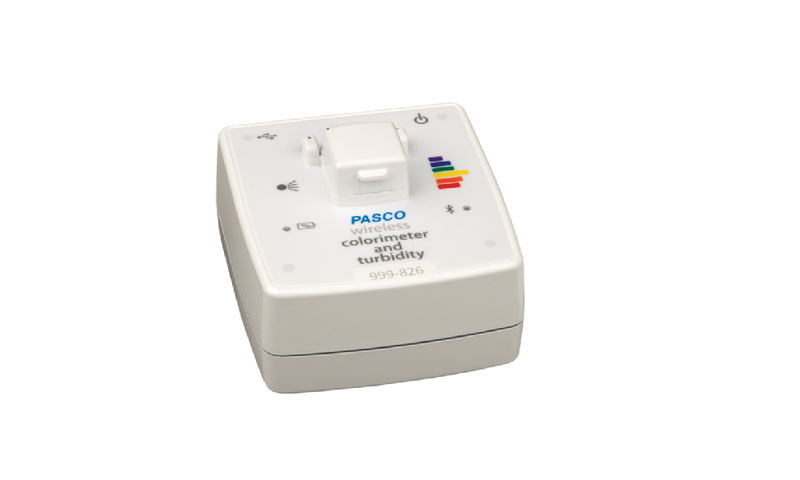
PS-3215 wireless colorimetry/turbidity sensor
The PS-3215 wireless colorimeter/turbidity sensor simultaneously measures absorbance and transmittance at six different wavelengths. It can be used to study Beer's law (absorbance versus concentration), enzyme activity, photosynthesis, and chemical reaction rates (absorbance versus time). It also serves as a high-quality turbidimeter for water-quality analysis. After simple calibration, students can quickly view real-time measurements at six visible wavelengths: 650nm (red), 600nm (orange), 570 nm (yellow), 550 nm (green), 500 nm (blue), and 450 nm (violet). Rather than only measuring transmitted light, the wireless colorimeter and turbidity sensor measures light scattered by the sample at 90 degrees for accurate, repeatable measurements. Its opaque cuvette compartment also reduces ambient-light interference to ensure measurement accuracy. Turbidity measurements require a cuvette with four clear sides. If a cuvette with two clear sides is used, at least orient a clear side toward the turbidity-measurement light source. When used with our ezSample snap-type sample vials for water-quality testing, built-in calibration curves for ammonia, nitrate, phosphate, chlorine, and iron determine chemical concentrations, displayed in ppm or g/L. These chemical tests follow the United States Geological Survey (USGS) field procedures for ion testing. See the Buying Guide tab for ezSample snap-type sample vials. Absorbance and transmittance measurement: Light from a broadband white LED passes through the solution onto a charge-coupled-device (CCD) array, where it is detected and analyzed. Parts of the array have narrowband filters that pass only six visible wavelengths—violet, blue, green, yellow, orange, and red—to the detector. Absorbance can be plotted against concentration as a Beer's-law curve or against time for kinetics studies. Turbidity measurement uses a collimated light source perpendicular to the sensor. Important: Solutions used in the colorimeter must be compatible with polystyrene, the cuvette material, and ABS plastic, the instrument-housing material. Solutions containing strong organic solvents such as acetone require glass cuvettes or 12-millimeter test tubes, because strong organic solvents damage plastic cuvettes. WARNING! This product may cause cancer and reproductive harm. For more information, visit www.P65Warnings.ca.gov. Note: This warning meets the requirements of California's Safe Drinking Water and Toxic Enforcement Act (Prop 65), indicating that the product may contain chemicals with potential health risks.
 Save to Favorites
Overview
Specifications
| Parameter | Value |
|---|---|
| Color detection / Characteristic wavelength | 650 nm (red), 600 nm (orange), 570 nm (yellow), 550 nm (green), 500 nm (blue), 450 nm (violet) |
| Detection Wavelength Range [Characteristic wavelength] | Characteristic wavelength ±25 nm |
| Absorbance - Measurement range | 0-3 Abs |
| Absorbance - Effective measurement range | 0.05-1.5 Abs |
| Transmittance | 0-100% |
| Turbidity - Illumination wavelength | 850 nm |
| Turbidity - Measurement range | 0-400 NTU |
| Turbidity - Accuracy | ±5% NTU |
| Connection Method | USB and Bluetooth 5.2 |
| Data Logging Function | Supported |
| Battery Type | Rechargeable Lithium-Polymer Battery (LiPo) |
| Stored-data-point memory (data logging)¹ [Refers to the Minimum Number of Data Points When All Measurement Functions Are Enabled; Actual Results Depend on the Enabled Measurement Functions.] | More than 15,000 |
| Battery Runtime - Connected State (Data Acquisition Mode)² [Refers to Continuous Use While Connected Until the Battery Is Exhausted; Actual Results Depend on the Sampling Rate, Activated Measurement Functions, and Battery Condition.] | More than 80 hours |
| Battery runtime - Logging state (data-logging mode)³ [Refers to Recording Data Until the Battery Is Exhausted; Actual Results Depend on the Sampling Rate, Activated Measurement Functions, and Battery Condition.] | 3 days |
Applications
Key Features
Datasheet
Please provide your email to download the datasheet.
Invalid email format. Please try again.
Supplier Information
Related Products
-
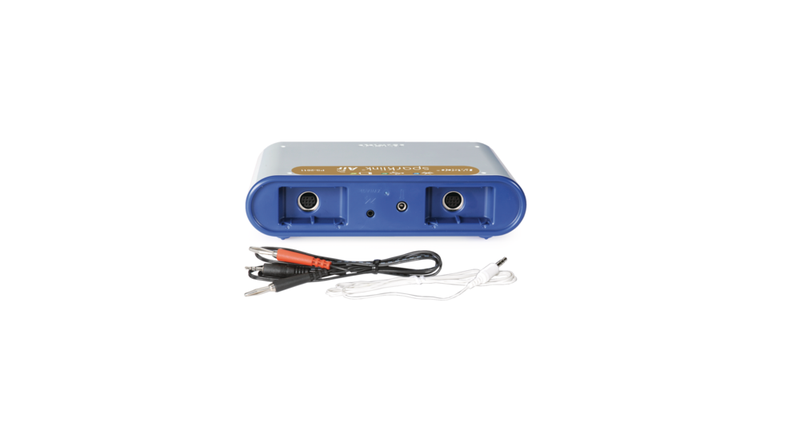 PS-2011 dual-channel Bluetooth interface
Sensors
Brolight
Interface Type: USB or Bluetooth 2.0 Interface: 4 (2 PASPORT interfaces, 1 voltage interface, 1 temperature interface)
The PS-2011 SPARKlink dual-channel Bluetooth interface lets teachers and students connect their devices by USB or Bluetooth to any of more than 70 PASPORT sensors in the PASCO range. Data are acquired with SPARKvue or PASCO Capstone. Teachers and students can use desktop or laptop computers running either program, or Bluetooth-enabled iOS or Android devices running the SPARKvue app. Note: SPARKlink Air connects to Google Chromebooks by USB but does not support Bluetooth connection to them.
-
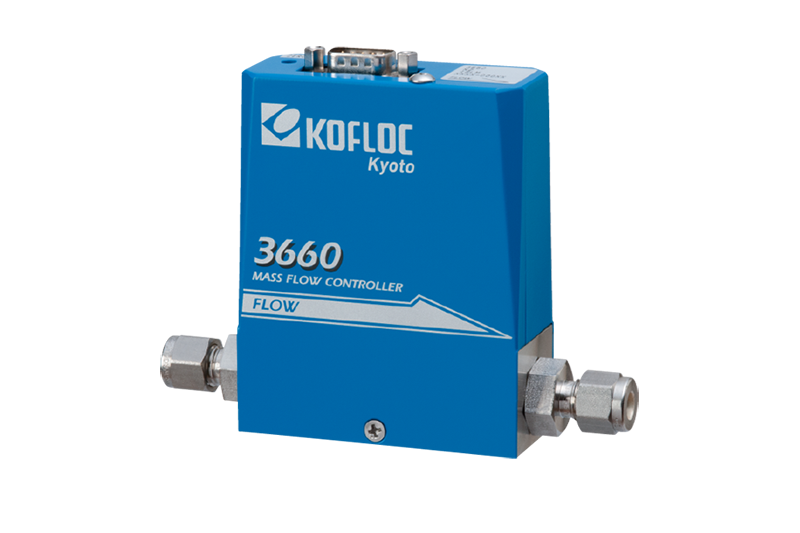 Gas mass flow controllers-3660 series
Sensors
Csl-vacuum
Flow-rate range [Different flow units at the two ends retained as in the source, without conversion]: 10SCCM~100SLM Gas/fluid: N2, AIR, H2, HE, AR, O2, CO2, etc. Electrical connection: Dsub 9-pin
An internal sensor measures gas flow in real time and compares it with the setpoint. The controller rapidly actuates a regulating valve, forming a closed loop that stabilizes actual flow precisely at the target.
-
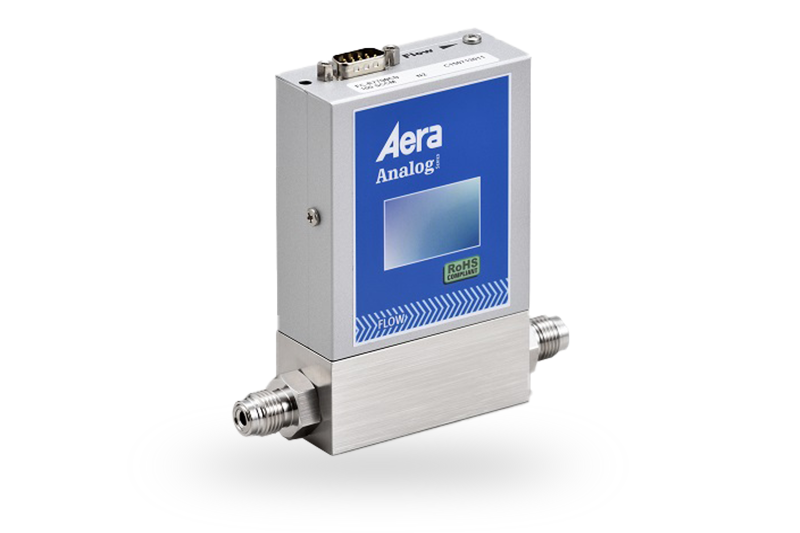 Gas mass flow controllers FC-R7700CD series
Sensors
Csl-vacuum
Flow-rate range [Different flow units at the two ends retained as in the source, without conversion]: 10SCCM~200SLM Gas/fluid: N2, AIR, H2, HE, AR, O2, CO2, etc. Electrical connection: Dsub 9-pin
An internal sensor measures gas flow in real time and compares it with the setpoint. The controller rapidly actuates a regulating valve, forming a closed loop that stabilizes actual flow precisely at the target.
-
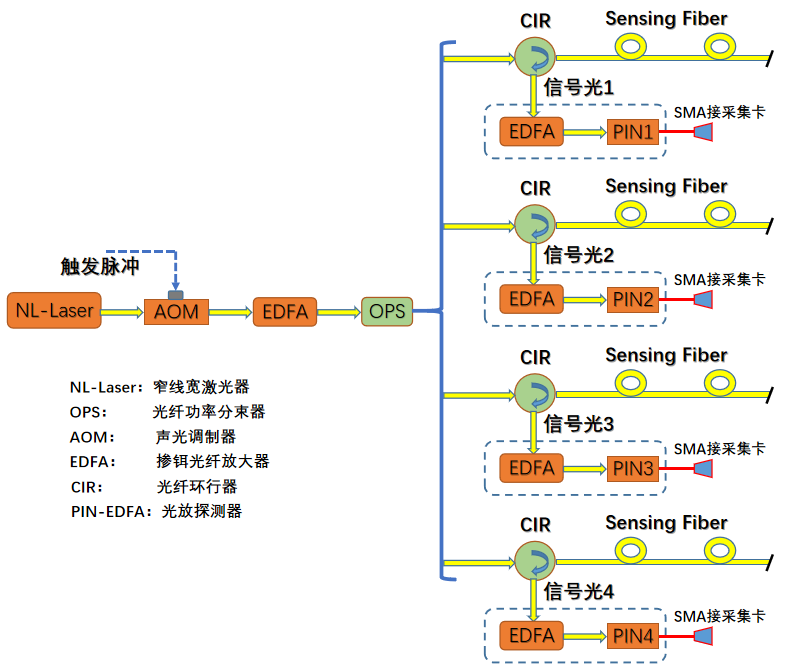 Fully integrated 4-channel DVS optical module
Sensors
Oe-photonics
Sensing distance: typical:20 km Number of detection channels: 4 channels Modulation mode: External modulation
For multichannel, fully integrated distributed vibration sensing (DVS), the DVS-AOM-L series uses an ultra-narrow-linewidth laser with optimized optomechanical/electrical integration. Serial-port parameter configuration, high integration, environmental-interference resistance, compact size, and convenience are provided. Sharing a narrow-linewidth laser reduces multichannel costs, particularly for demanding sensing applications. Custom solutions and specifications are available to sensor-equipment manufacturers.
-
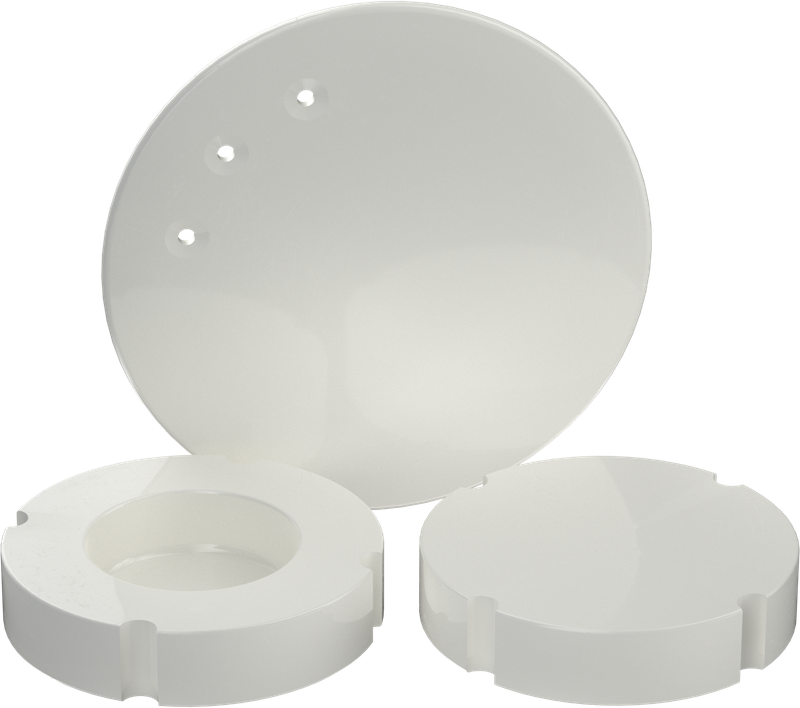 Ceramic pressure sensor
Sensors
Cctc
Ceramic parts for pressure sensors.
Related Articles
The ElFys PD25s series photodetectors adopt ElFys‑patented Black Silicon Induced Junction technology, delivering excellent spectral response spanning deep‑ultraviolet, visible and near‑infrared bands for diverse high‑precision photometry applications. Sub‑variants including H, M, HG and MG are optimised for low‑capacitance, low‑dark‑current and high‑reverse‑bias guard‑ring operations respectively. Multiple packaging configurations are available to satisfy various system‑design requirements.
Fomoptic delivers integrated one‑stop optical solutions covering precision optical fabrication and custom vacuum coating services. Supported by complete processing production lines, comprehensive metrology equipment and experienced engineering team, we provide full‑chain customized components, ranging from blank shaping, ultra‑precision polishing to thin‑film coating, for laser systems, infrared imaging, industrial optics and scientific‑research projects.
Wuhan Optical Valley Interlink Technology Co., Ltd. was founded in 2013 by a technical team from Huazhong University of Science and Technology.
For semiconductor, coating and laboratory vacuum chambers, thermal conductivity gauges suffer large measurement errors caused by gas type and ambient temperature.
Loading...
Name
Phone
Organization
Use Case

Database Platform