


ALPAO High-Speed Deformable Mirror DM820
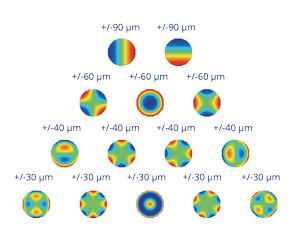
ALPAO deformable mirrors operate electromagnetically. Their large wavefront modulation range, high linearity and fast modulation make them well suited to astronomy, vision science, microscopy, defense and aerospace, FSO communications, lasers and physics, and microelectronics. Notable applications include the multi-object adaptive optics (MOAO) project on the 8.2-meter Subaru telescope, zebrafish brain imaging by the Betzig laboratory, which received the Nobel Prize in 2014, and the 39-meter E-ELT telescope. A deformable mirror supplied for E-ELT has 12000 elements. A deformable mirror (DM), also called a deformable reflector, is mainly used in adaptive optics systems to correct wavefront distortion. It consists of many actuators, each with an independent controller. Applied voltages produce the required mirror deformation to modulate wavefront aberrations. It is a key adaptive optics component. ALPAO deformable mirrors use a continuous reflective surface driven by magnetic actuators. Large stroke, high dynamic motion and excellent optical quality meet and exceed requirements for fast, accurate wavefront correction. Magnetic actuators move the continuous reflective surface, providing large deformation (up to 90 micrometers PV or tilt), high dynamic motion (settling times as low as 400μs at ±10%) and excellent optical quality (active best flat <7nm RMS, with <3nm RMS optional). Applications include astronomy, vision science, microscopy, defense and aerospace, FSO communications, lasers and physics, and microelectronics. Typical benefits of continuous deformable mirrors with drive electronics include average power consumption of a few watts and thin, flexible cables. ALPAO DMs combine large stroke, high dynamic motion and excellent optical quality. They offer fast wavefront correction, are straightforward to operate and package, and support precise aberration modulation and wavefront shaping, including high-order Zernike modes. Large surface deformation benefits adaptive optics: examples include dispensing with a separate tip-tilt mirror in astronomy, using large defocus for rapid z scanning in microscopy, and correcting large ocular aberrations in ophthalmology. Alpao deformable mirrors are fast, highly linear, continuous-face-sheet mirrors with large wavefront modulation, deformed by electromagnetic actuators. Together with Alpao adaptive-system control algorithms, they meet requirements for high-speed wavefront correction, with large modulation range, aberration modulation, high linearity and real-time operation for astronomy, vision science, microscopy, defense and aerospace, FSO communications, lasers and physics, and microelectronics. The adjacent animation illustrates the membrane, coil, magnet and spring technology: current applied to a coil moves a magnet vertically to deform the membrane. The French ALPAO mirror series uses electromagnetism. Energized voice coils move magnets attached to the mirror membrane to change its surface figure. ALPAO has more than 10 years of adaptive optics experience. Notable applications include MOAO on the 8.2-meter Subaru telescope, zebrafish brain imaging at the Betzig laboratory, which received the Nobel Prize in 2014, and the 39-meter E-ELT telescope; an E-ELT mirror has 12000 elements. Alpao high-speed mirrors use electromagnetic actuators to deform a continuous silicon-membrane reflective surface. Large wavefront modulation range, high linearity and real-time wavefront modulation suit astronomy, free-space laser communications, ophthalmology, multiphoton fluorescence microscopy and microelectronics for next-generation semiconductor equipment. Alpao adaptive optics control algorithms, combined with sensitive, fast EMCCD wavefront sensors, provide real-time atmospheric turbulence correction. Alpao originated as a spin-off from Joseph Fourier University in Grenoble, France. It develops fast, highly linear, continuous-face-sheet deformable mirrors with large wavefront modulation, using electromagnetic actuators. Products are used in astronomy, free-space laser communications, ophthalmology, multiphoton fluorescence microscopy and next-generation advanced semiconductor equipment. Work with the European Southern Observatory (ES0), Howard Hughes Medical Institute (HHMI, Betzig) and the University of Rochester has produced substantial research results in astronomy, multiphoton fluorescence microscopy and ophthalmology. ALPAO DMs use continuous reflective surfaces moved by magnetic actuators. Settling times as low as 400μs (±10%) with very low overshoot greatly reduce adaptive optics temporal error and improve correction. Hysteresis is almost absent (<2%), linearity is high (>97%) and stability is excellent. Direct control provides very low residual wavefront error. Drivers (SDKs) include Labview®, Matlab® and C/C++. Hardware and software support Microsoft Windows® XP (32-bit), 7, 8.1, 1 0 (32/64-bit) and many Linux® (32/64-bit) operating systems.
 Save to Favorites
Overview
Specifications
| Parameter | Value |
|---|---|
| Number of Channels | 820 |
| Aperture | 45 Mm |
| Spacing | 1.5 Mm |
| Closed-Loop Flatness [RMS] | 7 Nm |
| Maximum Mirror Deformation - Tilt [PV] | 12 μm |
| Maximum Mirror Deformation - Focus/Astigmatism [PV] | 10 μm |
| Maximum Mirror Deformation - 3x3 Deformation [PV] | 10 μm |
| Response | 0.5 ms |
| Bandwidth | 2000 Hz |
Key Features
Datasheet
Please provide your email to download the datasheet.
Invalid email format. Please try again.
Supplier Information
Related Products




Related Articles
As a professional ultraviolet‑laser solution provider, Precilasers has launched its 266 nm narrow‑linewidth industrial laser, delivering reliable single‑frequency output for high‑precision interference lithography, semiconductor inspection and precision metrology applications.
On November 28, 2024, the 3rd China Laser Star Enterprise Summit & Advanced Laser Processing Technology Summit, an annual influential event in the laser industry, was grandly held in Wuhan Optics Valley.
Within cutting‑edge ultrafast photonics research, asynchronous optical sampling (ASOPS) and synchronous sampling serve as fundamental technologies for terahertz excitation detection, coherent Raman imaging and other time‑resolved spectroscopy experiments.
A laser bar is an array semiconductor laser chip integrated with dozens of emitters, which realizes hundred-watt quasi-continuous output on a single chip. With regular emitter arrangement and controllable fill factor, integrated thermal design and superior wall-plug efficiency compared to single chips, it acts as the core light source for high-power pumping, medical lasers and precision processing.
Loading...
Name
Phone
Organization
Use Case

Database Platform