

Beamsplitter Coating
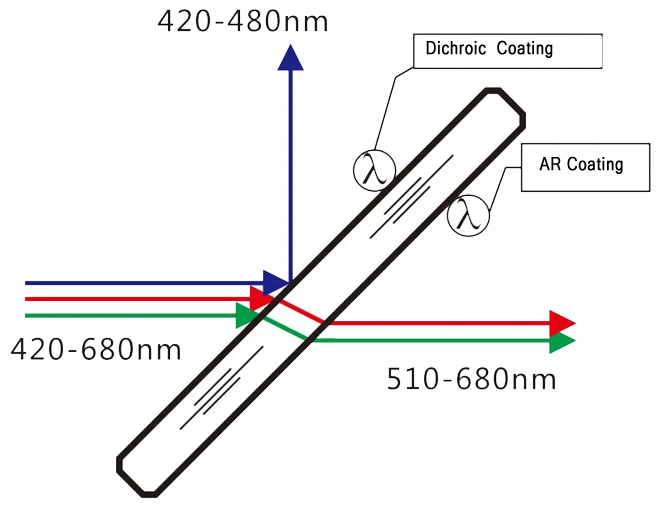
A device that splits a beam of light into two parts is called a beam splitter. The working component of a beam splitter is typically a coated plane, which exhibits specific reflectance and transmittance within a certain wavelength range. This plane is usually tilted, thereby separating the incident and reflected light. The predetermined reflectance and transmittance values of beam splitters vary depending on their applications. Spectral beam splitter coating are coatings designed to divide a light beam into two parts based on specific requirements and methods, primarily including wavelength beam splitters, intensity beam splitters, and polarizing beam splitters. Wavelength beam splitters (also called dichroic beam splitters) separate beams by wavelength regions using either cut-off filters or band-pass filters. These coating must control both transmitted and reflected light to achieve specific spectral curves. Intensity beam splitters divide light intensity into predetermined ratios, with broadband neutral beam splitters for visible light requiring polarization-independent coatings in applications like interferometers where depolarized beams are essential. Polarizing beam splitters utilize thin-film polarization effects at oblique incidence, existing in prism-type and plate-type configurations. Prism-type polarizers exploit Brewster angle polarization effects, where s-polarized light transmission increases with coating layers, achieving polarization separation when sufficient layers accumulate. These offer wide wavelength coverage and high polarization purity but lower laser damage resistance. Plate-type polarizers leverage the different reflection bandwidths of dielectric coatings for two polarization components at oblique angles, featuring narrower operational bandwidths but larger sizes and superior laser endurance, making them ideal for high-power laser systems.
 Save to Favorites
Overview
Datasheet
Please provide your email to download the datasheet.
Invalid email format. Please try again.
Supplier Information
Related Products
-
AR Antireflection Coating Optical Coatings Yinxinggx
Optical Specifications: Customizable Optical Specifications - Projection Wavelength Band: 400nm-700nm Optical Specifications - Single-Surface Transmittance: >95%
When light travels from an optically rarer to a denser medium, the reflected wave undergoes a half-wave phase change. With an AR film on glass, reflections from the film's front and rear surfaces have a half-wavelength optical path difference and cancel, increasing transmitted energy. Coating both glass faces reduces reflection on both. Magnetron sputtering forms transparent optical films through nanoscale atomic deposition. The source states that AR films do not affect the glass's physical properties while also hardening it, increasing surface hardness and adhesion for lasting protection as an integrated layer. AR films may be used together with waterproof and dustproof films for optical window glass.
-
Dielectric Coating Optical Coatings Atoptik
The fundamental principle of optical thin-film coatings relies on multi-beam interference. When light strikes a multilayer thin film composed of materials with varying refractive indices, it undergoes reflection and refraction at each interface. These beams superimpose and interfere. Constructive interference amplifies reflected/transmitted light intensity, while destructive interference reduces it. By adjusting material, thickness, and layer count, phase differences are controlled to selectively enhance or suppress specific wavelength transmission/reflection. The advantages of metal reflective films are their simple preparation process and broad operational wavelength range, while their drawbacks include high optical losses and inherently limited maximum reflectivity. To enhance the reflectivity of metal reflective films, several dielectric layers of specific thickness can be deposited on the outer surface, forming metal-dielectric reflective coatings. It should be noted that while metal-dielectric coatings improve reflectivity at specific wavelengths or wavebands, they compromise the neutral reflection characteristics of pure metal films. All-dielectric reflective coatings operate based on multiple-beam interference principles. Contrary to anti-reflection coatings, depositing a film material with higher refractive index than the substrate on an optical surface increases reflectivity. The simplest multilayer reflector consists of alternating high and low refractive index materials deposited through vapor deposition, with each layer's optical thickness equivalent to a quarter-wavelength of a specific light wave. Under such conditions, the reflected light vectors at each interface share identical vibration directions, resulting in cumulative amplitude enhancement as the number of film layers increases. Types of Dielectric Coating Based on functionality and structure, optical thin-film coatings are commonly classified into the following types: 1. Single-layer coating A single dielectric film deposited on a substrate, typically for anti-reflection (AR) or high-reflection (HR) purposes. It can be simplified as an equivalent interface for analyzing reflectance and transmittance. When the film thickness satisfiesnh = λ/4(n: refractive index,h: thickness,λ: wavelength), maximum/minimum reflectance is achieved. Ifn < √(n₀n₂)(n₀: incident medium refractive index,n₂: substrate refractive index), AR is realized; ifn > √(n₀n₂), HR is achieved. Perfect AR (n = √(n₀n₂)) requires rare materials. 2. Multilayer coating Composed of multiple dielectric layers with varying refractive indices, used for high reflection, color separation, filtering, or polarization. Equivalent refractive index concepts simplify analysis. For quarter-wavelength-thick layers (nh = λ/4), two layers with refractive indicesn₁andn₂can be equivalent to a single layer withn_I = n₁²/n₂. Common designs include quarter-wave (QWOT) and half-wave (HWOT) stacks with alternating high/low or identical refractive indices. 3. Metal coating A metallic film deposited on optical components for high reflection, beam splitting, or polarization. Reflectance/transmittance depends on the metal’s complex refractive index (n = n’ - in", wheren’andn"are real/imaginary parts). Metals exhibit strong absorption (largen") in visible wavelengths, yielding high reflectance and low transmittance. Common materials: Aluminum, Silver, Gold, Chromium. 4. Gradient coating Dielectric films with refractive indices varying along thickness or position, used for dispersion correction, depolarization, or broadband AR. Gradient coatings minimize abrupt interface reflections. Types include: · Thickness-gradient coating: Layer thickness varies spatially (e.g., wedge/taper). · Index-gradient coating: Refractive index varies continuously (e.g., linear/exponential profiles). Applications of Optical Dielectric Coating 1. Lasers: Laser systems require stable standing waves within resonant cavities to achieve stimulated emission and amplification. High-reflective or partially reflective optical dielectric coatings are applied at both ends of the cavity to form a feedback mechanism. 2. Optical Instruments: Components such as lenses, prisms, filters, beam splitters, and polarizers rely on optical dielectric coatings to enhance performance and stability. These coatings reduce reflection loss, increase transmittance, modify light color or polarization, and protect components from environmental factors like temperature, humidity, dust, and scratches. 3. Communication Systems: Devices including optical fibers, laser diodes, modulators, amplifiers, and switches utilize optical dielectric coatings to optimize efficiency and signal-to-noise ratio. They minimize insertion loss, boost output power, expand bandwidth, suppress feedback noise, and enable wavelength/mode multiplexing for higher system capacity and flexibility. 4. Solar Energy Utilization: Solar cells, thermal power systems, and lighting devices employ optical dielectric coatings to improve conversion efficiency and durability. These coatings enhance absorption, reduce reflection, regulate emissivity, suppress thermal radiation, and enable selective utilization or exclusion of specific solar wavelengths.
-
Infrared (IR) Antireflection (AR) Coating Optical Coatings Atoptik
Infrared anti-reflection coatings are widely used in near-infrared and mid-infrared bands. On one hand, the rise of near-infrared spectroscopy and its advantages in non-destructive in vivo testing have drawn significant attention to near-infrared applications. On the other hand, mid-infrared research holds great importance with the development of infrared imaging, infrared detection, infrared remote sensing, and aerospace applications. Infrared technology was initially applied in military fields, later expanding to atmospheric detection, aerospace, and civilian applications. In infrared optical systems, transmittance determines performance. Reducing surface reflection to enhance working-band transmittance is crucial for practical applications. Depositing anti-reflection coatings on infrared optical components has become a key research focus to minimize reflection loss and improve system capabilities. With advancing optics, increasing demand for infrared-band devices drives the development of high-performance infrared anti-reflection coatings as a vital research area. Cases of IR AR Coating Category | Key Research Findings | Materials Used | Performance Metrics | Applications NIR (0.78-2.5μm) AR Coatings | Tavg >91% (400-1000nm) using ZnS/YbF₃ on ZnS substrate | ZnS (substrate), ZnS/YbF₃ | 91% avg. transmittance (400-1000nm) | Spectral analysis NIR (0.78-2.5μm) AR Coatings | Tavg>97% (620-1550nm) using TiO₂/M1/SiO₂ | TiO₂/M1(Pr:Al₂O₃)/SiO₂ | 97% avg. transmittance (620-1550nm) | Broadband optics NIR (0.78-2.5μm) AR Coatings | Tavg>97.04% (550-780nm & 1.0-1.3μm) on K9 glass | TiO₂/SiO₂ on K9 glass | 97.04% avg. transmittance | Dual-band systems NIR (0.78-2.5μm) AR Coatings | Tavg>99.42% (0.9-1.7μm) on CaF₂ | TiO₂/SiO₂ on CaF₂ | 99.42% avg., 99.98% peak-performance NIR systems | IR (2.5-25μm) AR Coatings | BaF₂/ZnSe bilayer on Ge for 14-16μm | Ge substrate, BaF₂/ZnSe | Effective AR in 14-16μm | Satellite IR horizon sensors IR (2.5-25μm) AR Coatings | Comparative studies of ZnS/CdTe/ZnSe monolayers on Ge (10.4-12.5μm) | Ge substrate, ZnS/CdTe/ZnSe | Various performance | IR window applications Broadband IR AR | 8-14μm & 2-14μm broadband AR | Various substrates | Broadband coverage | Early broadband applications Broadband IR AR | Ion-assisted deposition on lead molybdate | Lead molybdate crystal | Improved performance | Fiber optic communications Broadband IR AR | ZnSe/BaF₂ on Ge (8-12μm, 97% avg.) | Ge substrate, ZnSe/BaF₂ | 97% avgmittance | Mid-IR applications Broadband IR AR | Extended to 6.4-15μm bandwidth | Various materials | Broadband coverage | Aerospace remote sensing Broadband IR AR | Ge/ZnS/YbF₃ on Ge (7.5-11.5μm, 98% avg., 99.2% peak) | Ge substrate, Ge/ZnS/YbF₃ | 98% avg., 99.2% peak | High-performance IR Broadband IR AR | ZnSe substrate with ZnSeS/YbF₃ (7-14μm, 97% avg.) | ZnSe substrate, ZnSe/ZnS/YbF₃ | 97% avg. transmittance | Broadband IR Broadband IR AR | ZnSe/YF₃ on ZnSe (2-16μm, 93% avg.) | ZnSe substrate, ZnSe/YF₃ | 93% avg. transmittance | Ultra-broadband IR Dual-band IR AR | Ge substrate for 3-5μm & 8-12μm (94% avg.) | Ge substrate | 94% avg. transmittance | Dual-band IR systems Dual-band IR AR | ZnS radome coating (>90% avg. on curved surfaces) | ZnS radome | >90% avg. transmittance | Aerospace applications Dual-band IR AR | IR fiber end-face coatings | Fiber optics | Reduced reflection | Fiber optic protection Dual-band IR AR | ZnS window for 0.8-1.7μm & 3.7-4.8μm | ZnS window | Dual-band performance | High-speed aircraft Extended Research | Conductive grid + AR coating for anti-fog/EM attenuation | Composite materials | Multifunctional | IR imaging systems Extended Research | Graded-index AR on ZnSe (3-12μm, 95% avg.) | ZnSe substrate | 95% avg. transmittance | Gradient optics Extended Research | Angle-insensitive AR on Al₂O₃ (3-5μm, 0°-60°) | Al₂O₃ substrate | Wide-angle performance | Polarization-sensitive systems Extended Research | | | |
-
Metal Coating Optical Coatings Atoptik
Metals with high extinction coefficients exhibit rapid light amplitude decay, increasing reflectance. Aluminum is used for UV, aluminum/silver for visible light, and gold/silver/copper for infrared regions. Chromium and platinum serve in specialized films. Oxidation-prone metals like aluminum, silver, and copper require protective dielectric coatings such as silicon monoxide, magnesium fluoride, silicon dioxide, or aluminum oxide to maintain optical stability. Metallic film mirrors, which are coated with a metal film layer on a substrate to reflect light, offer a broad reflective spectrum but often exhibit some light absorption. Common metallic film mirrors in the market include aluminum film mirrors, gold film mirrors, and silver film mirrors. 1. Aluminum Film Mirrors Aluminum film mirrors are typically made by vapor-depositing aluminum onto a high-precision polished planar substrate. Their performance is unaffected by the incident angle of light. Depending on application scenarios, variations include: mirrors with only aluminum film, those with a protective coating over the aluminum film to prevent damage, those with a protective coating to enhance UV reflectance, and those with protective coatings on parallel planar substrates. These mirrors exhibit high reflectance (>90%) from UV to IR wavelengths and have more durable optical coatings compared to other metals. 2. Silver Film Mirrors Silver film mirrors provide high reflectance across visible to infrared wavelengths. They offer higher reflectance than aluminum film mirrors in visible-IR regions and, unlike dielectric mirrors, are unaffected by light incidence angles. However, silver films adhere poorly to glass substrates, necessitating an additional protective coating to delay oxidation and extend service life. 3. Gold Film Mirrors Gold film mirrors are primarily used in near-infrared (NIR) and infrared (IR) broad spectra. They employ substrates with high thermal conductivity, strong gold adhesion, and heat resistance, such as silicon-based substrates or float glass. Gold films exhibit extremely high reflectance for IR/NIR light, with unreflected light fully absorbed by the gold rather than transmitting through the substrate. Gold film mirrors demonstrate greater mechanical strength and stability than silver film mirrors.
Related Articles
As a professional ultraviolet‑laser solution provider, Precilasers has launched its 266 nm narrow‑linewidth industrial laser, delivering reliable single‑frequency output for high‑precision interference lithography, semiconductor inspection and precision metrology applications.
On November 28, 2024, the 3rd China Laser Star Enterprise Summit & Advanced Laser Processing Technology Summit, an annual influential event in the laser industry, was grandly held in Wuhan Optics Valley.
Within cutting‑edge ultrafast photonics research, asynchronous optical sampling (ASOPS) and synchronous sampling serve as fundamental technologies for terahertz excitation detection, coherent Raman imaging and other time‑resolved spectroscopy experiments.
A laser bar is an array semiconductor laser chip integrated with dozens of emitters, which realizes hundred-watt quasi-continuous output on a single chip. With regular emitter arrangement and controllable fill factor, integrated thermal design and superior wall-plug efficiency compared to single chips, it acts as the core light source for high-power pumping, medical lasers and precision processing.
Loading...
Name
Phone
Organization
Use Case

Database Platform