

Polarizing Prisms (PBS) AT-PBS-12.7@1064
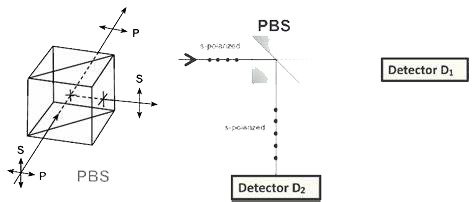
The beamsplitter is an optical component that divides an incident beam into two beams propagating in mutually perpendicular directions. Unlike general optical splitting elements, the two beams produced by it have a unique relationship: both beams are linearly polarized, and their polarization directions are perpendicular to each other. The composition of a polarizing beam splitter: It is typically made by cementing or optically contacting the hypotenuse sides of two right-angle prisms, with a polarizing beam splitting film applied to the hypotenuse. P-polarized light in the incident light is transmitted, while S-polarized light is reflected. Anti-reflective coatings are generally applied to all the incident and exit surfaces of the light beams.
 Save to Favorites
Overview
Specifications
| Parameter | Value |
|---|---|
| Polarization [Transmitted (T);Features of BeamSplitter] | p-polarized |
| Polarization [Reflected (R);Features of BeamSplitter] | s-polarized |
| Extinction Ratio [Transmitted (T);Features of BeamSplitter] | TP/TS >1000:1 |
| Extinction Ratio [Reflected (R);Features of BeamSplitter] | RS/RP >1000 |
| Beam [Transmitted (T);Features of BeamSplitter] | <±5 arcmin |
| Beam [Reflected (R);Features of BeamSplitter] | 90°±5 arcmin |
| Material [Specifications of BeamSplitter] | Optical glass |
| Diemsinon tolerance [Specifications of BeamSplitter] | ±0.2 |
| Surface flatness [@632.8nm;Specifications of BeamSplitter] | λ/4@632.8nm |
| Surface quality [Specifications of BeamSplitter] | 60/40 or better |
| Clear aperture [Dimensions ;Specifications of BeamSplitter] | >90% Dimensions |
| Extinction Ratio [Specifications of BeamSplitter] | Tp/ Ts>2000:1 |
| Output beam deviation [Specifications of BeamSplitter] | 0°±3'(T),90°±5'(Rs) |
| Incidence angle [Specifications of BeamSplitter] | 0°~2° |
| Coating [hypotenuse surface;all four external surfaces;Narrowband;R<0.25%;Specifications of BeamSplitter] | Functional layer: Polarization beam-splitting coating deposited on hypotenuse surface (Ta₂O₅/SiO₂ multilayer stack); Anti-reflective treatment: Narrowband multilayer anti-reflective coating (R<0.25%) applied to all four external surfaces |
| Temperature range [Specifications of BeamSplitter] | -30℃ to +70℃ |
| Wavelength [Catalog of BeamSplitter] | 1064nm |
| Dimension [Catalog of BeamSplitter] | 12.7×12.7×12.7 |
| Extinction Ratio [Catalog of BeamSplitter] | Tp/ Ts>2000:1 |
Applications
Key Features
Datasheet
Please provide your email to download the datasheet.
Invalid email format. Please try again.
Supplier Information
Related Products
-
 General-purpose beamsplitter plate
Beam Splitters
Tzjingda
Material: K9 or other optical materials Clear Aperture Dimension: >90 % Parallelism [Up to the stated maximum; Actual specification according to customer requirements]: ≤1 ″
-
Narrowband non-polarizing beamsplitter plate
Beam Splitters
Tzjingda
Material: K9 Clear Aperture Dimension: >90 % Surface Figure [Standard; 632.8nm; Per 25mm; Actual specification according to customer requirements]: λ/4
-
Visible and near-infrared beamsplitter plate Beam Splitters Uni-lens
Material: BK7, fused silica, boron float glass, etc. Dimensional Tolerance: ±0.1 mm Surface Figure [633nm]: λ/4
These beamsplitter plates can be used in high-power laser systems. The two beams travel along different optical paths determined by the incidence angle and plate thickness.
-
Beamsplitter Beam Splitters 100optics
Material: K9 or ZF glass Dimensional Tolerance: ±0.2 mm Surface Quality: 60 / 40
A polarizing cube beamsplitter separates a randomly polarized beam into two orthogonal linearly polarized components: S polarization is reflected at 90 degrees, while P polarization is transmitted. Each consists of a pair of high-precision, high-tolerance right-angle prisms bonded with a dielectric coating on the hypotenuse of one prism. Baijing Optoelectronics offers high-quality beamsplitters.
-
Non-polarizing beamsplitter (NPBS) Beam Splitters 100optics
Material: K9 or ZF glass Dimensional Tolerance: ±0.2 mm Surface Quality: 60 / 40
Made by bonding two precision, high-tolerance right-angle prisms, with a metal-dielectric coating on the hypotenuse of one prism. The coating has low polarization dependence, keeping S- and P-polarized transmission and reflection within 6% of one another. The source states that the incident polarization is therefore unchanged.
Related Articles
The LZFL405‑80mW‑3 series from Shenzhen Leirte Optoelectronics Co., Ltd. is a coaxial‑packaged violet‑blue single‑mode fiber‑coupled laser diode. It delivers 80 mW continuous‑wave output at 405 nm. Light is coupled into 3 μm core‑diameter single‑mode fiber for clean beam quality and easy integration into diverse optical systems. It serves as a compact violet‑blue light source for medical instruments and industrial printing applications.
Wuhan Optics Valley Quantum Technology Co., Ltd. is a leading domestic developer of high‑speed semiconductor optical chips and photodetector components. Our product portfolio covers InGaAs avalanche photodiode bare dies and PIN photodetector chips designed for fiber‑optic communication
As a professional ultraviolet‑laser solution provider, Precilasers has launched its 266 nm narrow‑linewidth industrial laser, delivering reliable single‑frequency output for high‑precision interference lithography, semiconductor inspection and precision metrology applications.
Electro-optic deflectors (EODs) are optical devices used to steer or deflect light beams by applying an electric field to a specialized optical crystal. Unlike mechanical beam steering systems that rely on moving mirrors, electro-optic deflectors enable high-speed, non-mechanical beam control with exceptional precision and responsiveness. They are widely used in laser scanning, optical communications, microscopy, laser printing, spectroscopy, and scientific research, where rapid and accurate laser beam positioning is essential.
Loading...
Name
Phone
Organization
Use Case

Database Platform