

Achromatic Lens
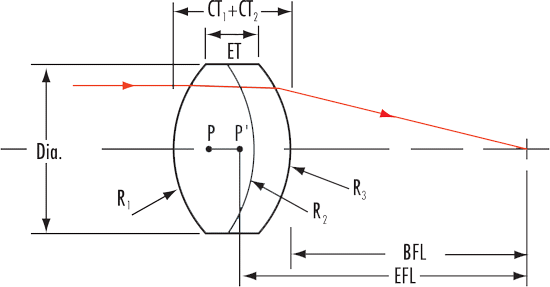
Achromatic Lenses are made of two concave and convex lenses with different refractive indices and different dispersion rates, which can minimize or eliminate color aberrations. ATOPTIK’s achromatic lenses are high-performance optical components designed to reduce chromatic aberration. They are widely used in microscopes, laser systems, optical imaging, spectrometers, and fiber optic communications, where high-precision imaging and beam manipulation are essential. These lenses effectively correct the refractive differences of different wavelengths, resulting in sharp and accurate optical focusing. How Achromatic Lenses Correct Chromatic Aberration for Sharper Imaging For better performance, usually the side with the larger radius of curvature (the flat surface) should be turned away from the collimated beam. Color difference comes from the difference in the dispersion and refraction coefficient of different wavelengths of light in the transmission material, so that different wavelengths of light converge at different focal points, double-bonded achromatic lens through the adhesive design of different material lenses, so that the dispersion of the two materials compensation each other, thereby reducing the comprehensive color difference. Achromatic design also helps to improve the image aberration of light sources in a wide wavelength range (composite light sources), improve spherical aberration at a suitable radius of curvature, and improve coma at the same time when the material is selected arbitrarily. Achromatic lenses provide sharper images than optical systems that use a single lens and can form smaller points of light, further improving the optical performance of the lens. Achromatic lenses are suitable for a variety of applications such as fluorescence microscopy, image relaying, detection or spectroscopy. ATOPTIK's achromatic bonded lens products offer almost constant focal lengths over a wide wavelength range and are available in stock for both positive and negative bonded achromatic lenses and achromatic lenses coated with a variety of anti-reflection films. Anti-reflection film options include VIS, NIR, and SWIR.
 Save to Favorites
Overview
Specifications
| Parameter | Value |
|---|---|
| Material [Normal] | Optical glass |
| Material [High Precision] | Optical glass |
| Material [Mfg. Limit] | Optical glass |
| Diameter Tolerance [Normal] | +0/-0.1mm |
| Diameter Tolerance [High Precision] | +0/-0.05mm |
| Diameter Tolerance [Mfg. Limit] | +0/-0.01mm |
| Thickness Tolerance [Normal] | +/-0.1mm |
| Thickness Tolerance [High Precision] | +/-0.05mm |
| Thickness Tolerance [Mfg. Limit] | +/-0.01mm |
| Focal Length Tolerance [Normal] | +/-2% |
| Focal Length Tolerance [High Precision] | +/-1% |
| Focal Length Tolerance [Mfg. Limit] | +/-0.5% |
| Centeration [Normal] | 3 arc min |
| Centeration [High Precision] | 1 arc min |
| Centeration [Mfg. Limit] | 10 arc sec |
| Surface Quality [Normal] | 60-40 |
| Surface Quality [High Precision] | 40-20 |
| Surface Quality [Mfg. Limit] | 10-5 |
| Surface Figure [High Precision] | 2 lambda |
| Surface Figure [Mfg. Limit] | 1 lambda |
| Surface Irregularity [Normal] | 1/4 lambda |
| Surface Irregularity [High Precision] | 1/10 lambda |
| Clear Aperture [Normal] | >80% |
| Clear Aperture [High Precision] | >90% |
| Clear Aperture [Mfg. Limit] | 100% |
| Bevel [Normal] | +/-0.2*45 degree |
| Bevel [High Precision] | +/-0.1*45 degree |
| Bevel [Mfg. Limit] | +/-0.05*45degree |
Key Features
Datasheet
Please provide your email to download the datasheet.
Invalid email format. Please try again.
Supplier Information
Related Products
-
Tera3001-SA dual-LENS multidaughterboard coupling equipment Optical Lenses Terawan
The Tera3001-s multidaughterboard automatic alignment platform serves 10G/14G/25G optical transceivers. It mainly aligns lenses in Chip On Board (COB) modules, with single- or dual-channel lens/source alignment, automatic dispensing, and UV curing. The Tera3001-S provides high coupling efficiency, stability, and UPH depending on customer design, plus one-button collision protection and UV protection.
-
355 field lens Optical Lenses Central-laser
Focal Length [Original Table Row 2; Focal Length=100mm; Parallel Values in the Same Row Not Split into Separate Models or Configurations]: 100 mm Working Distance [Original Table Row 2; Focal Length=100mm; Parallel Values in the Same Row Not Split into Separate Models or Configurations]: 136 mm Scan Range [Original Table Row 2; Focal Length=100mm; Parallel Values in the Same Row Not Split into Separate Models or Configurations]: 70 mm² × 70 mm²
355 field lens: large zinc-selenide (ZnSe) focusing lens with a small spot for accurate marking. Imported lens material provides long service life and reduces removal, installation, and alignment. The 355nm scanning field lens is suitable for ultraviolet laser-marking machines.
-
532 field lens Optical Lenses Central-laser
Focal Length [Original Table Row 2; Focal Length=100mm; Parallel Values in the Same Row Not Split into Separate Models or Configurations]: 100 mm Working Distance [Original Table Row 2; Focal Length=100mm; Parallel Values in the Same Row Not Split into Separate Models or Configurations]: 114.5 mm Scan Range [Original Table Row 2; Focal Length=100mm; Parallel Values in the Same Row Not Split into Separate Models or Configurations]: 70 mm² × 70 mm²
532 field lens: large zinc-selenide (ZnSe) focusing lens with a small spot for accurate marking. Imported lens material provides long service life and reduces removal, installation, and alignment. The 532nm field lens is suitable for green laser-marking machines.
-
CO2 field lens Optical Lenses Central-laser
Focal Length [Original table row 2; Focal length=72mm; Parallel values in the same row, without additional model or configuration splitting]: 72 mm Mirror Diameter [Original table row 2; Focal length=72mm; Parallel values in the same row, without additional model or configuration splitting]: 48 mm Scan Range [Original table row 2; Focal length=72mm; Parallel values in the same row, without additional model or configuration splitting]: 50 mm² × 50 mm²
CO2 field lens: large zinc-selenide (ZnSe) focusing lens with a small spot for accurate marking. Imported lens material provides long service life and reduces removal, installation, and alignment. The 10640nm scanning field lens is suitable for CO2 laser-marking machines.
-
YAG field lens Optical Lenses Central-laser
Focal Length [Original table row 2; Focal length=63mm; Parallel values in the same row, without additional model or configuration splitting]: 63 mm Working Distance [Original table row 2; Focal length=63mm; Parallel values in the same row, without additional model or configuration splitting]: 78 mm Scan Range [Original table row 2; Focal length=63mm; Parallel values in the same row, without additional model or configuration splitting]: 50 mm² × 50 mm²
YAG field lens: large zinc-selenide (ZnSe) focusing lens with a small spot for accurate marking. Imported lens material provides long service life and reduces removal, installation, and alignment. The 1064nm scanning field lens is suitable for fiber laser-marking machines.
Related Articles
The LZFL405‑80mW‑3 series from Shenzhen Leirte Optoelectronics Co., Ltd. is a coaxial‑packaged violet‑blue single‑mode fiber‑coupled laser diode. It delivers 80 mW continuous‑wave output at 405 nm. Light is coupled into 3 μm core‑diameter single‑mode fiber for clean beam quality and easy integration into diverse optical systems. It serves as a compact violet‑blue light source for medical instruments and industrial printing applications.
Wuhan Optics Valley Quantum Technology Co., Ltd. is a leading domestic developer of high‑speed semiconductor optical chips and photodetector components. Our product portfolio covers InGaAs avalanche photodiode bare dies and PIN photodetector chips designed for fiber‑optic communication
As a professional ultraviolet‑laser solution provider, Precilasers has launched its 266 nm narrow‑linewidth industrial laser, delivering reliable single‑frequency output for high‑precision interference lithography, semiconductor inspection and precision metrology applications.
Electro-optic deflectors (EODs) are optical devices used to steer or deflect light beams by applying an electric field to a specialized optical crystal. Unlike mechanical beam steering systems that rely on moving mirrors, electro-optic deflectors enable high-speed, non-mechanical beam control with exceptional precision and responsiveness. They are widely used in laser scanning, optical communications, microscopy, laser printing, spectroscopy, and scientific research, where rapid and accurate laser beam positioning is essential.
Loading...
Name
Phone
Organization
Use Case

Database Platform