

Visible-to-Near-Infrared Acousto-Optic Modulators AOMO 3200-121
AOMO 3200-121 is a compact visible-to-near-infrared acousto-optic modulator using tellurium dioxide as the acousto-optic medium. Designed for small-beam laser systems, it provides high-speed beam modulation, fast optical switching and stable intensity control. Broad spectral applicability, high diffraction efficiency and compact construction meet beam-control, response-speed and system-integration requirements in precision laser systems. The excellent acousto-optic properties of TeO₂ and a broadband antireflection-coating design allow AOMO 3200-121 to provide efficient, stable acousto-optic interaction from visible to near-infrared wavelengths, supporting reliable beam gating, pulse modulation and dynamic intensity adjustment. Its high switching contrast, small aperture and SMB flange interface facilitate rapid integration into space-constrained optical platforms, combining beam quality, system stability and ease of use. Applications include laser-scanning microscopy, optical imaging systems, analytical and inspection instruments, optical test platforms, research laser experimental systems and other precision photonics equipment, providing high-performance, highly reliable beam modulation for visible-to-near-infrared laser systems.
 Save to Favorites
Overview
Specifications
| Parameter | Value |
|---|---|
| Saturation RF Power [Wavelength 515 nm] | 0.7 W |
| Bragg Angle [Wavelength 515 nm] | 12.3 mrad |
| Beam Separation Angle [Wavelength 515 nm] | 24.6 mrad |
| Saturation RF Power [Wavelength 633 nm] | 1.0 W |
| Bragg Angle [Wavelength 633 nm] | 15.1 mrad |
| Beam Separation Angle [Wavelength 633 nm] | 30.2 mrad |
| Diffraction Efficiency [Test Wavelength 633 nm; Beam Diameter 60 μm] | 70% |
| Rise Time [Test Wavelength 633 nm; Beam Diameter 60 μm] | 14 ns |
| Modulation Bandwidth [Test Wavelength 633 nm; Beam Diameter 60 μm] | 52 MHz |
| Beam Ellipticity [Test Wavelength 633 nm; Beam Diameter 60 μm] | 15% |
| Diffraction Efficiency [Test Wavelength 633 nm; Beam Diameter 80 μm] | 75% |
| Rise Time [Test Wavelength 633 nm; Beam Diameter 80 μm] | 17 ns |
| Modulation Bandwidth [Test Wavelength 633 nm; Beam Diameter 80 μm] | 40 MHz |
| Beam Ellipticity [Test Wavelength 633 nm; Beam Diameter 80 μm] | 8% |
| Diffraction Efficiency [Test Wavelength 633 nm; Beam Diameter 100 μm] | 80% |
| Rise Time [Test Wavelength 633 nm; Beam Diameter 100 μm] | 20 ns |
| Modulation Bandwidth [Test Wavelength 633 nm; Beam Diameter 100 μm] | 31 MHz |
| Beam Ellipticity [Test Wavelength 633 nm; Beam Diameter 100 μm] | 4% |
| Diffraction Efficiency [Test Wavelength 633 nm; Beam Diameter 120 μm] | 80% |
| Rise Time [Test Wavelength 633 nm; Beam Diameter 120 μm] | 23 ns |
| Modulation Bandwidth [Test Wavelength 633 nm; Beam Diameter 120 μm] | 26.5 MHz |
| Beam Ellipticity [Test Wavelength 633 nm; Beam Diameter 120 μm] | 2% |
| Applicable Wavelength Band | Visible Light - Near Infrared |
| Minimum Wavelength | 450 nm |
| Maximum Wavelength | 850 nm |
| Center Frequency | 200 MHz |
| Clear Aperture Dimension | 0.32 mm × 2.5 mm |
| Rise/Fall Time | 159 ns |
| Acousto-optic Medium | TeO₂ |
| Acoustic Velocity | 4.2 mm/μs |
| RF Bandwidth [-9 dB Return Loss] | 50 MHz(@ -9 dB Return Loss ) |
| Input Impedance | 50 Ω |
| Standing Wave Ratio | ≤ 1.3:1 |
| Insertion Loss | ≤ 4% |
| Single-Surface Reflectance | ≤ 1% |
| Antireflection Coating Standard | MIL-C-48497 |
| Optical Power Density | 250 W/mm² |
| Extinction Ratio | ≥1000:1 |
| Polarization | At a 90° angle to the mounting plane |
Key Features
Datasheet
Supplier Information
Related Products
-
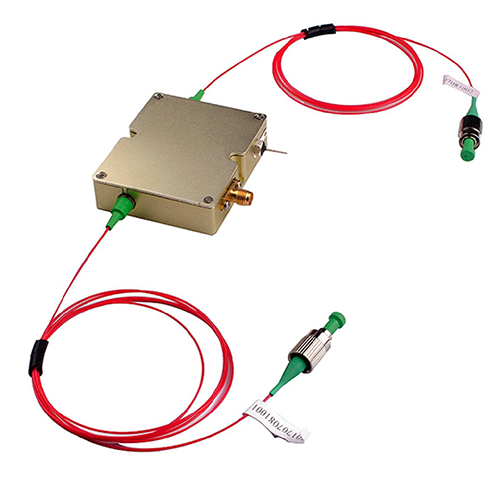 Fiber-Coupled Acousto-Optic Modulator (AOM) Module CoAOM-1550-50-40-D
Acousto-Optic Modulator
Shconnet
Center Wavelength: min:1520 nm; typical:1550 nm; max:1580 nm Rise Time: min:45 ns; typical:50 ns; max:60 ns Pulse Off Ratio (Extinction Ratio) [Pulsed]: min:45 dB; typical:50 dB
Acousto-optic modulation loads information onto an optical-frequency carrier through the acousto-optic effect. An amplitude-modulated electrical signal drives an electroacoustic transducer to generate a corresponding ultrasonic field. Light passing through the acousto-optic medium is modulated into an intensity-modulated carrier carrying the information. Shanghai Hanyu’s CoAOM fiber-coupled acousto-optic modulator modules use polarization-maintaining fiber at both input and output, with a high pulse extinction ratio, compact dimensions and an integrated RF driver for convenient system integration.
-
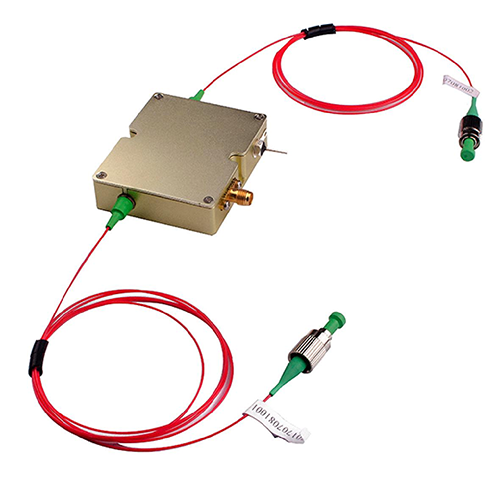 Fiber-Coupled Acousto-Optic Modulator (AOM) Module CoAOM-1550-50-40-A
Acousto-Optic Modulator
Shconnet
Center Wavelength: min:1520 nm; typical:1550 nm; max:1580 nm Rise Time: min:45 ns; typical:50 ns; max:60 ns Pulse Off Ratio (Extinction Ratio) [Pulsed]: min:45 dB; typical:50 dB
Acousto-optic modulation loads information onto an optical-frequency carrier through the acousto-optic effect. An amplitude-modulated electrical signal drives an electroacoustic transducer to generate a corresponding ultrasonic field. Light passing through the acousto-optic medium is modulated into an intensity-modulated carrier carrying the information. Shanghai Hanyu’s CoAOM fiber-coupled acousto-optic modulator modules use polarization-maintaining fiber at both input and output, with a high pulse extinction ratio, compact dimensions and an integrated RF driver for convenient system integration.
-
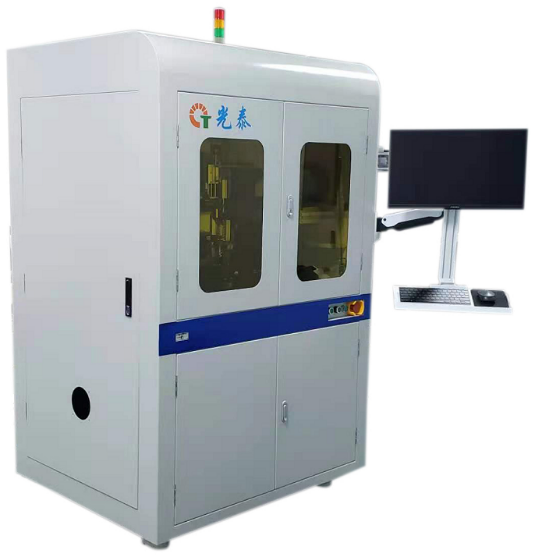 AOM Acousto-Optic Modulator Coupling System
Acousto-Optic Modulator
Szbrightas
Repeatability [IL Change During Repeated Coupling of the Same Item]: <0.2 dB Stability [Maximum IL Change Within 5 Minutes After Adhesive Application]: <0.1 dB Coupling Accuracy [Unidirectional Axis Positioning Accuracy]: <0.1 μm
1. The system includes visual positioning, automatic coupling, automatic adhesive dispensing and automatic UV functions. 2. Fully automatic, high-precision 11-axis motorized module. 3. A high-efficiency coupling algorithm and high-precision sensors automatically search for and identify 0th-order and 1st-order light. 4. Precision design for automatic adhesive dispensing, with ultraviolet-curing monitoring.
-
 Free-Space Acousto-Optic Modulator OSAO355-03-110
Acousto-Optic Modulator
Jcoptix
Operating Wavelength: 355 nm Dielectric Material: Quartz Crystal Transmittance: >99%
JCOPTIX free-space acousto-optic modulators use high-quality piezoelectric transducers such as quartz/lithium niobate and high-purity quartz media for laser control, optoelectronic integration, and research. Inverse piezoelectricity converts RF signals into ultrasound, creating periodic refractive-index changes, a volume grating, in quartz through acousto-optic/photoelastic effects. Adjusting RF intensity/frequency controls diffracted intensity, frequency shift, and direction for efficient real-time electrical-to-optical modulation. Precision structures and SMA-F RF connectors ensure stable transmission: input impedance 50 Ω, VSWR <1.2:1. Lightweight, thermally conductive 6063 aluminum housings and conductive cooling support stable industrial operation and demanding modulation. Free-space AOMs: wavelengths 355 nm, 450 nm, 532 nm, 780 nm, 1064 nm. Apertures: 2.0 mm/3.0 mm/4.0 mm for different beams. Input linear polarization perpendicular to base. Diffraction efficiency >85%. JCOPTIX units combine >85% efficiency and <1.2:1 VSWR for rapid switching/control. Response of 113 ns/mm supports high-speed optical communication; high damage thresholds suit powerful lasers. Applications: laser Q-switching/pulse generation, imaging/display dynamic spot control, fiber signal modulation/demodulation, medical beam-energy control, and diffraction research. RF drivers: frequencies 80 MHz, 100 MHz, 110 MHz. Stable, accurate fixed RF signals. SMA-F output. Quartz oscillators provide stable/accurate fixed signals; different modulation inputs produce required waveforms. Mainly for AOMs, outputs cover 80 MHz, 100 MHz, and 110 MHz. Rise/fall times: <50 ns and <35 ns. Output impedance: 50 Ω. Analog input: 0-5 V. DB9 input and SMA-F interface. Supplied cable has DB9 at one end and bare wires at the other: red +24 V power, black ground, blue digital control, green analog control. Power supplies and modulation generators are not included; contact support for accessory recommendations.
-
 Free-Space Acousto-Optic Modulator OSAO450-04-100
Acousto-Optic Modulator
Jcoptix
Operating Wavelength: 450 nm Dielectric Material: Quartz Crystal Transmittance: >97%
JCOPTIX free-space acousto-optic modulators use high-quality piezoelectric transducers such as quartz/lithium niobate and high-purity quartz media for laser control, optoelectronic integration, and research. Inverse piezoelectricity converts RF signals into ultrasound, creating periodic refractive-index changes, a volume grating, in quartz through acousto-optic/photoelastic effects. Adjusting RF intensity/frequency controls diffracted intensity, frequency shift, and direction for efficient real-time electrical-to-optical modulation. Precision structures and SMA-F RF connectors ensure stable transmission: input impedance 50 Ω, VSWR <1.2:1. Lightweight, thermally conductive 6063 aluminum housings and conductive cooling support stable industrial operation and demanding modulation. Free-space AOMs: wavelengths 355 nm, 450 nm, 532 nm, 780 nm, 1064 nm. Apertures: 2.0 mm/3.0 mm/4.0 mm for different beams. Input linear polarization perpendicular to base. Diffraction efficiency >85%. JCOPTIX units combine >85% efficiency and <1.2:1 VSWR for rapid switching/control. Response of 113 ns/mm supports high-speed optical communication; high damage thresholds suit powerful lasers. Applications: laser Q-switching/pulse generation, imaging/display dynamic spot control, fiber signal modulation/demodulation, medical beam-energy control, and diffraction research. RF drivers: frequencies 80 MHz, 100 MHz, 110 MHz. Stable, accurate fixed RF signals. SMA-F output. Quartz oscillators provide stable/accurate fixed signals; different modulation inputs produce required waveforms. Mainly for AOMs, outputs cover 80 MHz, 100 MHz, and 110 MHz. Rise/fall times: <50 ns and <35 ns. Output impedance: 50 Ω. Analog input: 0-5 V. DB9 input and SMA-F interface. Supplied cable has DB9 at one end and bare wires at the other: red +24 V power, black ground, blue digital control, green analog control. Power supplies and modulation generators are not included; contact support for accessory recommendations.
Related Articles
Driven by worldwide energy‑structure transformation, the lithium‑ion battery industry is expanding rapidly as green, high‑efficiency energy‑storage devices gain surging global market demand. With years‑long dedication to intelligent manufacturing, Han’s Laser Lithium‑battery Intelligent Equipment has accumulated solid R&D strength and rich practical experience. By integrating multiple cutting‑edge technologies, the company delivers high‑efficiency, eco‑friendly and sustainable lithium‑ion battery production lines, bringing revolutionary upgrades to the new‑energy battery sector.
A solid-state laser is one of the most common and reliable laser types used in modern industry, medical equipment, and scientific research. Unlike gas or fiber lasers, it uses solid materials as its gain medium to generate stable, high-brightness laser beams. Thanks to its high precision, long lifespan, and compact structure, solid-state lasers have become a mainstream solution for high-precision laser processing and optical systems.
FiDAR, the fiber‑optic radar vehicle positioning and tracking system developed by Jianhe Bafang, is a high‑sensitivity distributed fiber‑sensing solution designed for intelligent traffic road monitoring. It outputs real‑time spatial coordinates of every vehicle across the full road section around‑the‑clock, delivering a brand‑new sensing technology for vehicle‑road cooperation, smart highway construction and urban traffic management.
As a vital emerging sector of modern three-dimensional spatial economy, the low-altitude economy has become a new global growth driver. It covers a wide range of commercial scenarios, including UAV navigation and obstacle avoidance, precise airspace management, aerial mapping, low-altitude logistics distribution, security monitoring and emergency disaster rescue. Nevertheless, frequent extreme weather, complex terrain obstacles and increasingly dense low-altitude flight activities pose severe challenges to the safety and stability of low-altitude aircraft operations.
Loading...
Name
Phone
Organization
Use Case

Database Platform