
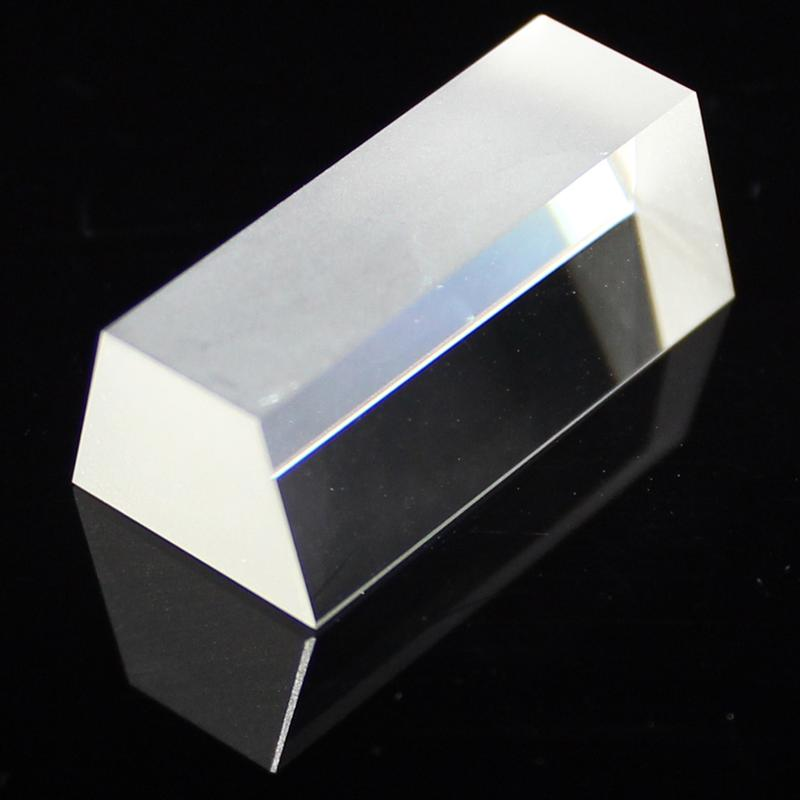
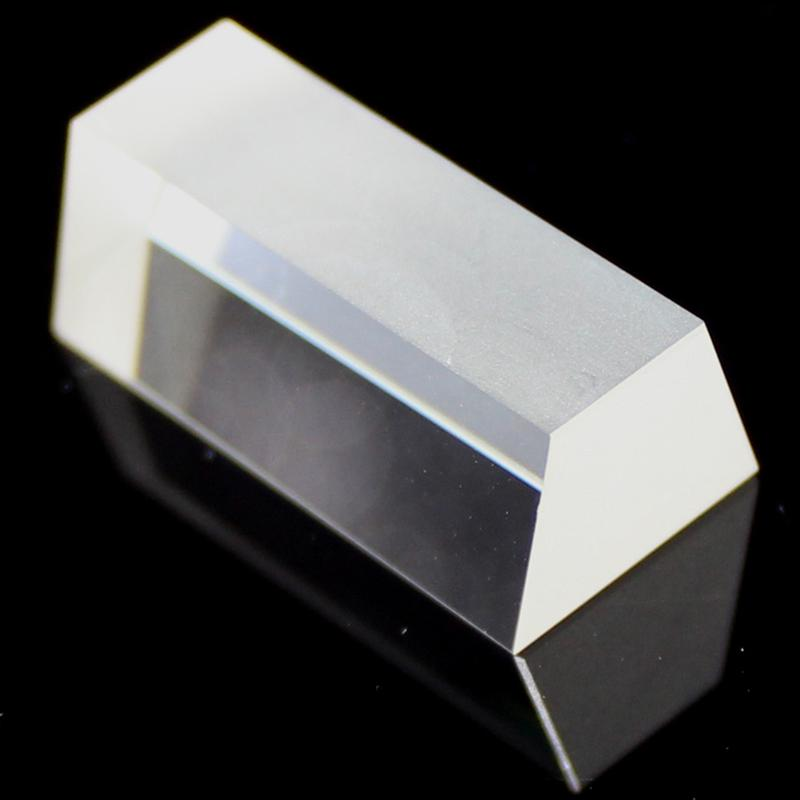
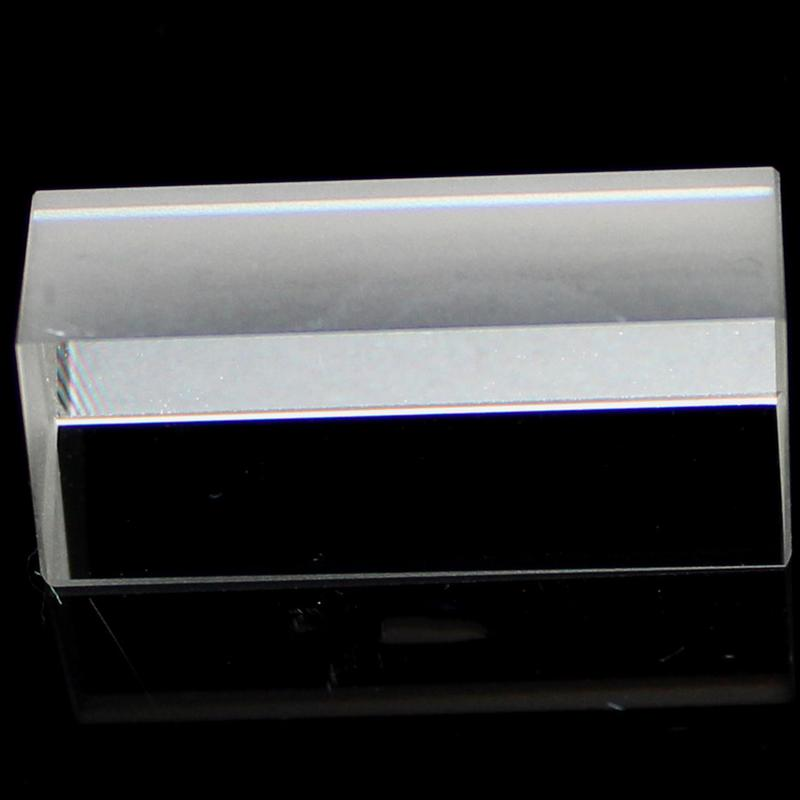
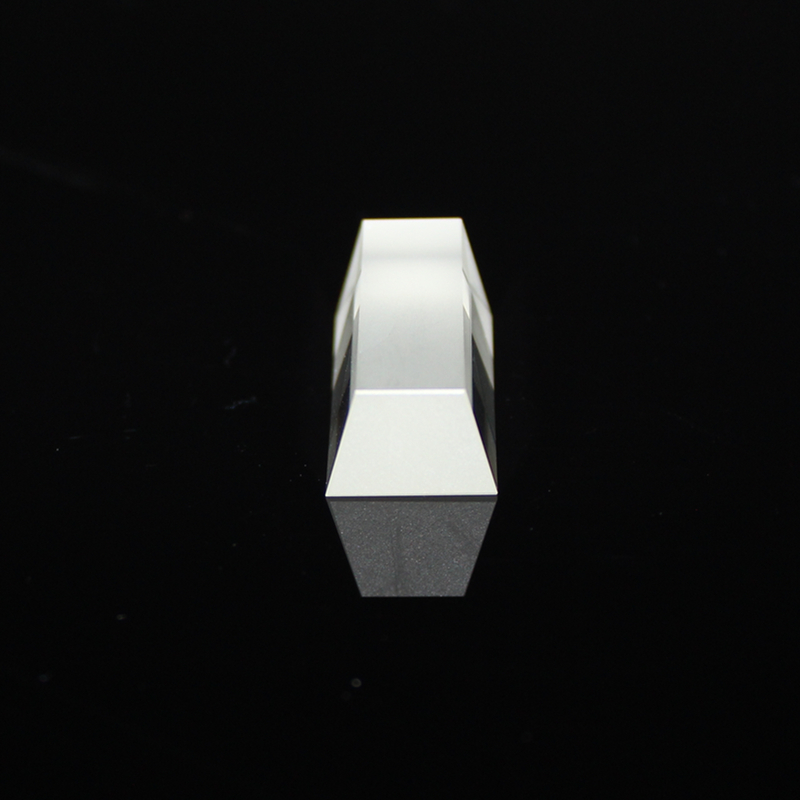
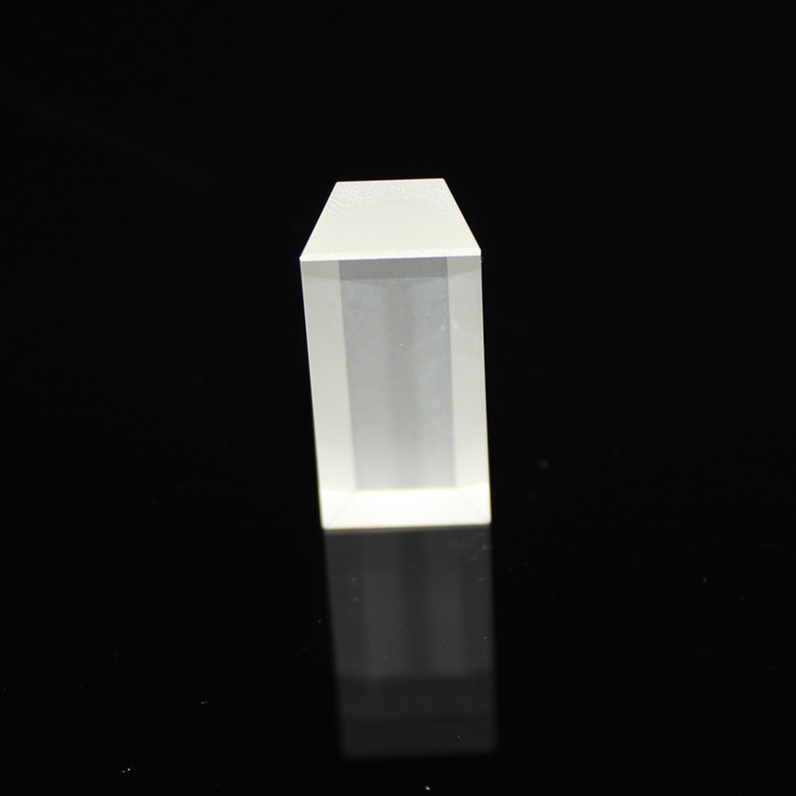
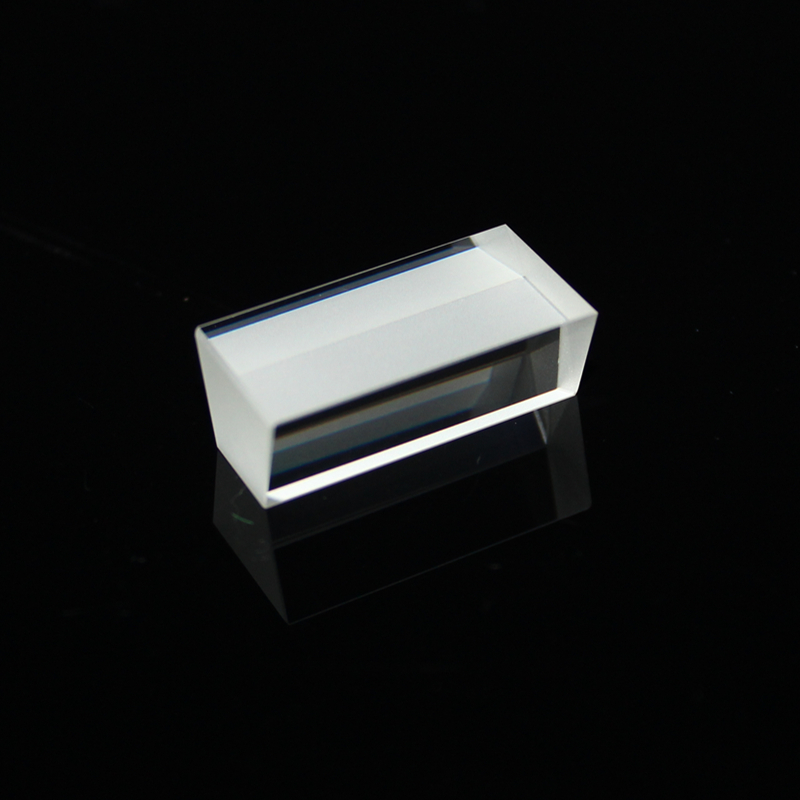
Optical Glass Dove Prism VY_PD001
Material: K9 glass, JGS1 glass, JGS2, JGS3, sapphire, ZnSe etc. Dimension: 0.50mm- 200mm Surface Accuracy: 40/20 Size Tolerance: +/-0.01mm Angle Tolerance: +/-30 min Coating: Optional ** Definiation of Dove prism Dove prism is a type of reflective prism which is used to invert an image. Dove prisms are shaped from a truncated right-angle prism. A beam of light travelling parallel to the longitudinal axis, entering one of the sloped faces of the prism undergoes total internal reflection from the inside of the longest (bottom) face and emerges from the opposite sloped face. Images passing through the prism are flipped (mirrored), and because only one reflection takes place, the image is also inverted but not laterally transposed. Refraction at the entrance and exit surfaces results in substantial image astigmatism when used in convergent light. Thus the Dove prism is used almost exclusively for images appearing at infinity. If the flat hypotenuse surface of a Dove prism is cut into a roof shape, the result is an Amici roof prism. Rotating prisms have an unusual and very interesting characteristic — if you look through the prism and rotate it around a longitudinal axis, the image rotates through twice the angle through which the dove prism itself rotates. For optimal peformance, use dove prisms with collimated light. Eg. The path of a beam through a Dove prism/ inverting prism ** Specifications for Dove Prisms The longest bottom face of the prisms typically feature an unbeveled sharp edge, while the top surface is ground. Our dove prisms are manufactured from high quality BK7 Grade A optical glass, Corning Fused Silica 7980, JGS1 UV grade fused silica, and JGS2. The dimension tolerance of a prism is defined as the acceptable variation of ranges in dimension. Our factory standard is a dimension tolerance of +/- 0.1 mm, and we can provide tighter tolerances if requested. The angle tolerance of our prisms is typically less than 5 arc minutes. This is defined as the amount of allowable variations in angles. Flatness of a prism is defined as the deviation of each of the surfaces from an ideal flat surface. The factory standard for our dove prisms is l/4l at 632.8 nm. Our factory standard for surface quality is 60-40 scratch and dig, which guarantees a highly polished surface. A scratch is defined as any marking or tearing of the glass surface. Digs are small rough spots on the glass surface, similar to pits. Bubbles in glass are considered digs. A surface quality rating of 60/40 scratch dig means that there are no digs with a diameter of larger than 0.04 mm or 0.0016 inch, and that all scratches have a brightness level of of less than 60 and, laid end to end, are no longer than ¼ the diameter of a circle with an area equal to the surface area. ** Rotation of Dove Prisms A reflection in one axis of a plane is always equivalent to a reflection and rotation in two other axes (with the angle between the source and image being twice the angle between the source and reflection axis of the prism). ** Application of Dove Prism Dove prisms can be used to create beam rotators, which have applications in fields such as astronomy, interferometry, and pattern recognition. They are used as image rotators for a variety of opto-mechanical systems. This type of prism was invented by Heinrich Wilhelm Dove, (1803-1878), a Prussian meteorologist and physicist. VY Optoelectronics Co.,Ltd. can produce all types of glass prism lenses, the coating or painting may be available by custom orders.
 Save to Favorites
Overview
Specifications
| Parameter | Value |
|---|---|
| Longest bottom face | typical:unbeveled sharp edge |
| Top surface | ground |
| Material | high quality BK7 Grade A optical glass, Corning Fused Silica 7980, JGS1 UV grade fused silica, and JGS2 |
| Dimension tolerance [factory standard;tighter tolerances if requested] | +/- 0.1 mm |
| Angle tolerance | typical:less than 5 arc minutes |
| Flatness [factory standard;632.8 nm] | l/4l at 632.8 nm |
| Surface quality [factory standard;scratch and dig] | 60-40 scratch and dig |
Applications
Datasheet
Please provide your email to download the datasheet.
Invalid email format. Please try again.
Supplier Information
Related Products
Related Articles
Developed by RealLight (Beijing), the R7M high‑power diode laser module belongs to the AW multi‑functional laser product family.
VCSEL, short for Vertical Cavity Surface Emitting Laser, is a widely used semiconductor laser component in modern optoelectronics. Unlike traditional edge-emitting lasers, VCSEL emits laser light vertically from its chip surface. Thanks to its low power consumption, stable beam quality, low cost, and easy integration, it has become the core light source for 3D sensing, wearable devices, and high-speed optical communication.
Fomoptic delivers integrated one‑stop optical solutions covering precision optical fabrication and custom vacuum coating services. Supported by complete processing production lines, comprehensive metrology equipment and experienced engineering team, we provide full‑chain customized components, ranging from blank shaping, ultra‑precision polishing to thin‑film coating, for laser systems, infrared imaging, industrial optics and scientific‑research projects.
For pulsed laser and full-spectrum optical testing, photodiodes and thermopiles have inherent drawbacks. Photodiodes show weak response in infrared band, while thermopiles feature slow response and cannot capture nanosecond narrow pulses.
Loading...
Name
Phone
Organization
Use Case

Database Platform