
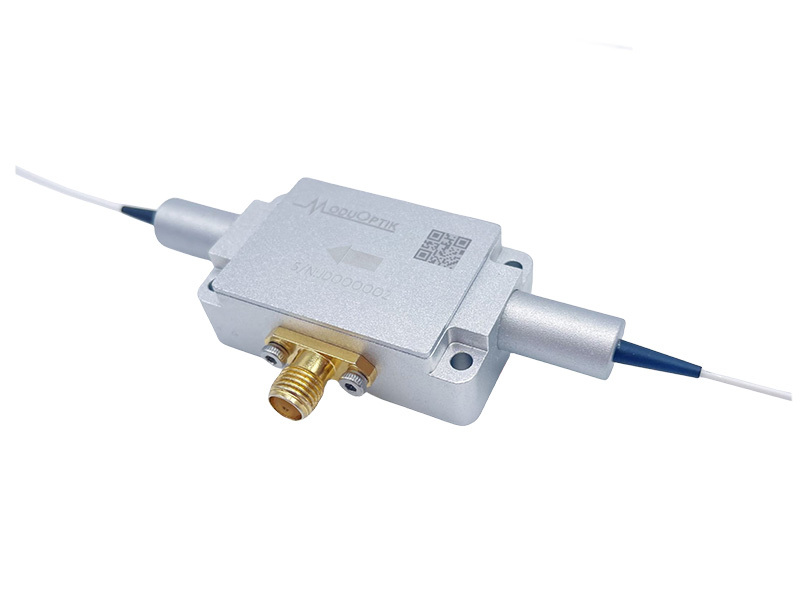
FM0027-TL120-F02-1064
An acousto-optic modulator (AOM) is generally used outside a laser cavity to change the intensity of the incident laser light (amplitude modulation, AM). This can be simple ON/OFF modulation for rapid switching or variable-level modulation for intensity control. The modulation mode is determined by the RF driver type and can be digital (on/off) or analog (sine, square, linear, random and other waveforms). The AOM RF drive generally uses a fixed frequency. The key AOM parameters are rise/fall times, which define the achievable modulation speed or amplitude modulation bandwidth. Rise/fall times are proportional to the beam diameter inside the modulator. Therefore, the incident laser beam diameter must be controlled to obtain a fast rise time. An AOM can serve as a shutter, switching on and off cyclically at a set frequency, or as a variable attenuator that dynamically controls transmitted light intensity. Laser modulation is achieved by controlling the acoustic waves induced by radio frequency in the acousto-optic crystal. Moduoptik has designed and developed free-space AOM products from a single channel to as many as 24 channels, and fiber-coupled AOM products in polarization-maintaining and non-polarization-maintaining versions. Frequencies currently reach 300MHz, with rise times as low as 6ns. Moduoptik offers a range of RF drivers matched to AOM products; the appropriate RF driver can be selected according to the product datasheet.
 Save to Favorites
Overview
Specifications
| Parameter | Value |
|---|---|
| Operating wavelength | 1064 nm |
| Operating frequency | 120 MHz |
| Fiber type | 10/125 Double-Clad |
| Rise time | < 45 ns |
| Insertion loss | <1 dB |
Applications
Datasheet
Supplier Information
Related Products
-
 Mid-Infrared Germanium Acousto-Optic Deflector AODF 4050 AODF 4050(锗)
Acousto-Optic Modulator
Sinteclaser
Acousto-optic Medium: Germanium Spectral Range: Far-Infrared Operating Wavelength: 9100 - 9500 nm
The AODF 4050 germanium acousto-optic deflector is designed for mid-infrared laser modulation and beam-control applications in the 9100–9500 nm band. It uses germanium as the acousto-optic interaction material and operates in a compressional acoustic mode. Its optical configuration uses linear horizontal polarization parallel to the base and supports stable operation over an RF frequency range of 40–60 MHz. Low-reflection antireflection coatings provide high transmission within the specified band to reduce optical loss. The AODF 4050 has an 11.6 mm clear aperture, high diffraction efficiency, and defined beam-separation characteristics at 9.4 µm, making it suitable for precision modulation and beam control in mid-infrared laser systems. It is water-cooled and equipped with push-in connectors for integration into high-power laser systems. Model identification: AODF 4050 (germanium) (97-03477-01).
-
Mid-Infrared Germanium Acousto-Optic Deflector AODF 4070 AODF 4070(锗)
Acousto-Optic Modulator
Sinteclaser
Acousto-optic Medium: Germanium Spectral Range: Far-Infrared Operating Wavelength: 9400 nm
The AODF 4070 germanium mid-infrared acousto-optic deflector is designed for beam deflection and scanning in the 9.4 µm band. It uses germanium as the acousto-optic interaction medium and operates in a longitudinal acoustic mode for high-precision mid-infrared beam control. Both input and output polarizations are parallel to the mounting reference plane, supporting stable, predictable integration into 9.4 µm laser systems. The RF system has a center frequency of 70 MHz and a bandwidth of 40 MHz for controlled acousto-optic deflection and scanning. The AODF 4070 uses a four-element phased-array structure with an integrated delay/beam-splitting module to support the required RF drive architecture and coordinated system control. It is water-cooled, has an 11 mm clear aperture and a 68 mrad scan angle, and is suitable for mid-infrared laser beam control, optical scanning, and specialized photonic systems. Model identification: AODF 4070 (germanium) (97-03260-04).
-
Visible Acousto-Optic Deflector AODF 4040
Acousto-Optic Modulator
Sinteclaser
Acousto-optic Medium: TeO₂ Acoustic Mode: Shear, Off-Axis Acoustic Velocity [±1%]: 660 m/sec
The AODF 4040 TeO₂ visible-light acousto-optic deflector is a low-power device for beam deflection and control over460–690 nm. It uses TeO₂ and an off-axis shear-wave acoustic mode. The descriptive text specifies vertical linear input polarization and horizontal linear output polarization for standardized integration and polarization separation. Low RF power requirements at460 nm suit compact beam-control architectures and efficient acousto-optic modulation. The AODF 4040 has a2 ×6 mm clear aperture and stable deflection under the specified minimum-efficiency condition for optical instruments, OEM visible-laser systems, and precision photonic applications. Main features (source table): Model |AODF 4040 (97-03461-01); Medium |TeO₂; Spectral Region |Visible; Operating Wavelength |460–690 nm; Clear Aperture |2 ×6 mm; Center Frequency |40 MHz; Acoustic Velocity |0.66 mm/μs; RF Bandwidth |1 MHz; RF Power |0.1 W; Scan Angle |0.9 mrad; Resolvable Spots |6; Input Polarization |Horizontal; Output Polarization |Vertical; Insertion Loss |<3%; Acoustic Mode |Off-Axis Shear Wave; Minimum Diffraction Efficiency |≥85%; Standing-Wave Ratio |<2.0:1. Official document:visible-light acousto-optic deflector AODF 4040.
-
Visible Acousto-Optic Deflector AODF 4120-2
Acousto-Optic Modulator
Sinteclaser
Acousto-optic Medium: TeO₂ Acoustic Mode: Shear, off axis Acoustic Velocity: .65 mm/μs
The AODF 4120-2 TeO₂ 413 nm visible-light acousto-optic deflector provides precision deflection and scanning of 413 nm visible-laser beams. TeO₂ operates in an off-axis shear-wave acoustic mode. Horizontal linear input and vertical linear output polarization support standardized integration and stable optical paths. Its RF center frequency is 120 MHz, with impedance matching across the operating band for stable RF drive and reliable beam control. The AODF 4120-2 has a large clear aperture, efficient deflection at low RF power, and defined diffraction performance. It serves scientific instruments, OEM photonic systems, and precision visible-laser platforms requiring accuracy and stability. Official document:visible-light acousto-optic deflector AODF 4120-2. Main features (source table): Model |AODF 4120-2 (97-02799-01); Medium |TeO₂; Spectral Region |Visible; Operating Wavelength |413 nm; Clear Aperture |10 mm; Center Frequency |120 MHz; Acoustic Velocity |0.65 mm/μs; RF Bandwidth |50 MHz; RF Power |<1.0 W; Scan Angle |31.8 mrad; Resolvable Spots |130; Input Polarization |Horizontal; Output Polarization |Vertical; Insertion Loss |3%; Acoustic Mode |Off-Axis Shear Wave; Minimum Diffraction Efficiency |≥75%; Standing-Wave Ratio |<2.2:1.
-
Visible Acousto-Optic Deflector AODF 4120-3
Acousto-Optic Modulator
Sinteclaser
Acousto-optic Medium: TeO₂ Acoustic Mode: Shear, off axis Acoustic Velocity: .65 mm/μs
The AODF 4120-3 TeO₂ 413 nm visible-light acousto-optic deflector provides precision deflection and scanning of 413 nm visible beams. TeO₂ operates in an off-axis shear-wave acoustic mode. Horizontal linear input and vertical linear output polarization support standardized path separation and stable integration. The RF center frequency is 120 MHz, with impedance matching across the operating band for stable drive and beam control. The AODF 4120-3 has a compact clear aperture, efficient deflection at low RF power (<0.3 W), and defined diffraction performance. It serves precision small-beam control in scientific instruments, OEM photonic platforms, and specialized laser systems. Official document:visible-light acousto-optic deflector AODF 4120-3. Main features (source table): Model |AODF 4120-3 (97-02799-02); Medium |TeO₂; Spectral Region |Visible; Operating Wavelength |413 nm; Clear Aperture |3 mm; Center Frequency |120 MHz; Acoustic Velocity |0.65 mm/μs; RF Bandwidth |50 MHz; RF Power |<0.3 W; Scan Angle |31.8 mrad; Resolvable Spots |154; Input Polarization |Horizontal; Output Polarization |Vertical; Insertion Loss |3%; Acoustic Mode |Off-Axis Shear Wave; Minimum Diffraction Efficiency |≥75%; Standing-Wave Ratio |<2.2:1.
Related Articles
Shandong Optochip specializes in independent R&D of industrial-grade optical chips for optical communication and fiber sensing. Our business includes overseas chip tape-out, domestic precision device packaging
Founded in Beijing in 2011, Beijing FJR Opto-electronic Technology Co., Ltd. specializes in R&D, manufacturing and sales of infrared thermal imaging equipment and complete optoelectronic systems.
Semiconductor laser diodes are essential light sources for industrial sensing, LiDAR and laser printing. Many engineers waste time picking mismatched models. We summarize 4 simple selection standards, plus a mature industrial product: HGLD-790TO5.6-ZSP-10mW from HAUCORE.
Driven by fast‑growing demands of 3D perception, biometric authentication and machine‑vision industries, near‑infrared imaging optics have become a vital hardware component for intelligent sensing systems.
Loading...
Name
Phone
Organization
Use Case

Database Platform