

Inductively Coupled Plasma Optical Emission Spectrometer (PerkinElmer)
PerkinElmer's ICP-OES is one of its most popular products. The ICP-OES factory has always been located in Shelton on the outskirts of New York, where the main technical R&D personnel have worked for more than 20 years, with stable production quality and a solid technical foundation. Since the introduction of the 5000 model in 1978, it has undergone continuous improvements through the 5500, 6500, P II, P1000, P2000, P40, and P400 models, with technology that has always remained far ahead. The Optima 3000 introduced in 1993 was the world's first full-spectrum simultaneous ICP-OES, and the patented dual-view observation technology introduced in 1994 brought ICP-OES performance into an entirely new stage. The Optima 4000 DV series and Optima 2000 DV introduced in 2000 are PerkinElmer's ninth- and tenth-generation products, while the Optima 5000DV series and Optima 2100 DV introduced in 2004 are the eleventh- and twelfth-generation products, representing the highest achievements of today's ICP-OES technology.; Related analytical methods 1. Direct determination method for multiple element contents in lubricating oils (ICP/AES method) Determination of trace metal impurities in gases by inductively coupled plasma atomic emission spectrometry ICP-OES and the periodic table of elements Determination of soluble Sb(III) and Sb(V) in the Chinese herbal medicine Tripterygium wilfordii by hydride generation ICP-AES Application research on the multiple spectral fitting (MSF) spectral interference subtraction method in the determination of phosphorus in steel by inductively coupled plasma atomic emission spectrometry Determination of P and S in iron ore by ICP-AES method Application of ICP-OES in the determination of impurity content in metallic gallium 05No4 -10 Direct determination of arsenic, aluminum, bismuth, chromium, copper, iron, lead, tin, antimony, and zinc in tin ingots by ICP-AES method Determination of major and impurity elements in magnesium alloys by inductively coupled plasma atomic emission spectrometry; Related analytical methods; 1. Direct determination method for multiple element contents in lubricating oils (ICP/AES method) Determination of trace metal impurities in gases by inductively coupled plasma atomic emission spectrometry ICP-OES and the periodic table of elements Determination of soluble Sb(III) and Sb(V) in the Chinese herbal medicine Tripterygium wilfordii by hydride generation ICP-AES Application research on the multiple spectral fitting (MSF) spectral interference subtraction method in the determination of phosphorus in steel by inductively coupled plasma atomic emission spectrometry Determination of P and S in iron ore by ICP-AES method Application of ICP-OES in the determination of impurity content in metallic gallium 05No4 -10 Direct determination of arsenic, aluminum, bismuth, chromium, copper, iron, lead, tin, antimony, and zinc in tin ingots by ICP-AES method Determination of major and impurity elements in magnesium alloys by inductively coupled plasma atomic emission spectrometry; Technical parameters * Stability: 1 hour RSD <1% Technical parameters * Stability: 1 hour RSD <1% Main features Instrument introduction PerkinElmer's ICP-OES is one of its most popular products. The ICP-OES factory has always been located in Shelton on the outskirts of New York, where the main technical R&D personnel have worked for more than 20 years, with stable production quality and a solid technical foundation. Since the introduction of the 5000 model in 1978, it has undergone continuous improvements through the 5500, 6500, P II, P1000, P2000, P40, and P400 models, with technology that has always remained far ahead. The Optima 3000 introduced in 1993 was the world's first full-spectrum simultaneous ICP-OES, and the patented dual-view observation technology introduced in 1994 brought ICP-OES performance into an entirely new stage. The Optima 4000 DV series and Optima 2000 DV introduced in 2000 are PerkinElmer's ninth- and tenth-generation products, while the Optima 5000DV series and Optima 2100 DV introduced in 2004 are the eleventh- and twelfth-generation products, representing the highest achievements of today's ICP-OES technology. Related analytical methods 1. Direct determination method for multiple element contents in lubricating oils (ICP/AES method) Determination of trace metal impurities in gases by inductively coupled plasma atomic emission spectrometry ICP-OES and the periodic table of elements Determination of soluble Sb(III) and Sb(V) in the Chinese herbal medicine Tripterygium wilfordii by hydride generation ICP-AES Application research on the multiple spectral fitting (MSF) spectral interference subtraction method in the determination of phosphorus in steel by inductively coupled plasma atomic emission spectrometry Determination of P and S in iron ore by ICP-AES method Application of ICP-OES in the determination of impurity content in metallic gallium 05No4 -10 Direct determination of arsenic, aluminum, bismuth, chromium, copper, iron, lead, tin, antimony, and zinc in tin ingots by ICP-AES method Determination of major and impurity elements in magnesium alloys by inductively coupled plasma atomic emission spectrometry Related analytical methods 1. Direct determination method for multiple element contents in lubricating oils (ICP/AES method) Determination of trace metal impurities in gases by inductively coupled plasma atomic emission spectrometry ICP-OES and the periodic table of elements Determination of soluble Sb(III) and Sb(V) in the Chinese herbal medicine Tripterygium wilfordii by hydride generation ICP-AES Application research on the multiple spectral fitting (MSF) spectral interference subtraction method in the determination of phosphorus in steel by inductively coupled plasma atomic emission spectrometry Determination of P and S in iron ore by ICP-AES method Application of ICP-OES in the determination of impurity content in metallic gallium 05No4 -10 Direct determination of arsenic, aluminum, bismuth, chromium, copper, iron, lead, tin, antimony, and zinc in tin ingots by ICP-AES method Determination of major and impurity elements in magnesium alloys by inductively coupled plasma atomic emission spectrometry
 Save to Favorites
Overview
Specifications
| Parameter | Value |
|---|---|
| Stability [1 hour] | 1 hour RSD < 1 % |
| Precision | Relative standard deviation RSD ≤ 0.5 % |
| Limit of detection | Detection limits for most elements can reach 0.1~1 ppb |
Key Features
Datasheet
Please provide your email to download the datasheet.
Invalid email format. Please try again.
Supplier Information
Related Products
-
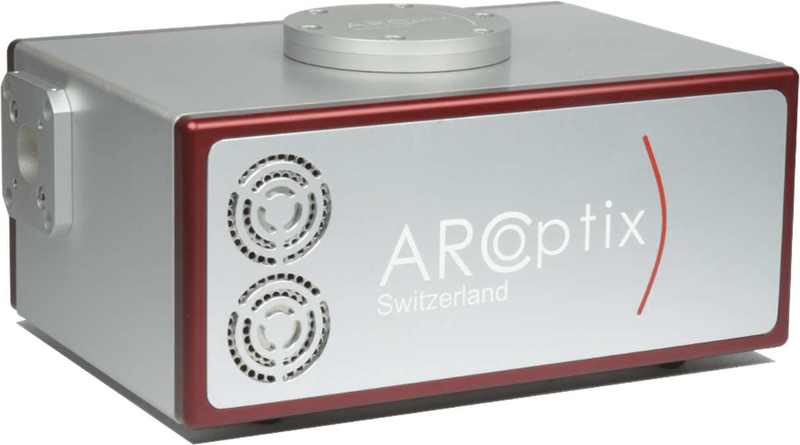 ARCoptix FT-MIR Rocket Fourier Transform Infrared Spectrometer FTMIR-L1-060-4TE
Spectrometers
Uniqueray
Beamsplitter Materials: CaF2 Measuring spectroscopy ranges ( Waves cm-1): 5000~1660 Measuring spectroscopy ranges ( Wavelength μm): 2~6
Switzerland ARCoptix Company production FT-IR“Rocket” Compact Fourier Transform Infrared Spectrometer ( Medium Infrared Spectrometer ) It's strong. 、 Small 、 Light and high performance properties 。FT-IR“Rocket” Available Optical Fiber Connection ( Here. Optical Fiber Inspect on-line in situ testing ), or free space measurements 。 Because of the use of photovoltaics Semiconductor Refrigeration MCT Mercury oxide detector ,FT-IR“Rocket” It provides high resolution and sensitivity. , Inline permanent alignment Interferometer and solid reference Laser Ensure high performance at each scan 。 The system is in Wavelength And it's very stable on the scale of the signal. , is Ideal tools for high-recurrence chemical measurements analysis 。 The system is also... is An optical spectrum analyser (OSA), Available for measurement Infrared Laser ,LED Spectra information for the same light source 。
-
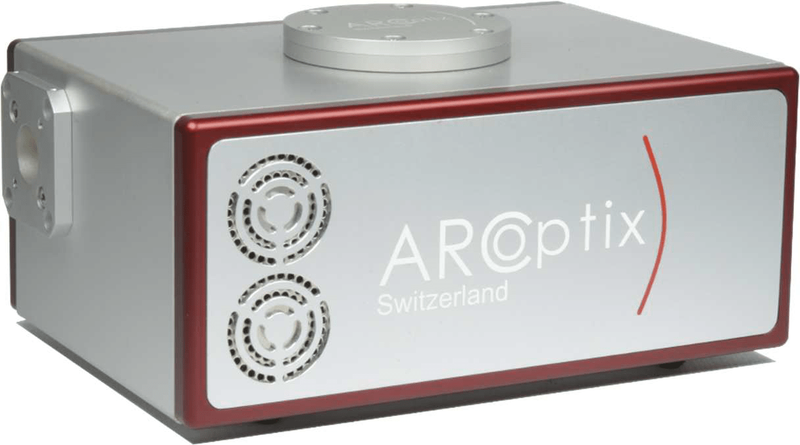 ARCoptix FT-MIR Rocket Fourier Transform Infrared Spectrometer FTMIR-L1-085-4TE
Spectrometers
Uniqueray
Beamsplitter Materials: CaF2 Measuring spectroscopy ranges ( Waves cm-1): 6600~1200 Measuring spectroscopy ranges ( Wavelength μm): 1.5~8.5
Switzerland ARCoptix Company production FT-IR“Rocket” Compact Fourier Transform Infrared Spectrometer ( Medium Infrared Spectrometer ) It's strong. 、 Small 、 Light and high performance properties 。FT-IR“Rocket” Available Optical Fiber Connection ( Here. Optical Fiber Inspect on-line in situ testing ), or free space measurements 。 Because of the use of photovoltaics Semiconductor Refrigeration MCT Mercury oxide detector ,FT-IR“Rocket” It provides high resolution and sensitivity. , Inline permanent alignment Interferometer and solid reference Laser Ensure high performance at each scan 。 The system is in Wavelength And it's very stable on the scale of the signal. , is Ideal tools for high-recurrence chemical measurements analysis 。 The system is also... is An optical spectrum analyser (OSA), Available for measurement Infrared Laser ,LED Spectra information for the same light source 。
-
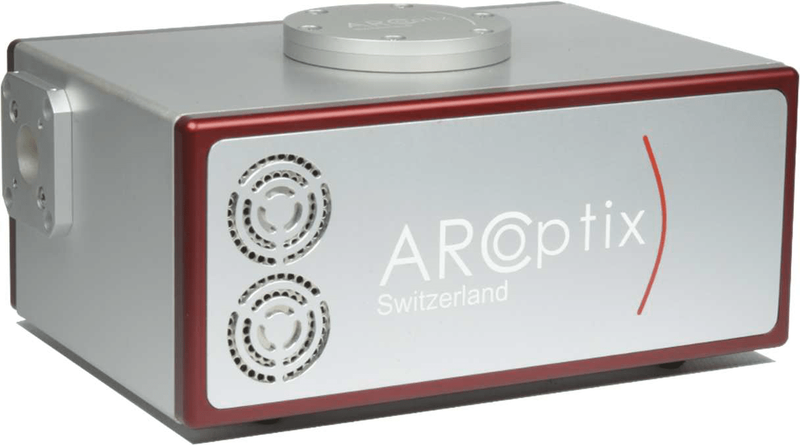 ARCoptix FT-MIR Rocket Fourier Transform Infrared Spectrometer FTMIR-L1-120-4TE
Spectrometers
Uniqueray
Beamsplitter Materials: ZnSe Measuring spectroscopy ranges ( Waves cm-1): 5000~830 Measuring spectroscopy ranges ( Wavelength μm): 2~12
Switzerland ARCoptix Company production FT-IR“Rocket” Compact Fourier Transform Infrared Spectrometer ( Medium Infrared Spectrometer ) It's strong. 、 Small 、 Light and high performance properties 。FT-IR“Rocket” Available Optical Fiber Connection ( Here. Optical Fiber Inspect on-line in situ testing ), or free space measurements 。 Because of the use of photovoltaics Semiconductor Refrigeration MCT Mercury oxide detector ,FT-IR“Rocket” It provides high resolution and sensitivity. , Inline permanent alignment Interferometer and solid reference Laser Ensure high performance at each scan 。 The system is in Wavelength And it's very stable on the scale of the signal. , is Ideal tools for high-recurrence chemical measurements analysis 。 The system is also... is An optical spectrum analyser (OSA), Available for measurement Infrared Laser ,LED Spectra information for the same light source 。
-
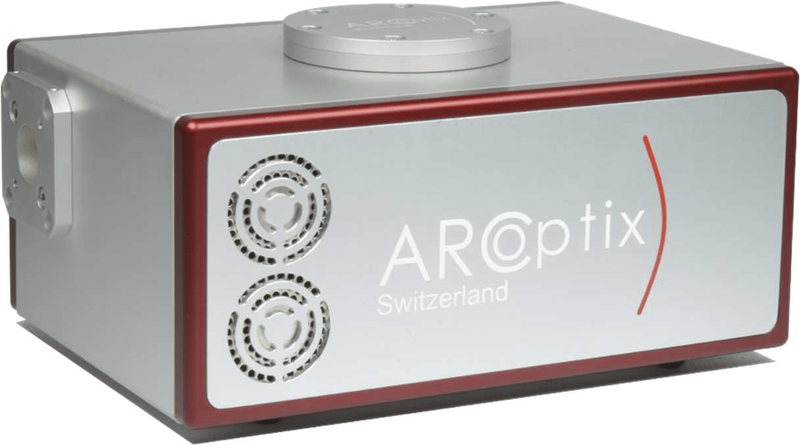 ARCoptix FT-MIR Rocket Fourier Transform Infrared Spectrometer FTMIR-L1-160- LN2
Spectrometers
Uniqueray
Beamsplitter Materials: ZnSe Measuring spectroscopy ranges ( Waves cm-1): 5000~650 Measuring spectroscopy ranges ( Wavelength μm): 2~16
Switzerland ARCoptix Company production FT-IR“Rocket” Compact Fourier Transform Infrared Spectrometer ( Medium Infrared Spectrometer ) It's strong. 、 Small 、 Light and high performance properties 。FT-IR“Rocket” Available Optical Fiber Connection ( Here. Optical Fiber Inspect on-line in situ testing ), or free space measurements 。 Because of the use of photovoltaics Semiconductor Refrigeration MCT Mercury oxide detector ,FT-IR“Rocket” It provides high resolution and sensitivity. , Inline permanent alignment Interferometer and solid reference Laser Ensure high performance at each scan 。 The system is in Wavelength And it's very stable on the scale of the signal. , is Ideal tools for high-recurrence chemical measurements analysis 。 The system is also... is An optical spectrum analyser (OSA), Available for measurement Infrared Laser ,LED Spectra information for the same light source 。
-
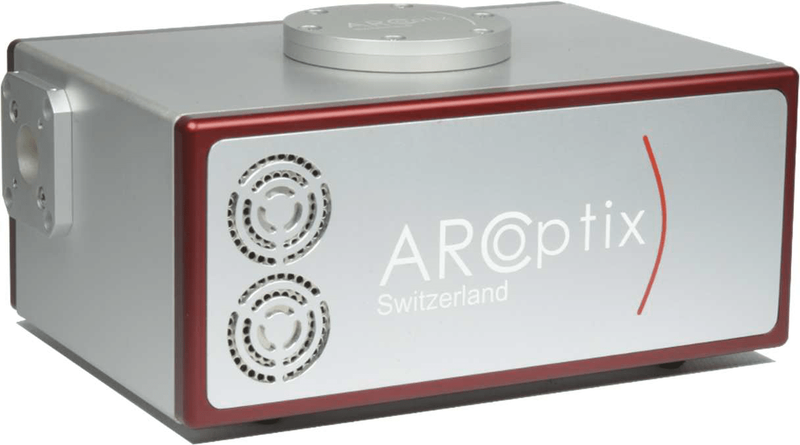 ARCoptix FT-MIR Rocket Fourier Transform Infrared Spectrometer FTMIR-L1-160- DLA
Spectrometers
Uniqueray
Beamsplitter Materials: ZnSe Measuring spectroscopy ranges ( Waves cm-1): 5000~650 Measuring spectroscopy ranges ( Wavelength μm): 2~16
Switzerland ARCoptix Company production FT-IR“Rocket” Compact Fourier Transform Infrared Spectrometer ( Medium Infrared Spectrometer ) It's strong. 、 Small 、 Light and high performance properties 。FT-IR“Rocket” Available Optical Fiber Connection ( Here. Optical Fiber Inspect on-line in situ testing ), or free space measurements 。 Because of the use of photovoltaics Semiconductor Refrigeration MCT Mercury oxide detector ,FT-IR“Rocket” It provides high resolution and sensitivity. , Inline permanent alignment Interferometer and solid reference Laser Ensure high performance at each scan 。 The system is in Wavelength And it's very stable on the scale of the signal. , is Ideal tools for high-recurrence chemical measurements analysis 。 The system is also... is An optical spectrum analyser (OSA), Available for measurement Infrared Laser ,LED Spectra information for the same light source 。
Related Articles
As a professional ultraviolet‑laser solution provider, Precilasers has launched its 266 nm narrow‑linewidth industrial laser, delivering reliable single‑frequency output for high‑precision interference lithography, semiconductor inspection and precision metrology applications.
On November 28, 2024, the 3rd China Laser Star Enterprise Summit & Advanced Laser Processing Technology Summit, an annual influential event in the laser industry, was grandly held in Wuhan Optics Valley.
Within cutting‑edge ultrafast photonics research, asynchronous optical sampling (ASOPS) and synchronous sampling serve as fundamental technologies for terahertz excitation detection, coherent Raman imaging and other time‑resolved spectroscopy experiments.
A laser bar is an array semiconductor laser chip integrated with dozens of emitters, which realizes hundred-watt quasi-continuous output on a single chip. With regular emitter arrangement and controllable fill factor, integrated thermal design and superior wall-plug efficiency compared to single chips, it acts as the core light source for high-power pumping, medical lasers and precision processing.
Loading...
Name
Phone
Organization
Use Case

Database Platform