
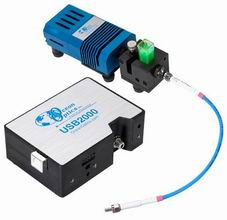
CHEM4-VIS-FIBER Fiber Optic Spectrometer
CHEM4-VIS-FIBER Fiber Optic Spectrometer;The CHEM4-VIS-FIBER fiber optic spectrometer covers a spectral range of 430-990 nm, with an optical resolution of 1.0 nm (FWHM), and can capture 3648 wavelengths within 1 second.;The CHEM4-VIS-FIBER fiber optic spectrometer integrates a USB4000 spectrometer with standard accessories for absorbance measurements, including an ISS-2 integrated sampling system, a 400 µm fiber, and a cuvette holder for 1-cm cuvettes. The CHEM4-VIS-FIBER can also be used for relative intensity and radiometric measurements, and other accessories (such as reflection probe and reflection probe and immersion probe) can be added for more measurement applications, giving this fiber-based system considerable flexibility.;Features;Fully integrated pre-assembled system covering the 430-990 nm spectral range with an optical resolution of 1.0 nm (FWHM);Compact system, ideal for laboratory and teaching use.;Flexible fiber-based system that makes it easy to add accessories;Deuterium tungsten halogen lamp integrated light source and cuvette holder;5 trigger modes;Integration time of 10 µs;The spectrometer can be quickly connected to a computer via the USB2.0 interface.;Light Source and Sample Holder;The CHEM4-UV-FIBER fiber optic spectrometer uses the ISS-2 integrated sampling system, which combines a deuterium tungsten halogen light source and a cuvette holder for 1-cm cuvettes. The ISS-2 sampling system is attached to the spectrometer via a 400 um fiber. The advantage of this design is that the light source can be easily connected to other fiber accessories (such as: reflection probes and transmission probes).;Programmable Microcontroller;The CHEMUSB4-UV-VIS fiber optic spectrometer uses our USB4000 spectrometer. The USB4000 spectrometer comes with a programmable microcontroller, which can conveniently control the spectrometer and accessories. Through a 22-pin connector, you can perform all operating parameters in the software: control the light source, create processes, and obtain information from external devices. The microcontroller has 8 programmable digital input/output interfaces for exchanging data with external devices (contact our engineering and technical personnel to obtain relevant information for writing GPIOs programs.).;Standard Component Design;Ocean Optics provides a complete set of fiber optic sampling accessories and teaching tools to enhance your CHEMUSB4-UV-VIS fiber optic spectrometer system. Most accessories have SMA905 connectors to facilitate various applications; changing the sampling system is also very simple—just remove the connector and add new components and accessories.;Plug-and-Play Operation;The CHEM4-VIS-FIBER fiber optic spectrometer can be connected to a computer, PDA, or other built-in controller via USB2.0 or RS232 serial interface. When using the serial port, a 5-volt power supply must be provided to the system (not included). The proprietary parameter data of each spectrometer is written into the memory on the USB4000; our spectrometer operating software reads these values to facilitate parameter adjustment and hot swapping between computers.;Serial Port Operation Tips: Serial Port Operation Tips: When using the serial port, a 5-volt external power supply must be provided to the USB4000 system (not included). SpectraSuite spectrometer software does not support spectrometer operation through the serial port. However, using the built-in serial port command settings, you can write your own software program that can be used for serial port operation.;Specifications;Physical Specifications;Spectrometer Dimensions:;Spectrometer Weight:;Light Source Dimensions;Light Source Weight:;Detector;Toshiba TCD1304AP linear CCD array;Detector Range:;200-1100 nm (the preset coverage range of CHEMUSB4-UV-VIS is 430-990 nm);Pixels;3648 pixels;Pixel size:;8 μm x 200 μm;Pixel Well Depth;100,000 electrons;Signal-to-Noise Ratio;300:1 (full signal);A/D Resolution;16-bit;Dark Noise;12 RMS counts;Corrected Linearity;Sensitivity;130 photons/count @ 400 nm: 60 photons/count @ 600 nm;Lens optical throughput f/4, asymmetrical crossed Czerny-Turner;Focal Length;Input 42mm; Output 68mm;Entrance Aperture;25 µm wide slit;Grating;HC-1 grating option;Not selectable;Detector focusing option;Optional, L4;OFLV filter option;Other platform option;Longpass OF-1 filter;Collimating mirror and focusing mirror;Standard;UV-enhanced lens;None;Fiber Connector:;SMA905 interface, connected to a 0.22 NA single-strand fiber;Wavelength Range:;300:1 (full signal);Analog-to-Digital Resolution;24 RMS counts;Integration Time;3 µs to 65 seconds;Dynamic Range;2x 10^8 (system), 1300:1 single acquisition;Power Consumption;600 mA @ 12 VDC;Extra power supply (included);Optical Path;Cuvette Shape;Light Source;Deuterium tungsten halogen light source;"Z" dimension;900 hours (tungsten lamp);Time to reach stable output;Power Consumption:;Data Transfer Speed:;Via USB 2.0 port, full scan into memory every 4 milliseconds;Via USB1.1 port, full scan into memory every 18 milliseconds;Input/Output;Yes, 8 programmable digital input/output interfaces for exchanging data with external devices;Analog Channels;Auto-zero;Breakout Box Compatibility;Yes, compatible with HR4-BREAKOUT;Trigger Modes;Filter function (gating function);22-pin connector;Operating System;Windows 98/Me/2000/XP, Mac OS X, and Linux systems with a USB port; any 32-bit Windows operating system with a serial port;Computer Interface;USB 2.0 @ 480 Mbps (compatible with USB1.1);
 Save to Favorites
Overview
Specifications
| Parameter | Value |
|---|---|
| Spectrometer dimensions | 89.1 mm × 63.3 mm × 34.4 mm |
| Spectrometer weight | 190 grams |
| Light source dimensions | 155 mm × 50 mm × 53.3 mm |
| Light source weight | 240 g |
| Detector | Toshiba TCD1304AP Linear CCD Array |
| Detector range | 200-1100nm (CHEMUSB4-UV-VIS preset coverage range is 430-990nm) |
| Pixel | 3648 pixels |
| Pixel size: Pixel size | 8 μm × 200 μm |
| Pixel well depth | 100,000 electrons |
| Signal-to-noise ratio | 300:1 (full signal) |
| A/D resolution | 16-bit |
| Detector dark noise | 12 RMS counts |
| Corrected linearity | >99.8 % |
| Sensitivity [400nm] | 130 photons/count |
| Sensitivity [600nm] | 60 photons/count |
| Design | Lens throughput f/4, asymmetrical crossed Czerny-Turner |
| Focal length [Input] | 42 mm |
| Focal length [Output] | 68 mm |
| Entrance aperture | 25 µm wide slit |
| Grating | #2 |
| HC-1 grating option | Not selectable |
| Detector focusing option | Optional, L4 |
| OFLV filter selection selection | OFLV-350-1000 |
| Other platform other platform selection | Longpass OF-1 filter |
| Collimating mirror and focusing mirror | Standard |
| UV-enhanced lens | None |
| Fiber connector | SMA905 interface, connected to 0.22NA single-strand fiber |
| Wavelength Range | 430990 nm |
| Optical resolution | 1.0 nm FWHM |
| Spectrometer dark noise | 24 RMS counts |
| Integration time | 3 µs to 65 seconds |
| Dynamic range | 2x 10⁸ (system), 1300:1 single acquisition |
| Stray light [600 nm] | <0.05 % |
| Stray light [435 nm] | 0.10 % |
| Power consumption [12 VDC; additional power supply (included)] | 600 mA @ 12 VDC; additional power supply (included) |
| Optical Path Length | 1 cm |
| Test tube shape | Square |
| Light source | Deuterium tungsten halogen light source |
| "Z" dimension | 15 mm |
| Lamp life [Tungsten lamp] | 900 hours (tungsten lamp) |
| Time to reach stable output | ~30 minutes |
| Power consumption [5 VDC] | 250 mA @ 5 VDC |
| Data transfer speed | Full scan into memory every 4 milliseconds via USB 2.0 port; full scan into memory every 18 milliseconds via USB1.1 port |
| Input/Output | Yes, 8 programmable digital input/output interfaces for exchanging data with external devices |
| Analog channel | No |
| Auto zero | Yes |
| Breakout box compatibility | Yes, compatible with HR4-BREAKOUT |
| Trigger modes | 5 modes |
| Filter function (gating function) | Yes |
| Connector | 22-pin connector |
| Operating System | Windows 98/Me/2000/XP with USB port, Mac OS X and Linux systems; any 32-bit Windows operating system with serial port |
| Computer interface [480 Mbps (compatible with USB1.1); RS-232 (2-wire) @ 115.2 K baud] | USB 2.0 @ 480 Mbps (compatible with USB1.1); RS-232 (2-wire) @ 115.2 K baud |
| Peripheral interface | SPI (3-wire); I2C circuit interface |
Key Features
Datasheet
Please provide your email to download the datasheet.
Invalid email format. Please try again.
Supplier Information
Related Products
-
BIM-6602A series high-resolution spectrometers UV-NIR BIM-6602A-15 Spectrometers Brolight
Fiber Connectors [BIM-6602A: Parameter Specifications]: SMA905 Detector [BIM-6602A: Parameter Specifications]: Hamamatsu S11639, Line-Array CMOS Detector Pixel [BIM-6602A: Parameter Specifications]: 2048 Pixels, Each Pixel 14μm×200μm
The BIM-6602A series spectrometer uses a high-resolution optomechanical structure in a compact, portable design, with resolution as fine as 0.08 nm. Interchangeable gratings adjust optical resolution and spectral range. Upgraded circuitry provides a 10000:1 dynamic range, minimum integration time of 0.5 milliseconds, and 600:1 signal-to-noise ratio for weak-signal detection. RS232 communication and improved interference resistance make it ideal for industrial and scientific applications.
-
BIM-6602A series high-resolution spectrometers UV-NIR BIM-6602A-16 Spectrometers Brolight
Fiber Connectors [BIM-6602A: Parameter Specifications]: SMA905 Detector [BIM-6602A: Parameter Specifications]: Hamamatsu S11639, Line-Array CMOS Detector Pixel [BIM-6602A: Parameter Specifications]: 2048 Pixels, Each Pixel 14μm×200μm
The BIM-6602A series spectrometer uses a high-resolution optomechanical structure in a compact, portable design, with resolution as fine as 0.08 nm. Interchangeable gratings adjust optical resolution and spectral range. Upgraded circuitry provides a 10000:1 dynamic range, minimum integration time of 0.5 milliseconds, and 600:1 signal-to-noise ratio for weak-signal detection. RS232 communication and improved interference resistance make it ideal for industrial and scientific applications.
-
BIM-6602A series high-resolution spectrometers UV-NIR BIM-6602A-17 Spectrometers Brolight
Fiber Connectors [BIM-6602A: Parameter Specifications]: SMA905 Detector [BIM-6602A: Parameter Specifications]: Hamamatsu S11639, Line-Array CMOS Detector Pixel [BIM-6602A: Parameter Specifications]: 2048 Pixels, Each Pixel 14μm×200μm
The BIM-6602A series spectrometer uses a high-resolution optomechanical structure in a compact, portable design, with resolution as fine as 0.08 nm. Interchangeable gratings adjust optical resolution and spectral range. Upgraded circuitry provides a 10000:1 dynamic range, minimum integration time of 0.5 milliseconds, and 600:1 signal-to-noise ratio for weak-signal detection. RS232 communication and improved interference resistance make it ideal for industrial and scientific applications.
-
BIM-6602A series high-resolution spectrometers UV-NIR BIM-6602A-18 Spectrometers Brolight
Fiber Connectors [BIM-6602A: Parameter Specifications]: SMA905 Detector [BIM-6602A: Parameter Specifications]: Hamamatsu S11639, Line-Array CMOS Detector Pixel [BIM-6602A: Parameter Specifications]: 2048 Pixels, Each Pixel 14μm×200μm
The BIM-6602A series spectrometer uses a high-resolution optomechanical structure in a compact, portable design, with resolution as fine as 0.08 nm. Interchangeable gratings adjust optical resolution and spectral range. Upgraded circuitry provides a 10000:1 dynamic range, minimum integration time of 0.5 milliseconds, and 600:1 signal-to-noise ratio for weak-signal detection. RS232 communication and improved interference resistance make it ideal for industrial and scientific applications.
-
BIM-6602A series high-resolution spectrometers UV-NIR BIM-6602A-19 Spectrometers Brolight
Fiber Connectors [BIM-6602A: Parameter Specifications]: SMA905 Detector [BIM-6602A: Parameter Specifications]: Hamamatsu S11639, Line-Array CMOS Detector Pixel [BIM-6602A: Parameter Specifications]: 2048 Pixels, Each Pixel 14μm×200μm
The BIM-6602A series spectrometer uses a high-resolution optomechanical structure in a compact, portable design, with resolution as fine as 0.08 nm. Interchangeable gratings adjust optical resolution and spectral range. Upgraded circuitry provides a 10000:1 dynamic range, minimum integration time of 0.5 milliseconds, and 600:1 signal-to-noise ratio for weak-signal detection. RS232 communication and improved interference resistance make it ideal for industrial and scientific applications.
Related Articles
The LZFL405‑80mW‑3 series from Shenzhen Leirte Optoelectronics Co., Ltd. is a coaxial‑packaged violet‑blue single‑mode fiber‑coupled laser diode. It delivers 80 mW continuous‑wave output at 405 nm. Light is coupled into 3 μm core‑diameter single‑mode fiber for clean beam quality and easy integration into diverse optical systems. It serves as a compact violet‑blue light source for medical instruments and industrial printing applications.
Wuhan Optics Valley Quantum Technology Co., Ltd. is a leading domestic developer of high‑speed semiconductor optical chips and photodetector components. Our product portfolio covers InGaAs avalanche photodiode bare dies and PIN photodetector chips designed for fiber‑optic communication
As a professional ultraviolet‑laser solution provider, Precilasers has launched its 266 nm narrow‑linewidth industrial laser, delivering reliable single‑frequency output for high‑precision interference lithography, semiconductor inspection and precision metrology applications.
Electro-optic deflectors (EODs) are optical devices used to steer or deflect light beams by applying an electric field to a specialized optical crystal. Unlike mechanical beam steering systems that rely on moving mirrors, electro-optic deflectors enable high-speed, non-mechanical beam control with exceptional precision and responsiveness. They are widely used in laser scanning, optical communications, microscopy, laser printing, spectroscopy, and scientific research, where rapid and accurate laser beam positioning is essential.
Loading...
Name
Phone
Organization
Use Case

Database Platform