
Color Glass Filter HWB850
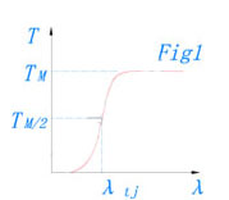
R = Reflectance no = index of refraction of air n1 = index of refraction of the color glass, typically 1.51-1.56. Therefore, R is 0.04 at one surface for a typical color glass in the air. The total reflection loss for two surfaces is approximately 0.08. Internal transmittance can also be used to determine the transmission at other glass thickness by: Tt1 = Internal transmittance at λfor thickness t1 Tt2 = Internal transmittance at λfor thickness t2 Based on their spectral transmission characteristic, primarily we divide color glass into 3 categories. And according to the color, optical properties, and the first alphabet of the Chinese pronunciation of the colors, we further divided them into 20 groups and 117 types and named them. 1.Cut-off Color Glass The glass is named based on spectral characteristic, which is represented by the wavelength transmission limit. For example, if the transmission limit of glass is 490nm,then it is named as JB490.There are altogether 5 groups and 35 types glasses. 2.Absorption-selective Color Glass This category of glass can be divided into 14 groups and 78 types in this catalogue based on spectral characteristic represented by wavelength transmission. 3.Neutral Color Glass The glasses in this category are named based on their average transmission on a 2mm thick sample at the wavelength from 400nm to 700nm. For example, if the average transmission is 70%, we name it as ZAB70. Altogether here are 10 types of glass in this category. But the transmission of three types(ZAB65,ZAB30,ZAB5) is tested at the wavelength of 440nm-660nm. Spectral transmittance characteristic The limit wavelength of transmission(t) refers to the wavelength, at which the transmittance is 50% of the maximum transmittance at the defined wavelength(Lambda 0) when the thickness of the sample glass is defined. We use Lambda tj to represent it. Lambda0 is the transmittance at a defined wavelength. It is the top transmittance of the transmittance curve. The slope of transmittance curve is represented by the difference between the light density at Lambdatj and Lambdatj-20nm at a certain glass thickness. That is K = D Lambdatj-20nm - D Lambdatj. The average transmittance is the average of a group of transmittance values measured every 20nm among the defined wavelength range. The allowable deviation of the average transmittance means the allowable deviation of average transmittance of a certain type of glass. We use Delta Tp to represent it. The maximum allowable deviation means the absolute difference between the transmittance with the maximum average transmittance deviation and the average transmittance. We use Qz to represent it. Transmittance of Color Glass As any other transparent optics materials, color glass also has surface reflectance, which is given by: (Tt2)=(Tt1)t2/t1 1.Cut-off Color Glass The spectral transmittance curve of this kind of glass is as shown in Fig.1. Their spectral characteristic is represented by the limit wavelength of transmission(Lambdatj), the allowable deviation of limit wavelength of transmission, the transmittance(TLambda 0) at a defined wavelength and the slope of transmission curve(K). 2.Absorption-selective Color Glass This kind of glass only transmits(or absorbs)light within one or several wavelength ranges as shown in fig.2. Their spectral characteristic is represented by the transmittance of a defined wavelength at a certain glass thickness and the allowable deviation value of transmittance at a certain glass thickness. 3.Neutral Color Glass This kind of glass uniformly absorbs all the light at different visible wavelengths. Its transmittance curve is as shown in Fig.3. Their spectral characteristic is represented by the average transmittance(Tp), the allowable deviation of the average transmittance and the maximum allowable deviation Qz.
 Save to Favorites
Overview
Specifications
| Parameter | Value |
|---|---|
| HOYA [Color Glass Comparative (CHINESE, SCHOTT, HOYA)] | IR-85 |
Key Features
Datasheet
Please provide your email to download the datasheet.
Invalid email format. Please try again.
Supplier Information
Related Products
-
 FL490FF-FISH FISH Excitation Block
Optical Filters
Situoli
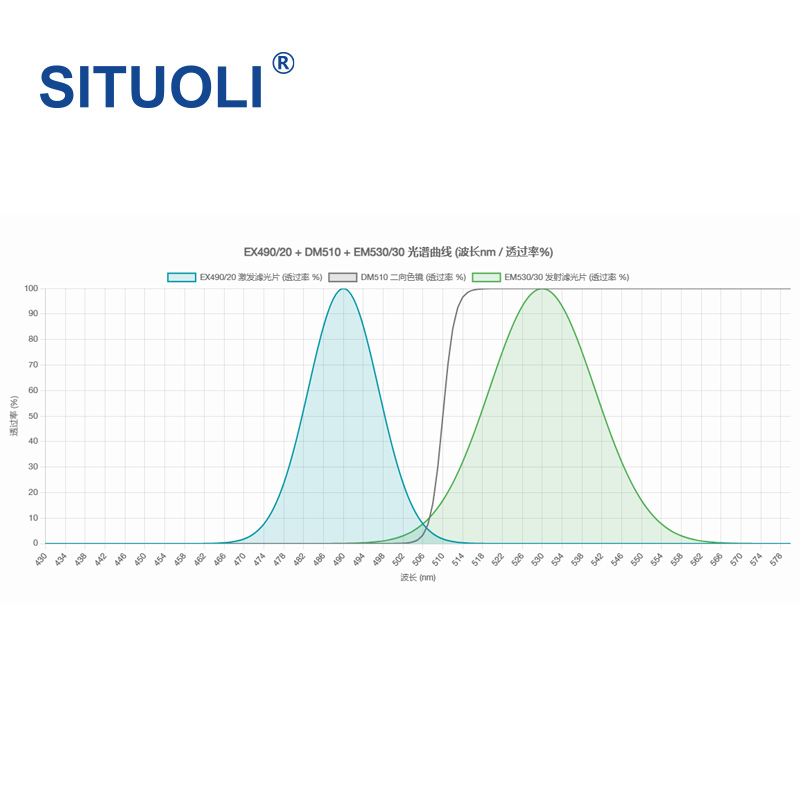
EX490/20 Excitation Filter - Center Wavelength: 490nm EX490/20 Excitation Filter - Half Bandwidth: 20nm EX490/20 Excitation Filter - Effective Wavelength Band [Narrowband Cyan-Green Light Excitation]: 480nm ~ 500nm
Full product name: Mirror Unit for fluorescence microscopy, bandpass fluorescence excitation block specifically for FISH-Green. Optical configuration: excitation filter EX490/20 + dichroic beamsplitter DM510 + emission filter EM530/30. Standard accessory: dedicated protective storage case (including case). Compatible fluorescence systems: FISH-Green green probes, GFP green fluorescent protein and Green-series fluorescent dyes.
-
 FL435LFF-FISH FISH Excitation Block
Optical Filters
Situoli
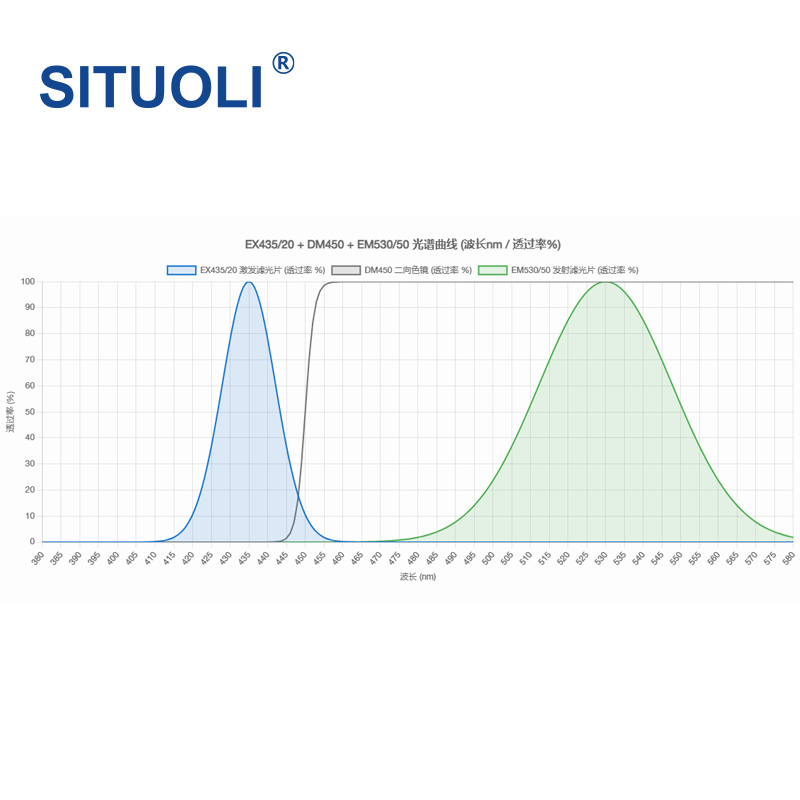
EX435/20 Excitation Filter - Center Wavelength: 435nm EX435/20 Excitation Filter - Half Bandwidth: 20nm EX435/20 Excitation Filter - Effective Wavelength Band [Blue Narrowband Excitation]: 425nm ~ 445nm
Full product name: Mirror Unit for fluorescence microscopy, bandpass fluorescence excitation block specifically for FISH-Aqua. Optical configuration: excitation filter EX435/20 + dichroic beamsplitter DM450 + emission filter EM530/50. Standard accessory: dedicated protective storage case (including case). Compatible fluorescence systems: FISH-Aqua probes, green fluorescent dyes and broadband green fluorescent labels.
-
 FL390FF-FISH FISH Excitation Block
Optical Filters
Situoli
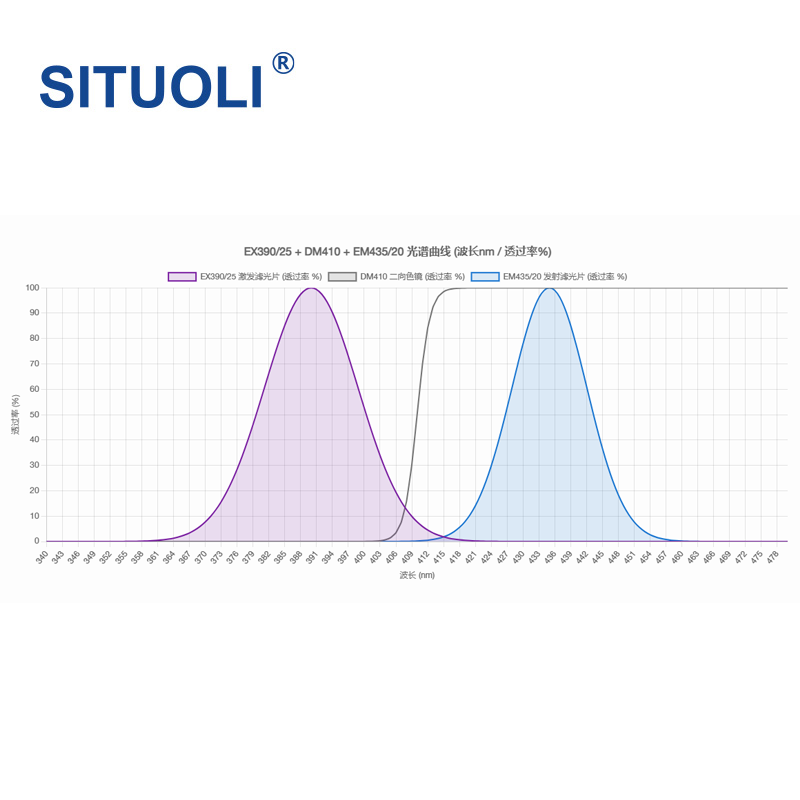
EX390/25 Excitation Filter - Center Wavelength: 390nm EX390/25 Excitation Filter - Half Bandwidth: 25nm EX390/25 Excitation Filter - Effective Wavelength Band [Narrowband UV-Blue Light Excitation]: 377.5nm ~ 402.5nm
Full product name: Mirror Unit for fluorescence microscopy, bandpass fluorescence excitation block specifically for FISH-Blue. Optical configuration: excitation filter EX390/25 + dichroic beamsplitter DM410 + emission filter EM435/20. Standard accessory: dedicated protective storage case (including case). Compatible fluorescence systems: FISH-Blue blue probes, DAPI, Hoechst 33342 and blue fluorescent protein.
-
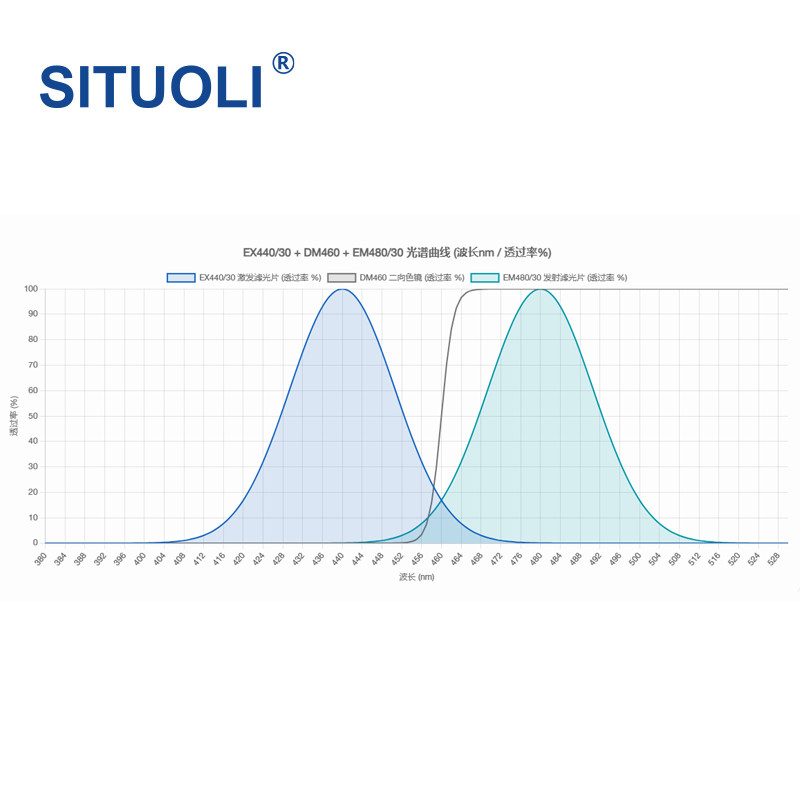 FL440FF-FISH FISH Excitation Block
Optical Filters
Situoli
EX440/30 Excitation Filter - Center Wavelength: 440nm EX440/30 Excitation Filter - Half Bandwidth: 30nm EX440/30 Excitation Filter - Effective Wavelength Band [Blue Narrowband Excitation]: 425nm ~ 455nm
Full product name: Mirror Unit for fluorescence microscopy, bandpass fluorescence excitation block specifically for FISH-Aqua. Optical configuration: excitation filter EX440/30 + dichroic beamsplitter DM460 + emission filter EM480/30. Standard accessory: dedicated protective storage case (including case). Compatible fluorescence systems: FISH-Aqua cyan fluorescent probes, CFP cyan fluorescent protein and Aqua-series fluorescent dyes.
-
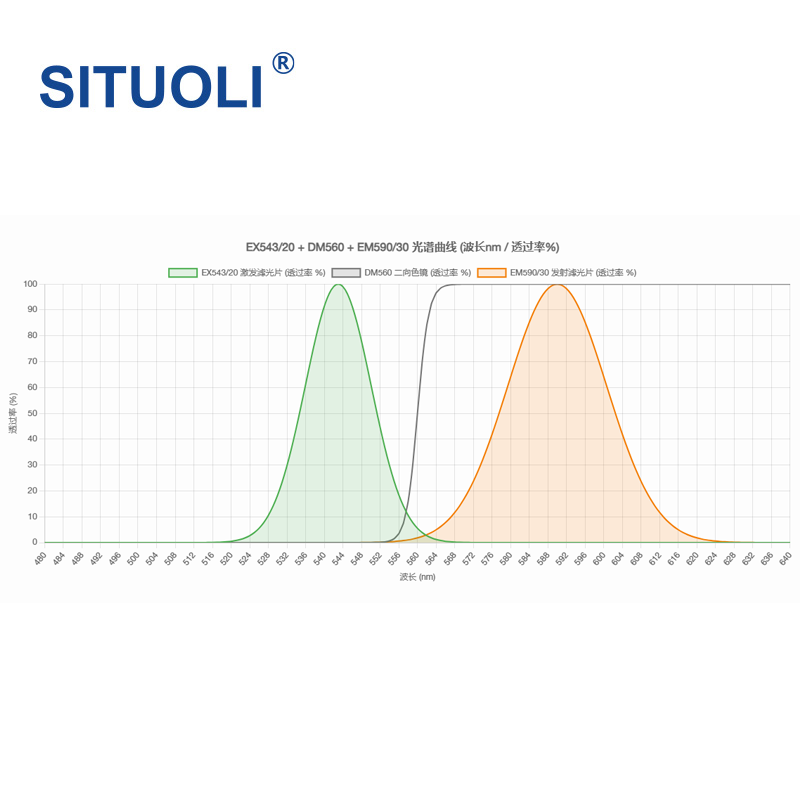 FL543FF-FISH FISH Excitation Block
Optical Filters
Situoli
EX543/20 Excitation Filter - Center Wavelength: 543nm EX543/20 Excitation Filter - Half Bandwidth: 20nm EX543/20 Excitation Filter - Effective Wavelength Band [Narrowband Yellow-Green Light Excitation]: 533nm ~ 553nm
Full product name: Mirror Unit for fluorescence microscopy, bandpass fluorescence excitation block specifically for FISH-Orange. Optical configuration: excitation filter EX543/20 + dichroic beamsplitter DM560 + emission filter EM590/30. Standard accessory: dedicated protective storage case (including case). Compatible fluorescence systems: FISH-Orange orange fluorescent probes, Orange-series fluorescent dyes and ROX dye.
Related Articles
Against the evolving demands for military‑grade hardware, rail transit equipment and heavy‑duty machinery that run under high‑shock vibrating conditions, anti‑loose connectors serve as indispensable hardware for stable power delivery and high‑speed signal transmission.
Developed by RealLight (Beijing), the R7M high‑power diode laser module belongs to the AW multi‑functional laser product family.
GYOPTICS 30 W collimated isolator is a highly‑reliable passive optical component optimized for 1064 nm high‑power laser systems. Characterized by low insertion loss and superior backward‑light suppression capability, it effectively blocks reflected light traveling back toward the laser resonator, eliminating back‑reflection‑induced instability and protecting fiber or solid‑state laser sources during long‑term operation.
Santec introduces the HSL‑20‑C‑E swept laser. Built on proprietary MEMS technology, this compact integrated light source combines high‑speed scanning and long coherence length, optimized for SS‑OCT imaging systems. Configurable start trigger and k‑clock outputs are available to meet development requirements for medical‑biological imaging and industrial non‑destructive inspection equipment.
Loading...
Name
Phone
Organization
Use Case

Database Platform