
Biochemical Filter
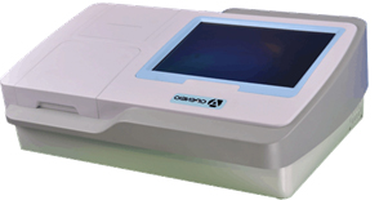
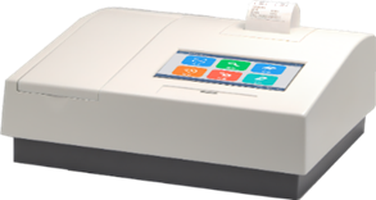
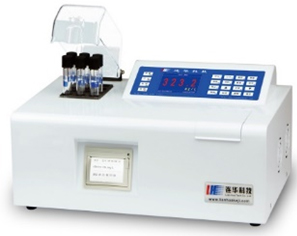
Biochemical analyzers assess blood/body-fluid markers such as transaminases, hemoglobin, the unclear source label 但富春, creatinine, enzymes and glucose. Using Lambert–Beer principles, precision interference filters/gratings select monochromatic light. Transmitted sample light is detected electrically, converted/processed and compared with a standard curve to determine concentration. Typical wavelengths are340,380,405,414,450,480,492,505,510,520,535,546,550,578,589,600,610,620,630,650,670,700,750,766 and800nm. Microplate readers quantify antigen/antibody colorimetrically. ClassⅠ/Ⅱ use single-band precision interference filters; classⅢ uses linear-variable interference filters/gratings. Light partly absorbed by microplate specimens reaches a photodetector, then data processing gives results. Typical wavelengths are405,450,492,540,570,620 and630nm. 北京同生科技's biochemical filters give high SNR through deep blocking. Ultrahard, corrosion-resistant coatings are described as essentially permanent.
 Save to Favorites
Overview
Applications
Key Features
Datasheet
Please provide your email to download the datasheet.
Invalid email format. Please try again.
Supplier Information
Related Products
-
 FL490FF-FISH FISH Excitation Block
Optical Filters
Situoli
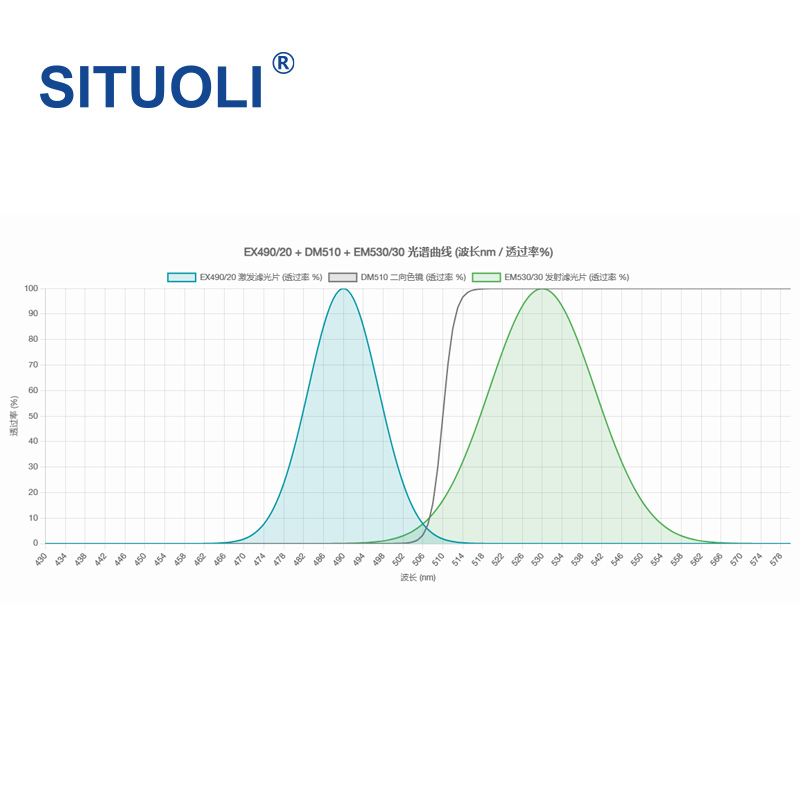
EX490/20 Excitation Filter - Center Wavelength: 490nm EX490/20 Excitation Filter - Half Bandwidth: 20nm EX490/20 Excitation Filter - Effective Wavelength Band [Narrowband Cyan-Green Light Excitation]: 480nm ~ 500nm
Full product name: Mirror Unit for fluorescence microscopy, bandpass fluorescence excitation block specifically for FISH-Green. Optical configuration: excitation filter EX490/20 + dichroic beamsplitter DM510 + emission filter EM530/30. Standard accessory: dedicated protective storage case (including case). Compatible fluorescence systems: FISH-Green green probes, GFP green fluorescent protein and Green-series fluorescent dyes.
-
 FL435LFF-FISH FISH Excitation Block
Optical Filters
Situoli
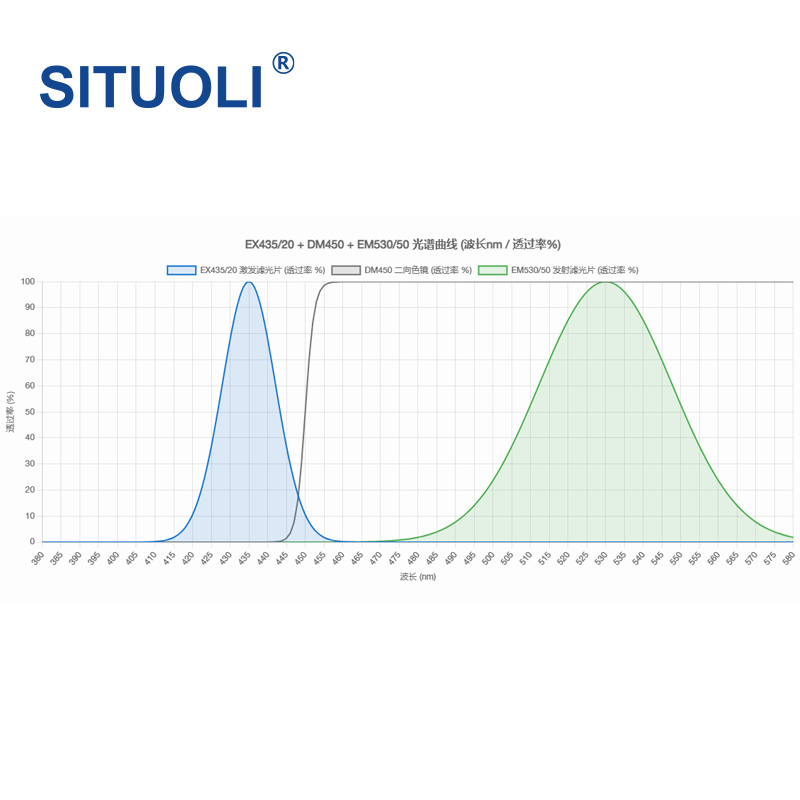
EX435/20 Excitation Filter - Center Wavelength: 435nm EX435/20 Excitation Filter - Half Bandwidth: 20nm EX435/20 Excitation Filter - Effective Wavelength Band [Blue Narrowband Excitation]: 425nm ~ 445nm
Full product name: Mirror Unit for fluorescence microscopy, bandpass fluorescence excitation block specifically for FISH-Aqua. Optical configuration: excitation filter EX435/20 + dichroic beamsplitter DM450 + emission filter EM530/50. Standard accessory: dedicated protective storage case (including case). Compatible fluorescence systems: FISH-Aqua probes, green fluorescent dyes and broadband green fluorescent labels.
-
 FL390FF-FISH FISH Excitation Block
Optical Filters
Situoli
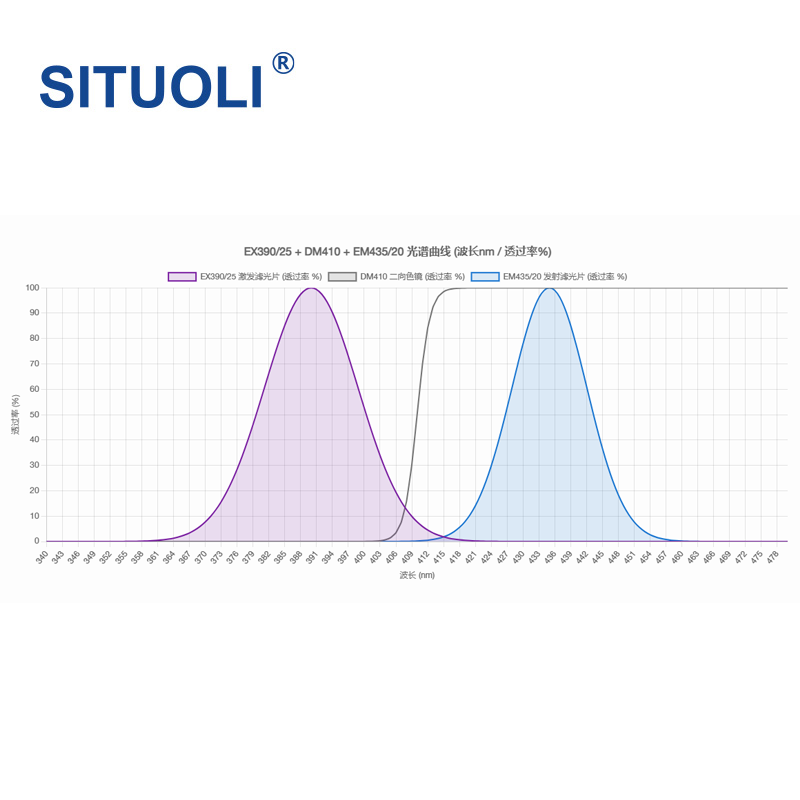
EX390/25 Excitation Filter - Center Wavelength: 390nm EX390/25 Excitation Filter - Half Bandwidth: 25nm EX390/25 Excitation Filter - Effective Wavelength Band [Narrowband UV-Blue Light Excitation]: 377.5nm ~ 402.5nm
Full product name: Mirror Unit for fluorescence microscopy, bandpass fluorescence excitation block specifically for FISH-Blue. Optical configuration: excitation filter EX390/25 + dichroic beamsplitter DM410 + emission filter EM435/20. Standard accessory: dedicated protective storage case (including case). Compatible fluorescence systems: FISH-Blue blue probes, DAPI, Hoechst 33342 and blue fluorescent protein.
-
 FL440FF-FISH FISH Excitation Block
Optical Filters
Situoli
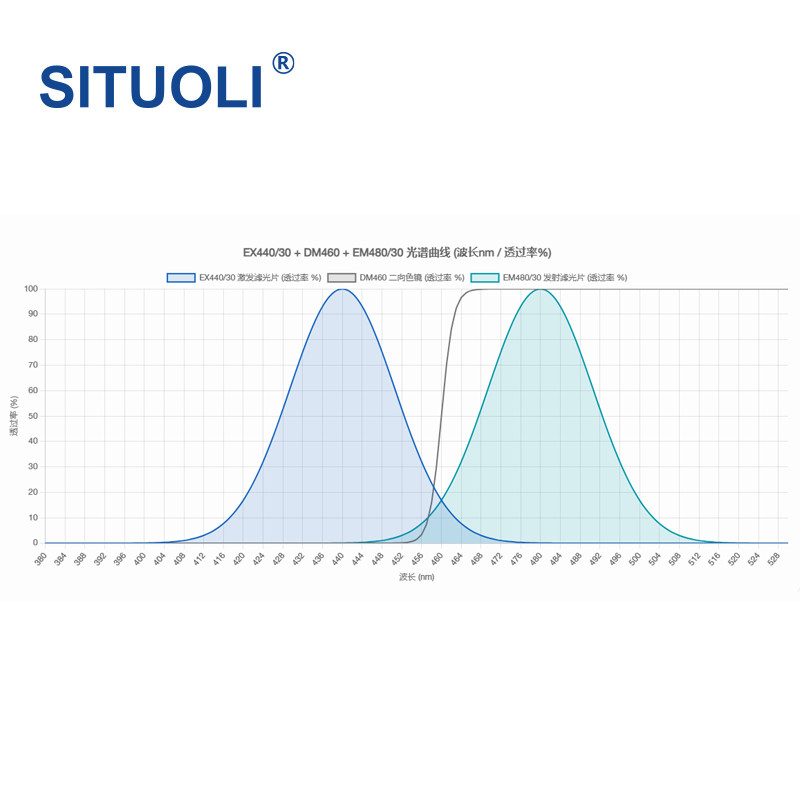
EX440/30 Excitation Filter - Center Wavelength: 440nm EX440/30 Excitation Filter - Half Bandwidth: 30nm EX440/30 Excitation Filter - Effective Wavelength Band [Blue Narrowband Excitation]: 425nm ~ 455nm
Full product name: Mirror Unit for fluorescence microscopy, bandpass fluorescence excitation block specifically for FISH-Aqua. Optical configuration: excitation filter EX440/30 + dichroic beamsplitter DM460 + emission filter EM480/30. Standard accessory: dedicated protective storage case (including case). Compatible fluorescence systems: FISH-Aqua cyan fluorescent probes, CFP cyan fluorescent protein and Aqua-series fluorescent dyes.
-
 FL543FF-FISH FISH Excitation Block
Optical Filters
Situoli
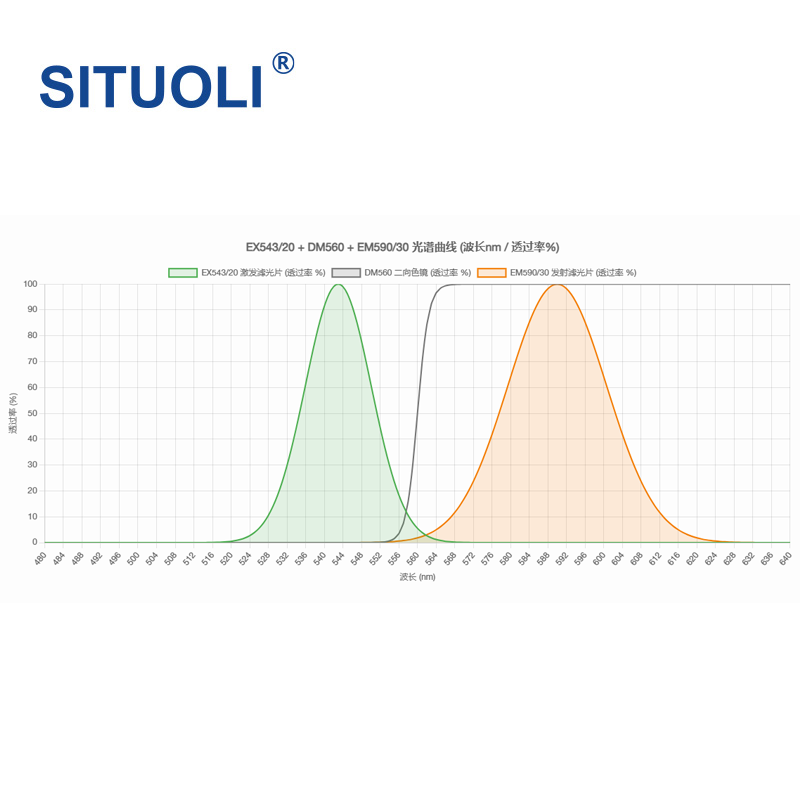
EX543/20 Excitation Filter - Center Wavelength: 543nm EX543/20 Excitation Filter - Half Bandwidth: 20nm EX543/20 Excitation Filter - Effective Wavelength Band [Narrowband Yellow-Green Light Excitation]: 533nm ~ 553nm
Full product name: Mirror Unit for fluorescence microscopy, bandpass fluorescence excitation block specifically for FISH-Orange. Optical configuration: excitation filter EX543/20 + dichroic beamsplitter DM560 + emission filter EM590/30. Standard accessory: dedicated protective storage case (including case). Compatible fluorescence systems: FISH-Orange orange fluorescent probes, Orange-series fluorescent dyes and ROX dye.
Related Articles
VCSEL, short for Vertical Cavity Surface Emitting Laser, is a widely used semiconductor laser component in modern optoelectronics. Unlike traditional edge-emitting lasers, VCSEL emits laser light vertically from its chip surface. Thanks to its low power consumption, stable beam quality, low cost, and easy integration, it has become the core light source for 3D sensing, wearable devices, and high-speed optical communication.
As fundamental refractive optical components, plano‑convex spherical lenses consist of one convex spherical surface and one flat surface.
FiDAR, the fiber‑optic radar vehicle positioning and tracking system developed by Jianhe Bafang, is a high‑sensitivity distributed fiber‑sensing solution designed for intelligent traffic road monitoring. It outputs real‑time spatial coordinates of every vehicle across the full road section around‑the‑clock, delivering a brand‑new sensing technology for vehicle‑road cooperation, smart highway construction and urban traffic management.
Raybowlaser, a professional manufacturer of high-power laser chips, has officially launched its upgraded new-generation 1470nm high-performance laser chip. Achieving groundbreaking progress in rated output power and wall-plug efficiency (WPE), this innovative laser chip delivers superior and reliable core light source solutions for medical cosmetology, industrial processing, agricultural applications and scientific research equipment.
Loading...
Name
Phone
Organization
Use Case

Database Platform