
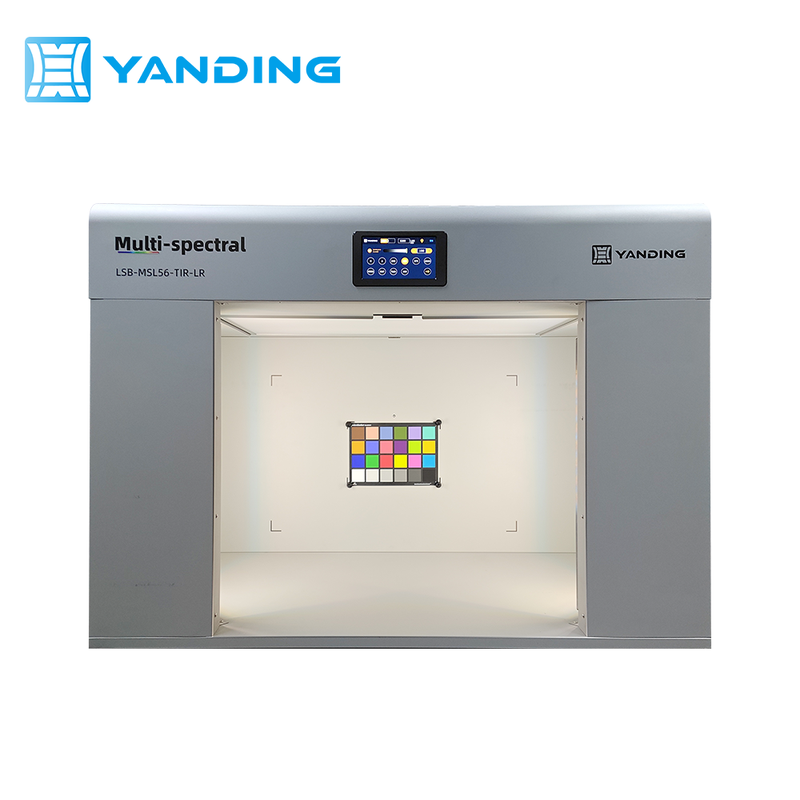
56-Channel (Visible + Near-Infrared) Multispectral Light Source Box LSB-MSL56-TIR-LR
LSB-MSL56-TIR-LR is a professional standard-light solution combining advanced optics and intelligent control. Its 56 selected LEDs and spectral-fitting algorithm accurately simulate international standard illumination from 2000K to 20000K for demanding vision and imaging tests. Applications include imaging, color reproduction, visual object-color evaluation and camera/sensor testing and calibration. Bilateral fill lighting raises chart uniformity above 90%, while CWF, TL84 and U30 fluorescent modes provide flexible, reliable illumination for research, inspection and development. The 56-channel lightbox uses LEDs with 56 different peak wavelengths and an in-house fitting algorithm to reproduce typical ambient spectra. Left/right multispectral sources illuminate a 24-color chart with uniformity above 90%; standard fluorescent alternatives include CWF, TL84 and U30. Packing list | main unit x1; power cord x1 (Chinese standard 1.5m, US standard 3m); RS-485-to-USB Type-A cable x1 (3m); specification document x1; user manual x1; test report x1.
 Save to Favorites
Overview
Specifications
| Parameter | Value |
|---|---|
| Physical Dimensions [Length × Width × Height] | 1,350 mm × 936 mm × 760 mm (long × wide × high) |
| Quality | Approximately 96 kg |
| Temperature (storage) of the environment | 10-30 ℃ |
| Temperature (use) [23-27°C (Scope of recommendations), 18-28°C (Permissibility)] | 23-27°C (Scope of recommendations), 18-28°C (Permissibility) |
| Enter power specification | 100-240V, 50/60Hz |
| Rated Power | 750 W |
| Light Source Type | Standard Light Box |
| Type of radiation | LED (Line diode)/CCFL (Cool cathode fluorescent lamps: TL84/CIE F11, CWF/CIE F2, U30) |
| LED channel number | 56 |
| Life expectancy of the radiation body [LED] | >10,000 |
| Life expectancy of the radiation body [Fluorescent tubes] | 400-2,000 |
| Warm-Up Time [LED] | 2 min |
| Warm-Up Time [Fluorescent tubes] | 2 min |
| Overwrite band | Visible and infrared (VIS and NIR) |
| Spectral Range | 360nm-980nm |
| Lightness (LED) [D65 / (in the back center of the inside of the light box), 60,000 steps] | >9,000 |
| Lightness (LED) [D50 / (in the back center of the inside of the light box), 60,000 steps] | >7,500 |
| Lightness (fluorescent lamps) [200-degree transferable.] | > 1000 lux (at the centre of the inside side of the lightbox), 200-degree transferable |
| Associated Colour Temperature (CCT) | 2,000-20,000 |
| Color Index (CIE Ra) [A/H/D50/D65/D75] | ≥97~99(A/H/D50/D65/D75) |
| Photosymmetrical [Inside the lightbox, back, center area 20cm × 30cm.] | 90 ± 5% (backside of the inside of the lightbox, centre area 20 cm × 30 cm) |
| Photospectral compatibility (FTT) [H-ray / GFC Compatibility Method] | 92 % |
| Photospectral compatibility (FTT) [A-light / GFC Compatibility Method] | 94 % |
| Photospectral compatibility (FTT) [D50 / GFC formulation method] | 98 % |
| Photospectral compatibility (FTT) [D65 / GFC formulation method] | 97 % |
| Photospectral compatibility (FTT) [D75 / GFC formulation method] | 96 % |
| Spectra Data Storage Capacity | Photo-based hardware can store 100 sets of pre-spectroscopy data, with no special storage capacity limitations for supporting control software |
| Preset Spectroscopy | Default configuration of 5 common light-source spectras, selected by touch screen |
| Operating Mode | General default spectral call/ custom spectral call |
| Control Method | Control (7 " WVGA Touch screen)/Computer Program |
| Control Interface | RS-485 |
| Supporting software | YD-MSL light source control software (support for windows 10/11 operating system) |
| API (Application Programming Interface) | Provided (supports C++14/C++11 and the Microsoft Visual studio 2022(v143) development environment) |
Applications
Key Features
Datasheet
Please provide your email to download the datasheet.
Invalid email format. Please try again.
Supplier Information
Related Products
-
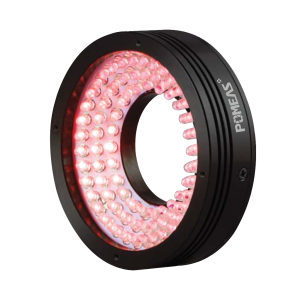 Infrared Light Source GH4265-IR
Photon Sources
Pomeas
Category: Ring Light Source Power: 1.1 W Voltage: 24 V
The POMEAS infrared light-source series uses near-infrared LEDs, providing greater penetration than conventional visible light for inspection tasks that require strong light penetration.
-
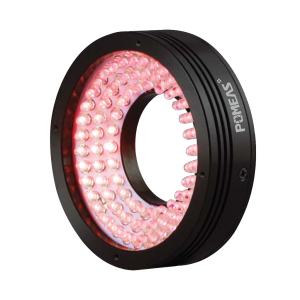 Infrared Light Source GH5260-IR
Photon Sources
Pomeas
Category: Ring Light Source Power: 1.3 W Voltage: 24 V
The POMEAS infrared light-source series uses near-infrared LEDs, providing greater penetration than conventional visible light for inspection tasks that require strong light penetration.
-
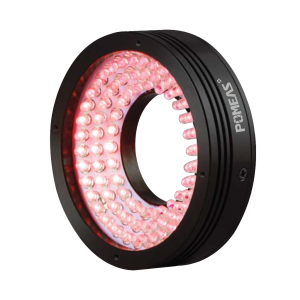 Infrared Light Source GH7390-IR
Photon Sources
Pomeas
Category: Ring Light Source Power: 2.4 W Voltage: 24 V
The POMEAS infrared light-source series uses near-infrared LEDs, providing greater penetration than conventional visible light for inspection tasks that require strong light penetration.
-
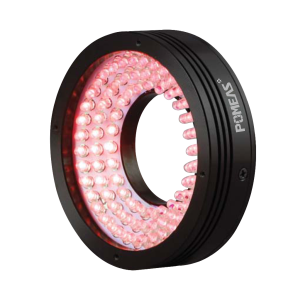 Infrared Light Source GH7460-IR
Photon Sources
Pomeas
Category: Ring Light Source Power: 2.4 W Voltage: 24 V
The POMEAS infrared light-source series uses near-infrared LEDs, providing greater penetration than conventional visible light for inspection tasks that require strong light penetration.
-
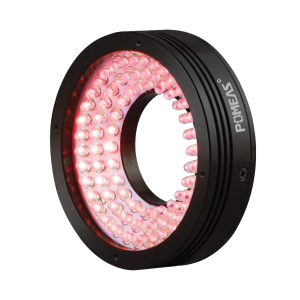 Infrared Light Source GH7430-IR
Photon Sources
Pomeas
Category: Ring Light Source Power: 1.7 W Voltage: 24 V
The POMEAS infrared light-source series uses near-infrared LEDs, providing greater penetration than conventional visible light for inspection tasks that require strong light penetration.
Related Articles
As a top‑tier supplier of tunable laser chips, Shandong Zhongxin Optoelectronics Technology Company has newly launched the world’s first budget‑friendly fiber‑Bragg‑grating (FBG) demodulator and scanning module.
Semiconductor laser diodes are essential light sources for industrial sensing, LiDAR and laser printing. Many engineers waste time picking mismatched models. We summarize 4 simple selection standards, plus a mature industrial product: HGLD-790TO5.6-ZSP-10mW from HAUCORE.
Founded in 2003, BWT Beijing Optoelectronics adheres to the mission "Let Dreams Fly With Light" and vision of becoming a Global Leader in Laser Solutions, guided by the core value "Innovate to Achieve Extraordinary".
Founded in November 2017, TIANJIN H‑CHIP TECHNOLOGY GROUP CORPORATION is a professional manufacturing‑service provider dedicated to micro‑nano optoelectronic chips. It holds multiple prestigious qualifications, including National High‑Tech Enterprise, one of Tianjin’s first Gazelle‑certified Enterprises, Specialized‑Refined‑Differentiated‑Innovative SME, and Leading Enterprise for Strategic Emerging Industries.
Loading...
Name
Phone
Organization
Use Case

Database Platform