
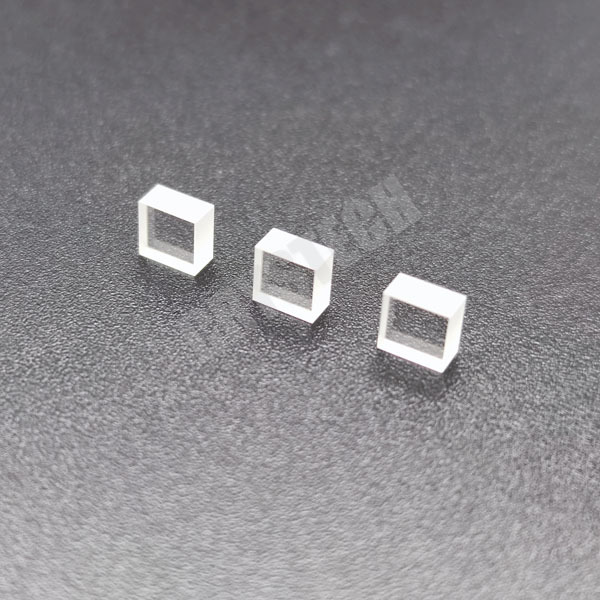
BBO (BBO-X-557-C1)
Because of a small acceptance angle and large walk-off, good laser beam quality (small divergence, good mode condition, etc.) is the key for BBO to obtain high conversion efficiency. Tight focus of laser beam is not recommended. BBO is the only NLO material which can be used to produce the fifth harmonic generation (5HG) of Nd:YAG lasers at 213 nm. BBO is a negative uniaxial crystal with ordinary refractive-index(no) larger than extraordinary refractive-index(ne). Both type I and type II phase-matching can be reached by angle-tuning. The phase matching angles of frequency doubling are shown in following figure. Frequency-doubling and -tripling of ultrashort-pulse lasers are the applications in which BBO shows superior properties. As thin as 0.02mm BBO for this purpose is available.. A laser pulse as short as 10 fs can be efficiently frequency-doubled with a thin BBO, in terms of both phase-velocity and group-velocity matching. The OPO and OPA of BBO are powerful tools for generating a widely tunable coherent radiation from the UV to IR. The tuning angles of type I and type II BBO OPO and OPA are shown in following figure, respectively. BBO can also be used for E-O applications. It has wide transmission range from UV to about 3500nm and it has much higher damage threshold than KD*P and LiNbO3. It has many advantages, including a very short pulse, good beam quality and compact size. Although it has a relative small electro-optic coefficient, the Half-wave voltage is high (7KV at 1064nm,3*3*20mm3), long and thin BBO can reduce the voltage requirements. CRYSTECH can supply 25mm long high quality BBO crystal with Z-cut, AR-coated and Gold plated on the side faces.
 Save to Favorites
Overview
Specifications
| Parameter | Value |
|---|---|
| Dimension Tolerance | W(+/-0.1)*H(+/-0.1)*L(+0.5/-0.1)mm |
| Angle Tolerance | +/-0.25° |
| Perpendicularity | ≤ 10’ |
| Scratch/Dig | 20/10 |
| Chamfer [45°] | ≤ 0.2mm x 45° |
| Parallelism | ≤10″ |
| Chips | ≤ 0.1mm |
| Flatness (λ) [633nm] | λ/10@633nm |
| Clear Aperture | ≥ 90% |
| Wavefront distortion (λ) [633nm] | λ/8@633nm |
| Damage Threshold [1064nm; 10ns; 10Hz] | 1GW/cm² (1064nm, 10ns, 10Hz) |
| Cut Angle | Θ=47.7°φ=0° |
| Size | 5 mm × 5 mm × 7 mm |
| Coating [532&266nm] | AR/AR@532&266nm |
| Effective NLO Coefficient (d36(KDP)) [type I; 1064nm; SHG; d36(KDP)] | 5.3 |
| Effective NLO Coefficient (d36(KDP)) [type I; 1064nm; THG; d36(KDP)] | 4.9 |
| Effective NLO Coefficient (d36(KDP)) [type I; 1064nm; FHG; d36(KDP)] | 3.8 |
| Effective NLO Coefficient (d36(KDP)) [type I; 1064nm; 5HG; d36(KDP)] | 3.4 |
| Acceptance Angle [type I; 1064nm; SHG] | 1.0 mrad·cm |
| Acceptance Angle [type I; 1064nm; THG] | 0.5 mrad·cm |
| Acceptance Angle [type I; 1064nm; FHG] | 0.3 mrad·cm |
| Acceptance Angle [type I; 1064nm; 5HG] | 0.2 mrad·cm |
| Walk-off Angle [type I; 1064nm; SHG] | 3.2 ° |
| Walk-off Angle [type I; 1064nm; THG] | 4.1 ° |
| Walk-off Angle [type I; 1064nm; FHG] | 4.9 ° |
| Walk-off Angle [type I; 1064nm; 5HG] | 5.5 ° |
| Crystal Structure | Trigonal, space group R3c |
| Lattics Parameters | a=b=12.532Å, c=12.717Å, Z=6 |
| Melting point | About 1095℃ |
| Mohs Hardness | 4 |
| Density | 3.85g/cm3 |
| Thermal Conductivity [┴c] | 1.2W/m/K(┴c) |
| Thermal Conductivity [//c] | 1.6W/m/K(//c) |
| Thermal Expansion Coefficients | 11=4x10⁻⁶/K; 33=36x10-6/K |
| Transparency Range | 190-3500nm |
| SHG Phase Matchable Range [Type I] | 409.6-3500nm(Type I) |
| SHG Phase Matchable Range [Type II] | 525-3500nm(Type II) |
| therm-optic Coefficients (dno/dT) | dno/dT=-16.6x10-6 |
| therm-optic Coefficients (dne/dT) | dne/dT=-9.3x10-6 |
| Absorption Coefficients [1064nm] | <0.1%/cm at 1064nm |
| Absorption Coefficients [532nm] | <1%/cm at 532nm |
| Angle Acceptance (θ) [θ, Type I,1064 SHG] | 0.8mrad-cm (θ, Type I,1064 SHG) |
| Angle Acceptance (θ) [θ, Type II,1064 SHG] | 1.27mrad-cm (θ, Type II,1064 SHG) |
| Temperature Acceptance | 55℃-cm |
| Spectral Acceptance | 1.1nm-cm |
| Walk-off Angle [Type I 1064 SHG] | 2.7° (Type I 1064 SHG) |
| Walk-off Angle [Type II 1064 SHG] | 3.2° (Type II 1064 SHG) |
| NLO Coefficients (deff (I)) [Type I] | deff (I)=d31sinθ+(d11cosΦ-d22sin3Φ)cosθ |
| NLO Coefficients (deff (II)) [Type II] | deff (II)=(d11sin3Φ+d22cos3Φ)cos2θ |
| Non-vanished NLO susceptibilities (d11) | d11=5.8xd36(KDP) |
| Non-vanished NLO susceptibilities (d31) | d31=0.05xd11 |
| Non-vanished NLO susceptibilities (d22) | d22<0.05xd11 |
| sellmeier Equations(λ in μm ) | no2=2.7359+0.01878 / (λ2-0.01822) -0.01354 λ2 |
| sellmeier Equations(λ in μm ) | ne2=2.3753+0.01224 / (λ2-0.01667) -0.01516 λ2 |
| Electro-optic coefficients (r22) | r22=2.7pm/V |
| Half-wave voltage [at 1064nm; 3*3*20mm3] | 7KV (at 1064nm,3*3*20mm3) |
| Resistivity | >1011 ohm-cm |
| Relative Dielectric Constant (εs11/εo) | εs11/εo:6.7 |
| Relative Dielectric Constant (εs33/εo) | εs33/εo:8.1 |
| Relative Dielectric Constant-Tan δ | Tan δ<0.001 |
Applications
Key Features
Datasheet
Please provide your email to download the datasheet.
Invalid email format. Please try again.
Supplier Information
Related Products
-
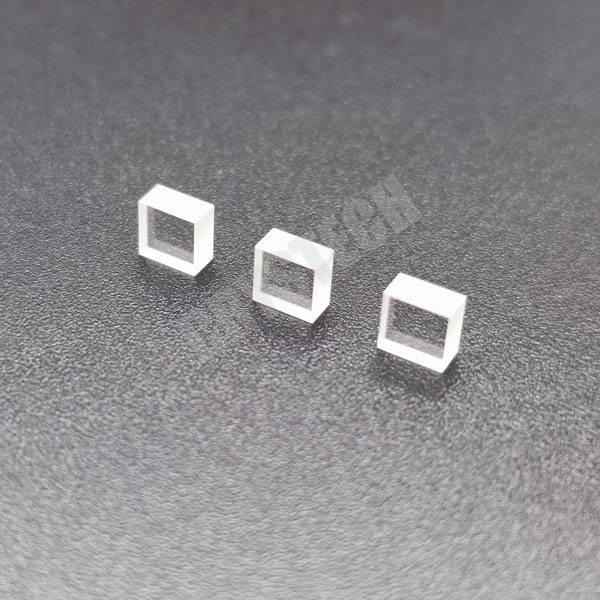 BBO (BBO-X-447-C1)
Crystallography
Crystech
BBO (BBO-X-447-C1)
Crystallography
Crystech
Dimension Tolerance: W(+/-0.1)*H(+/-0.1)*L(+0.5/-0.1)mm Angle Tolerance: +/-0.25° Perpendicularity: ≤ 10’
Because of a small acceptance angle and large walk-off, good laser beam quality (small divergence, good mode condition, etc.) is the key for BBO to obtain high conversion efficiency. Tight focus of laser beam is not recommended. BBO is the only NLO material which can be used to produce the fifth harmonic generation (5HG) of Nd:YAG lasers at 213 nm. BBO is a negative uniaxial crystal with ordinary refractive-index(no) larger than extraordinary refractive-index(ne). Both type I and type II phase-matching can be reached by angle-tuning. The phase matching angles of frequency doubling are shown in following figure. Frequency-doubling and -tripling of ultrashort-pulse lasers are the applications in which BBO shows superior properties. As thin as 0.02mm BBO for this purpose is available.. A laser pulse as short as 10 fs can be efficiently frequency-doubled with a thin BBO, in terms of both phase-velocity and group-velocity matching. The OPO and OPA of BBO are powerful tools for generating a widely tunable coherent radiation from the UV to IR. The tuning angles of type I and type II BBO OPO and OPA are shown in following figure, respectively. BBO can also be used for E-O applications. It has wide transmission range from UV to about 3500nm and it has much higher damage threshold than KD*P and LiNbO3. It has many advantages, including a very short pulse, good beam quality and compact size. Although it has a relative small electro-optic coefficient, the Half-wave voltage is high (7KV at 1064nm,3*3*20mm3), long and thin BBO can reduce the voltage requirements. CRYSTECH can supply 25mm long high quality BBO crystal with Z-cut, AR-coated and Gold plated on the side faces.
-
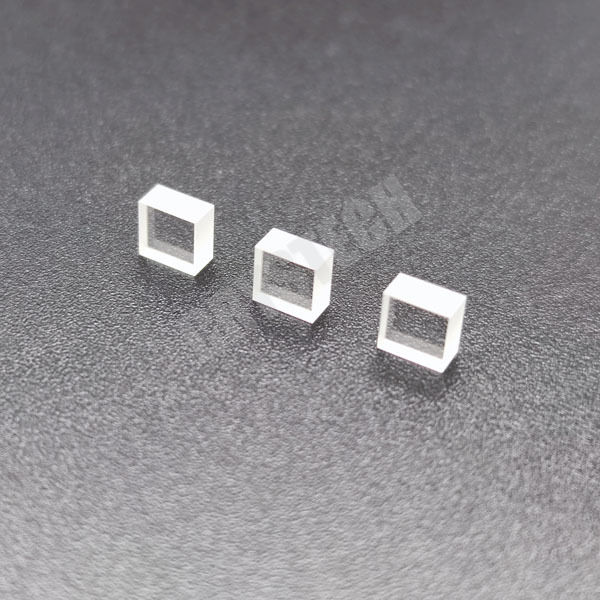 BBO (BBO-X-667-C1)
Crystallography
Crystech
BBO (BBO-X-667-C1)
Crystallography
Crystech
Dimension Tolerance: W(+/-0.1)*H(+/-0.1)*L(+0.5/-0.1)mm Angle Tolerance: +/-0.25° Perpendicularity: ≤ 10’
Because of a small acceptance angle and large walk-off, good laser beam quality (small divergence, good mode condition, etc.) is the key for BBO to obtain high conversion efficiency. Tight focus of laser beam is not recommended. BBO is the only NLO material which can be used to produce the fifth harmonic generation (5HG) of Nd:YAG lasers at 213 nm. BBO is a negative uniaxial crystal with ordinary refractive-index(no) larger than extraordinary refractive-index(ne). Both type I and type II phase-matching can be reached by angle-tuning. The phase matching angles of frequency doubling are shown in following figure. Frequency-doubling and -tripling of ultrashort-pulse lasers are the applications in which BBO shows superior properties. As thin as 0.02mm BBO for this purpose is available.. A laser pulse as short as 10 fs can be efficiently frequency-doubled with a thin BBO, in terms of both phase-velocity and group-velocity matching. The OPO and OPA of BBO are powerful tools for generating a widely tunable coherent radiation from the UV to IR. The tuning angles of type I and type II BBO OPO and OPA are shown in following figure, respectively. BBO can also be used for E-O applications. It has wide transmission range from UV to about 3500nm and it has much higher damage threshold than KD*P and LiNbO3. It has many advantages, including a very short pulse, good beam quality and compact size. Although it has a relative small electro-optic coefficient, the Half-wave voltage is high (7KV at 1064nm,3*3*20mm3), long and thin BBO can reduce the voltage requirements. CRYSTECH can supply 25mm long high quality BBO crystal with Z-cut, AR-coated and Gold plated on the side faces.
-
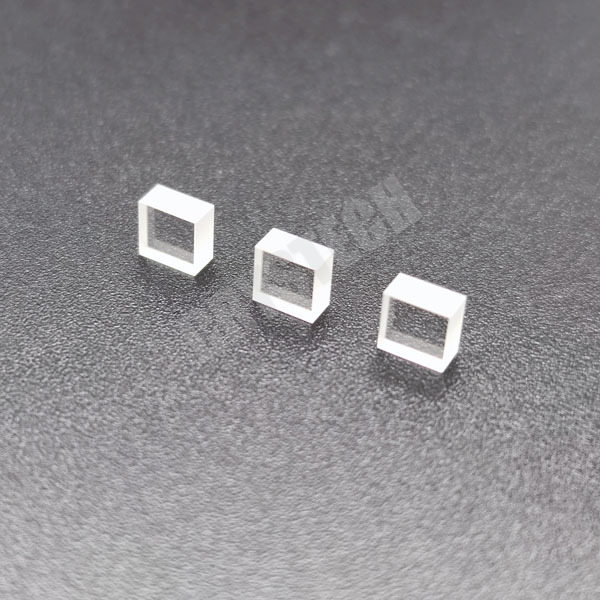 BBO (BBO-Y-447-C2)
Crystallography
Crystech
BBO (BBO-Y-447-C2)
Crystallography
Crystech
Dimension Tolerance: W(+/-0.1)*H(+/-0.1)*L(+0.5/-0.1)mm Angle Tolerance: +/-0.25° Perpendicularity: ≤ 10’
Because of a small acceptance angle and large walk-off, good laser beam quality (small divergence, good mode condition, etc.) is the key for BBO to obtain high conversion efficiency. Tight focus of laser beam is not recommended. BBO is the only NLO material which can be used to produce the fifth harmonic generation (5HG) of Nd:YAG lasers at 213 nm. BBO is a negative uniaxial crystal with ordinary refractive-index(no) larger than extraordinary refractive-index(ne). Both type I and type II phase-matching can be reached by angle-tuning. The phase matching angles of frequency doubling are shown in following figure. Frequency-doubling and -tripling of ultrashort-pulse lasers are the applications in which BBO shows superior properties. As thin as 0.02mm BBO for this purpose is available.. A laser pulse as short as 10 fs can be efficiently frequency-doubled with a thin BBO, in terms of both phase-velocity and group-velocity matching. The OPO and OPA of BBO are powerful tools for generating a widely tunable coherent radiation from the UV to IR. The tuning angles of type I and type II BBO OPO and OPA are shown in following figure, respectively. BBO can also be used for E-O applications. It has wide transmission range from UV to about 3500nm and it has much higher damage threshold than KD*P and LiNbO3. It has many advantages, including a very short pulse, good beam quality and compact size. Although it has a relative small electro-optic coefficient, the Half-wave voltage is high (7KV at 1064nm,3*3*20mm3), long and thin BBO can reduce the voltage requirements. CRYSTECH can supply 25mm long high quality BBO crystal with Z-cut, AR-coated and Gold plated on the side faces.
-
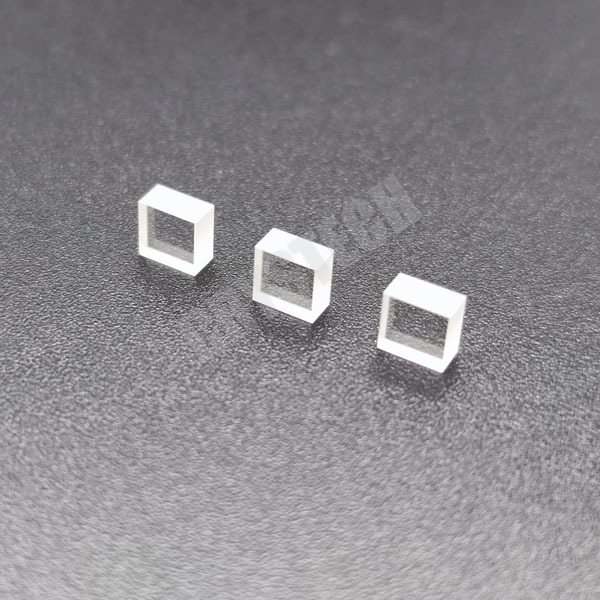 BBO (BBO-Y-557-C2)
Crystallography
Crystech
BBO (BBO-Y-557-C2)
Crystallography
Crystech
Dimension Tolerance: W(+/-0.1)*H(+/-0.1)*L(+0.5/-0.1)mm Angle Tolerance: +/-0.25° Perpendicularity: ≤ 10’
Because of a small acceptance angle and large walk-off, good laser beam quality (small divergence, good mode condition, etc.) is the key for BBO to obtain high conversion efficiency. Tight focus of laser beam is not recommended. BBO is the only NLO material which can be used to produce the fifth harmonic generation (5HG) of Nd:YAG lasers at 213 nm. BBO is a negative uniaxial crystal with ordinary refractive-index(no) larger than extraordinary refractive-index(ne). Both type I and type II phase-matching can be reached by angle-tuning. The phase matching angles of frequency doubling are shown in following figure. Frequency-doubling and -tripling of ultrashort-pulse lasers are the applications in which BBO shows superior properties. As thin as 0.02mm BBO for this purpose is available.. A laser pulse as short as 10 fs can be efficiently frequency-doubled with a thin BBO, in terms of both phase-velocity and group-velocity matching. The OPO and OPA of BBO are powerful tools for generating a widely tunable coherent radiation from the UV to IR. The tuning angles of type I and type II BBO OPO and OPA are shown in following figure, respectively. BBO can also be used for E-O applications. It has wide transmission range from UV to about 3500nm and it has much higher damage threshold than KD*P and LiNbO3. It has many advantages, including a very short pulse, good beam quality and compact size. Although it has a relative small electro-optic coefficient, the Half-wave voltage is high (7KV at 1064nm,3*3*20mm3), long and thin BBO can reduce the voltage requirements. CRYSTECH can supply 25mm long high quality BBO crystal with Z-cut, AR-coated and Gold plated on the side faces.
Related Articles
On November 28, 2024, the 3rd China Laser Star Enterprise Summit & Advanced Laser Processing Technology Summit, an annual influential event in the laser industry, was grandly held in Wuhan Optics Valley.
Looking for a market-verified 808nm pump laser diode? This guide introduces HAUCORE DM-8E5A-8OD (HGLD-808-COS-D-5W), its core advantages, key specs and mainstream industrial, medical & research applications.
Precise spectral screening is essential for high-precision medical detection, spectroscopic analysis and intelligent imaging systems. Tailored for visible and near-infrared spectral separation, the SP900 shortpass optical filter delivers high-efficiency light transmission and deep infrared blocking performance. It effectively eliminates stray light interference, improves signal-to-noise ratio (SNR), and serves as a core optical component for biomedical instruments, scientific analysis equipment and machine vision systems.
Founded in 2019, Jilin JC Ultrafast Equipment Co., Ltd. is a high-tech enterprise incubated by the Ultrafast Optoelectronics Center of Jilin University. Our R&D team owns 15 years of profound experience in femtosecond laser micro-nano fabrication.
Loading...
Name
Phone
Organization
Use Case

Database Platform